Address
Work Hours
Monday to Friday: 7AM - 7PM
Weekend: 10AM - 5PM

Address
Work Hours
Monday to Friday: 7AM - 7PM
Weekend: 10AM - 5PM


How Egyptian pomegranate compares with Spain, Turkey, India and Peru on season window, variety, size curve and freight distance, and which origin holds each month.
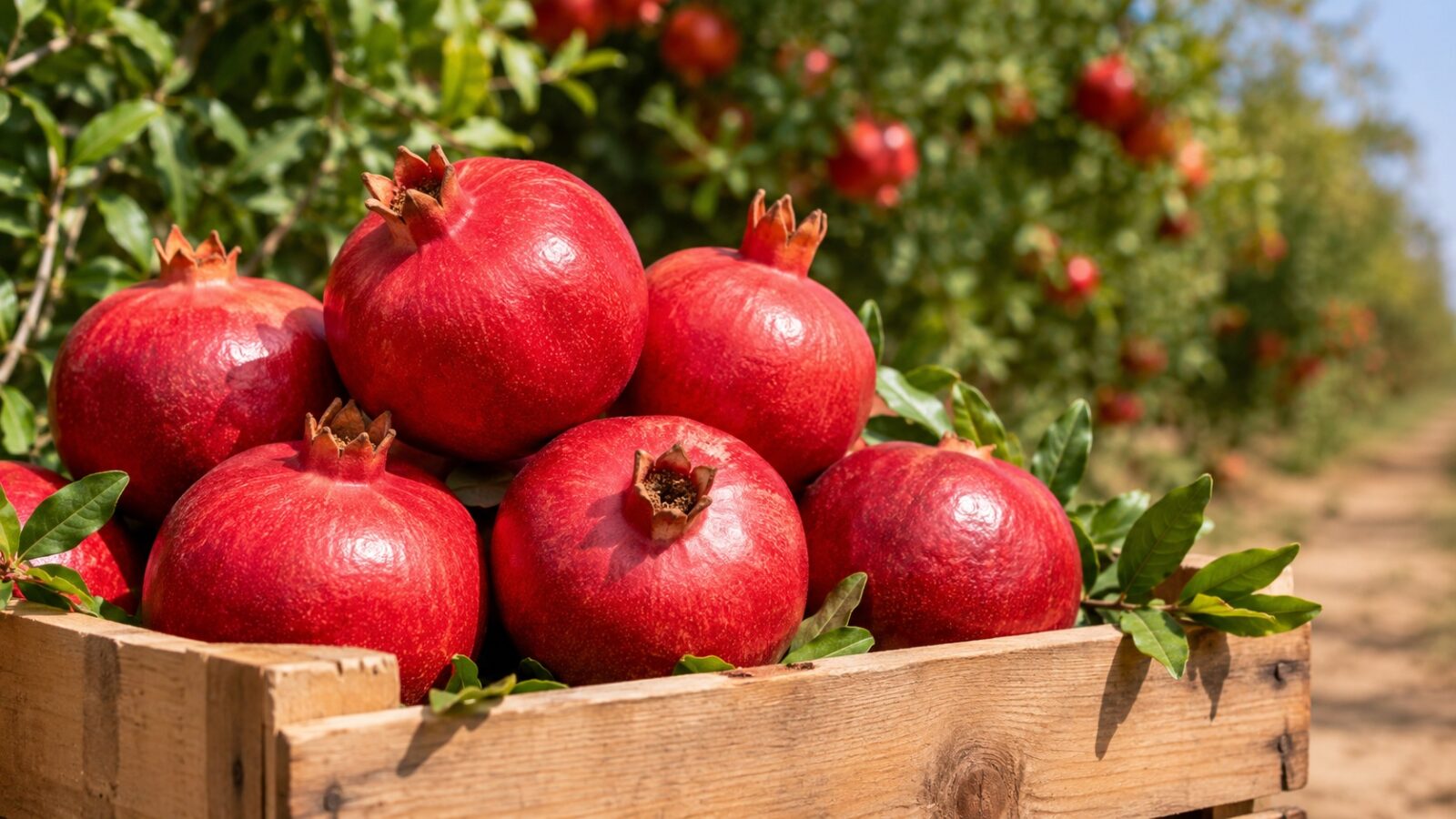
Egyptian pomegranate ships from late August to December, which places it against Turkey and Spain in the same northern autumn window and clear of Peru in the southern one. The question a buyer actually needs answered is not which origin is best, but which origin holds which weeks and what each one costs to land. This comparison sets the five competing origins side by side.
| Origin | Export window | Main variety | Transit to Jebel Ali | Transit to Rotterdam |
|---|---|---|---|---|
| Egypt | Late Aug to Dec | Wonderful, 116 | 7 to 10 days | 10 to 14 days |
| Spain | Sep to Jan | Mollar de Elche, Wonderful | 16 to 21 days | Road, 3 to 5 days |
| Turkey | Sep to Feb | Hicaznar | 10 to 14 days | Road or sea, 7 to 12 days |
| India | Year round, peaks Feb to May and Sep to Nov | Bhagwa | 5 to 8 days | 20 to 26 days |
| Peru | Feb to May | Wonderful | 28 to 35 days | 18 to 24 days |
In the GCC the contest is short-haul. India lands Bhagwa in five to eight days at Jebel Ali and prices aggressively. Egyptian pomegranate arrives in seven to ten days with Wonderful, which carries the deep red aril colour and higher acidity that the retail programmes in Saudi Arabia and the UAE specify. Turkish Hicaznar sits between the two on both counts. Where a Gulf buyer is filling a red, sweet-tart Wonderful programme, India cannot supply the variety, and that decides the order more often than price does.
Spain has the structural advantage into Europe. Road transit of three to five days from Alicante against ten to fourteen days by sea from Alexandria or Damietta is not something an Egyptian exporter can argue away, and Spanish Mollar de Elche has an established following as a soft-seed variety. Egypt competes in Europe on two things: the September and early October weeks before Spanish volume is fully in, and price on Wonderful for processing and aril extraction, where appearance tolerance is wider.
Peru ships February to May, which is exactly when Egypt, Spain and Turkey are out. For a buyer running a year-round pomegranate programme, Peru and Egypt are complements rather than rivals. The practical consequence is that the Egyptian contracting conversation should happen in July and August, before the Peruvian contract for the following spring is signed, not after.
Where Egypt does not win is size curve at the top end. Spanish and Peruvian fruit runs larger on average, so a programme built on counts 6 to 8 will find Egyptian supply thinner than a programme built on counts 9 to 12. Specify the count before agreeing the price, not after.
For the Egyptian side of this in full, see Egyptian pomegranate exports 2026/2027 for sizing and packing, and the Egyptian produce export calendar for how the pomegranate window sits against the rest of the season.
PEI Trade is the exporter, not a neutral reviewer. For 2026/2027 pomegranate availability by count and destination, message the export desk on WhatsApp at +20 10 9911 1918.
