Address
Work Hours
Monday to Friday: 7AM - 7PM
Weekend: 10AM - 5PM
Address
Work Hours
Monday to Friday: 7AM - 7PM
Weekend: 10AM - 5PM



Key definition: Payment methods in export trade set how and when an exporter is paid and how much risk each side carries. The four main options are the Letter of Credit (LC), telegraphic transfer (TT), cash against documents (CAD), and open account — ranging from bank-guaranteed security to trust-based deferred payment. The right choice balances payment security for the seller against cash flow and trust for the buyer.
In international produce trade, the payment method is agreed alongside the Incoterm and shapes the whole deal: it decides who carries the risk of non-payment or non-delivery, how quickly funds move, and which documents trigger release of the goods. This page explains the main export payment methods, compares them, and sets out the payment and shipping terms PEI Trade works with.
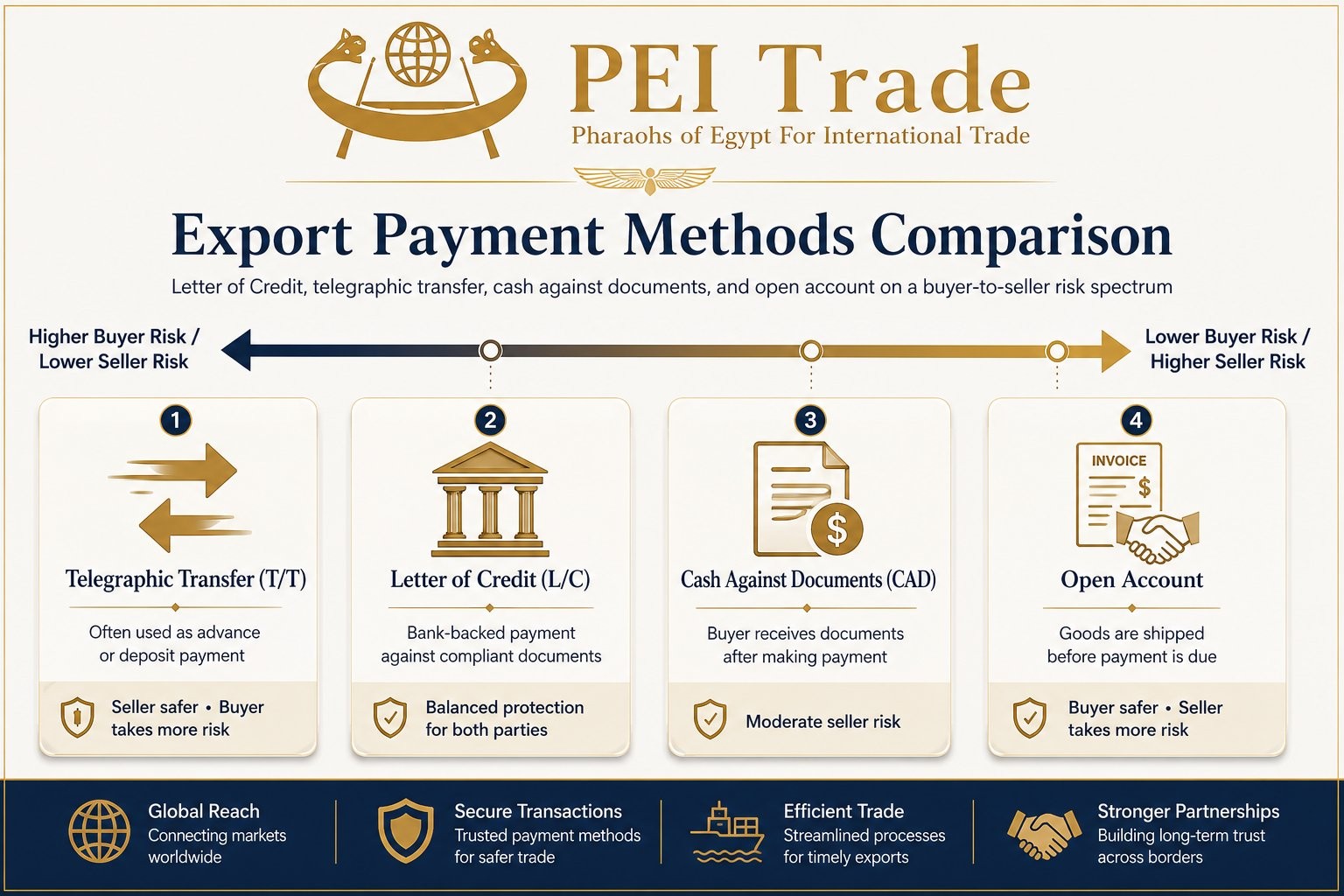
A Letter of Credit is a guarantee from the buyer’s bank to pay the seller once the seller presents documents that comply with the LC’s terms. An LC at sight pays on presentation of compliant documents. It offers the strongest balance of security: the seller is paid by a bank rather than relying on the buyer, while the buyer’s bank only pays against correct shipping documents. Letters of Credit are governed by the ICC’s UCP 600 rules. They cost more and demand precise documentation, so they suit new relationships and larger orders.
A telegraphic transfer (also called a wire or T/T) is a direct bank-to-bank payment. In produce trade it is usually split — for example a deposit to confirm the order and the balance against a scanned bill of lading and documents. TT is faster and cheaper than an LC: the deposit protects the seller’s commitment costs, while paying the balance against shipping documents protects the buyer. It suits established relationships and smaller orders.
Under cash against documents, the seller ships the goods and hands the shipping documents to a bank, which releases them to the buyer only against payment (or acceptance of a draft). The buyer cannot collect the cargo without paying, so the seller keeps control of the documents until paid — a middle ground between the security of an LC and the simplicity of open account.
On open account, the goods are shipped and the buyer pays later — commonly 30 to 60 days after delivery. It is the most buyer-friendly term and the riskiest for the seller, who finances the gap and carries the non-payment risk. It is normally reserved for long-term, trusted partners or backed by credit insurance.
| Payment method | How it works | Risk balance | Typical use |
|---|---|---|---|
| Letter of Credit (LC) at sight | Buyer’s bank pays the seller against compliant shipping documents | Lowest risk for both; bank-backed | New relationships, larger orders |
| Telegraphic Transfer (TT) | Direct bank transfer, often a deposit plus balance against documents | Deposit protects seller; balance-on-documents protects buyer | Established buyers, smaller orders |
| Cash Against Documents (CAD) | Bank releases documents to the buyer only on payment | Seller keeps control of documents until paid | Repeat buyers with some trust |
| Open Account | Goods shipped; buyer pays later (e.g., 30–60 days) | Favours the buyer; highest risk for the seller | Long-term trusted partners |
For convenience only. If there is any conflict, the signed PI/contract prevails.
Commercial Invoice, Packing List, Certificate of Origin, Phytosanitary Certificate (fresh produce), Fumigation Certificate (when required), Bill of Lading/Air Waybill, and any agreed special certificates.
We share booking details and ETAs post-vessel confirmation and provide scanned copies of export documents promptly.
Letters of Credit and documentary collections in international trade are governed by the rules of the International Chamber of Commerce, in particular the Uniform Customs and Practice for Documentary Credits (UCP 600).
PEI Trade. “Payment Methods in Export Trade: LC, TT, CAD & Open Account.” PEI Trade Export Knowledge Base. https://peitrade.com/payment-and-shipping-terms/
A Letter of Credit (LC) at sight is generally the safest, because the buyer bank guarantees payment to the seller against compliant shipping documents, protecting both sides.
An LC is a bank guarantee that pays the seller against compliant documents, offering high security. A TT is a direct bank transfer, often split into a deposit and a balance against documents; it is faster and cheaper but offers less built-in security.
Under cash against documents, a bank releases the shipping documents to the buyer only against payment, so the seller keeps control of the cargo until it is paid.
On open account, the goods are shipped and the buyer pays later, commonly 30 to 60 days after delivery. It favours the buyer and carries the highest risk for the seller.
PEI Trade accepts LC at sight (preferred for new buyers) or TT bank transfer, typically a 30 percent deposit to confirm and 70 percent against the scanned bill of lading and documents.
For any question about these terms, email [email protected] or use the Contact Us form.
Disclaimer: This content is a general template for B2B operations and does not constitute legal advice. Please seek local counsel for jurisdiction-specific requirements.