Address
Work Hours
Monday to Friday: 7AM - 7PM
Weekend: 10AM - 5PM

Address
Work Hours
Monday to Friday: 7AM - 7PM
Weekend: 10AM - 5PM


The Netherlands is Egypt’s gateway into the fast-growing European mandarin trade. Egypt has become the EU’s top non-EU citrus supplier, and mandarin volumes into the bloc nearly tripled to 71,457 tonnes in the 2025/26 season. Rotterdam-based importers re-distribute Egyptian easy-peelers (HS 0805.20) across the EU and UK. This guide covers varieties, cold-chain logistics, EU requirements, seasonality and pricing for Dutch buyers.
The Netherlands is Egypt’s EU re-export hub for mandarins via Rotterdam. Egypt is now the EU’s #1 non-EU citrus supplier; mandarin volumes into the EU nearly tripled to 71,457 t in 2025/26. Peak supply is November–March. Preferred variety: Fremont (seedless); Murcott extends the season. Imports must meet EU MRLs, plant-health rules and retail schemes (GLOBALG.A.P, GRASP, BRCGS).
The Netherlands is Europe’s leading citrus re-export platform. Dutch traders have driven Egypt’s surge into the EU easy-peel market, sourcing seedless Fremont and late Murcott to complement Spanish clementines and fill gaps in the supply calendar. Rotterdam’s reefer, repacking and distribution infrastructure makes it the natural first port for Egyptian mandarins destined for multiple European retailers — the engine behind the near-tripling of EU volumes.
| Market snapshot | Detail |
|---|---|
| Role | EU re-export gateway (Rotterdam) |
| EU mandarin volume 2025/26 | 71,457 t (nearly 3× prior season) |
| HS code | 0805.20 (mandarins & easy-peelers) |
| Transit time | 8–12 days by sea |
| Peak window | November–March |
| Key varieties | Fremont (seedless), Murcott |
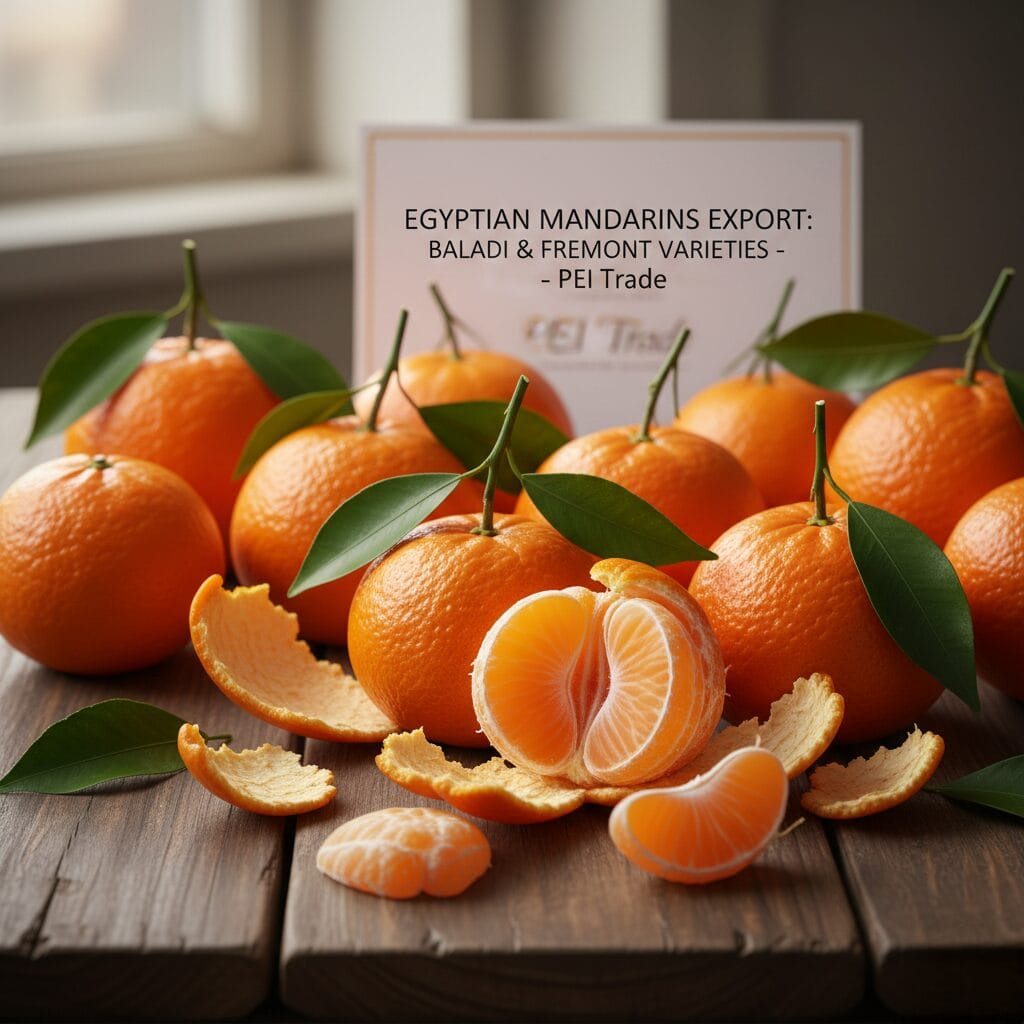
Fremont: the EU-preferred Egyptian easy-peeler — near-seedless, deep-orange, uniform, with the appearance European retail demands. Murcott: a late, very sweet tangor that extends supply into spring. Graded to EU/UNECE calibre standards (sizes 1-XXX to 10), packed in cartons or retail-ready nets/punnets. Grade A (Class I) fruit is colour-uniform and blemish-free; Class II routes to processing.
Shipments sail from Alexandria or Damietta to Rotterdam in roughly 8–12 days. Mandarins travel in reefer containers at 4–6°C at 90–95% RH, with careful handling to protect the delicate rind. Fruit is pre-cooled, waxed and cushioned. At Rotterdam it is inspected, repacked to retailer spec (nets, punnets, cartons) and distributed across the EU/UK cold chain.
EU imports require a phytosanitary certificate and compliance with EU plant-health entry rules for citrus. Pesticide residues must meet EU MRLs — among the strictest globally — verified by border and retailer testing. Organised buyers require GLOBALG.A.P plus GRASP at farm level and typically BRCGS or IFS at the packhouse. Labelling follows EU marketing standards (variety, class, calibre, origin, packer), with full lot traceability.
| Period | Availability |
|---|---|
| October–November | Early Baladi — season opening |
| December–February | Peak — Fremont main crop |
| February–March | Late Murcott — fills the post-clementine gap |
Late Murcott is a key EU advantage, arriving as Spanish clementines wind down and keeping European shelves stocked with easy-peel fruit into spring.
Source & data: Egyptian mandarin exports to the EU nearly tripled to 71,457 t in 2025/26 (from 24,938 t); Egypt is the EU’s top non-EU citrus supplier. Source: FreshPlaza, 2026. HS code 0805.20 (mandarins). Figures are Egypt-market trade data; per-shipment specifications are confirmed at contracting.
PEI Trade — New Cairo, Egypt. Request a quote or mandarin spec sheet →