Address
Work Hours
Monday to Friday: 7AM - 7PM
Weekend: 10AM - 5PM

Address
Work Hours
Monday to Friday: 7AM - 7PM
Weekend: 10AM - 5PM


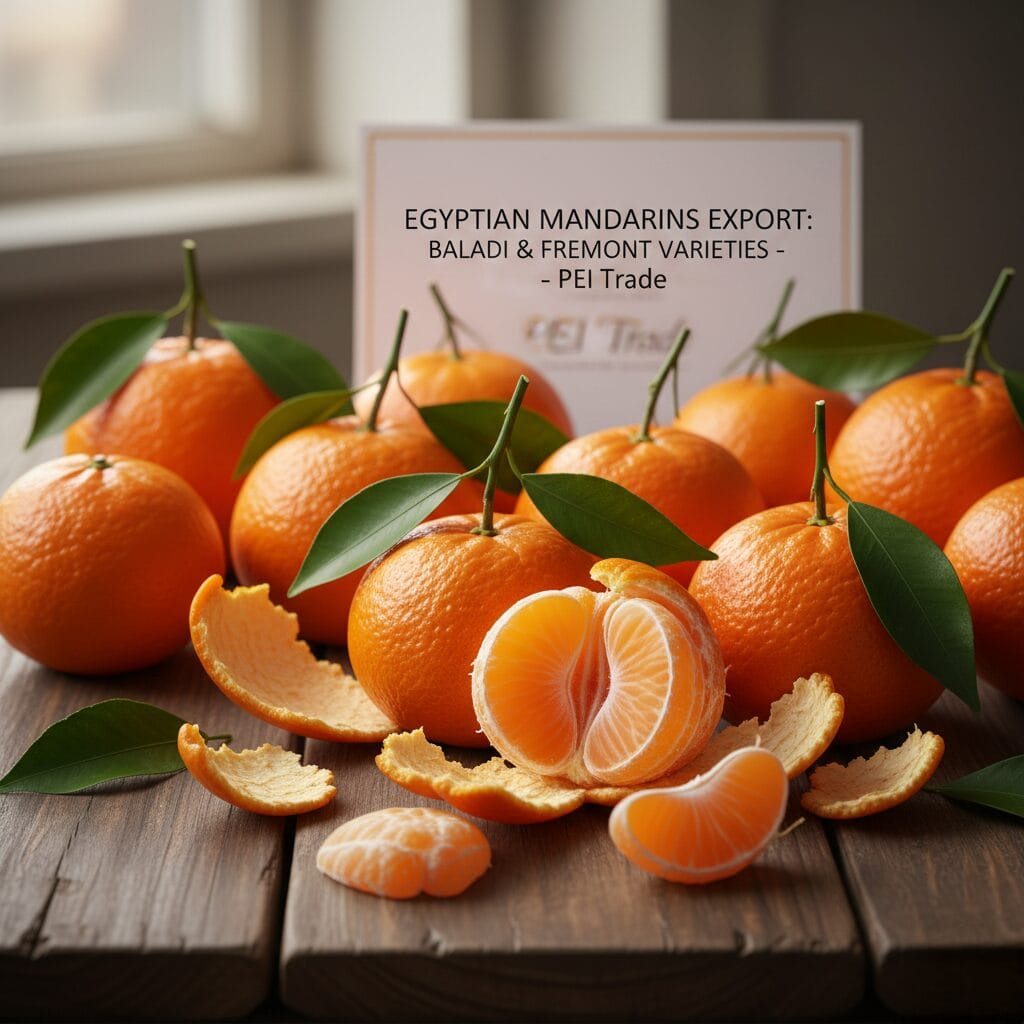
The UK is a large easy-peel citrus market that imports all of its mandarins, and Egypt has become an increasingly important supplier. Seedless, sweet Egyptian mandarins (HS 0805.20) suit British supermarket programmes and land through the winter window. For UK importers and retailers, Egypt offers EU-standard fruit, competitive pricing and season extension into spring. This guide covers varieties, logistics, UK requirements, seasonality and pricing.
The UK imports all its easy-peel citrus; Egypt is a growing supplier. Peak supply is November–March. Preferred variety: Fremont (seedless), with late Murcott for spring. Transit is 9–13 days by reefer (often via Rotterdam or direct). UK imports need a phytosanitary certificate, UK MRL compliance, and retailer schemes (GLOBALG.A.P, GRASP, BRCGS).
Easy-peelers are a core UK retail category, especially in the run-up to Christmas and through winter. With no domestic production, British supermarkets source from Spain, Morocco and increasingly Egypt. Egyptian seedless Fremont meets UK spec on appearance and eating quality, while late Murcott extends availability as Spanish and Moroccan seasons close. Competitive pricing and reliable volumes make Egypt an attractive programme supplier.
| Market snapshot | Detail |
|---|---|
| Market profile | Large easy-peel retail market (100% imported) |
| HS code | 0805.20 (mandarins & easy-peelers) |
| Route | Direct or via Rotterdam |
| Transit time | 9–13 days by sea |
| Peak window | November–March |
| Key varieties | Fremont (seedless), Murcott |
Fremont: near-seedless, deep-orange, uniform — the UK-preferred easy-peeler, sold loose or in nets/punnets. Murcott: late, very sweet, extends the season into spring. Graded to UK/UNECE calibre standards (sizes 1-XXX to 10). Grade A (Class I) is colour-uniform, blemish-free and seedless-friendly for supermarket programmes; Class II routes to value lines or processing.
Shipments reach the UK direct to Southampton/Tilbury or trans-shipped via Rotterdam, in roughly 9–13 days. Mandarins travel in reefer containers at 4–6°C at 90–95% RH with careful rind protection. Fruit is pre-cooled, waxed and cushioned, then repacked to retailer spec (nets, punnets, flow-wrap) on arrival. Cold-chain integrity is critical to meet UK shelf-life expectations.
UK imports require a phytosanitary certificate and compliance with UK plant-health and food-safety rules. Pesticide residues must meet UK MRLs (closely aligned with EU). British retailers require GLOBALG.A.P plus GRASP at farm level and BRCGS at the packhouse, along with their own technical protocols. Labelling follows UK marketing standards (variety, class, calibre, origin, packer), with full lot traceability.
| Period | Availability |
|---|---|
| October–November | Early Baladi — pre-Christmas build-up |
| December–February | Peak — Fremont main crop |
| February–March | Late Murcott — spring season extension |
Egypt’s late Murcott is especially valuable to UK retailers, keeping easy-peel programmes stocked as competing origins wind down.
Source & data: Egypt is the EU’s top non-EU citrus supplier; mandarin exports to the EU nearly tripled to 71,457 t in 2025/26. Source: FreshPlaza, 2026. HS code 0805.20 (mandarins). Figures are Egypt-market trade data; per-shipment specifications are confirmed at contracting.
PEI Trade — New Cairo, Egypt. Request a quote or mandarin spec sheet →