Address
Work Hours
Monday to Friday: 7AM - 7PM
Weekend: 10AM - 5PM

Address
Work Hours
Monday to Friday: 7AM - 7PM
Weekend: 10AM - 5PM



Key definition: Incoterms for fresh produce are the standardized three-letter trade rules — published by the International Chamber of Commerce (ICC) — that define who pays for transport and insurance and exactly where the risk for the goods passes from seller to buyer. The right Incoterm decides who pays for the reefer container and who carries the loss if the cold chain fails in transit. The four that cover almost all Egyptian fruit and vegetable exports are FOB, CFR, CIF, and DAP.
Choosing the right Incoterm is one of the first decisions in any fresh produce export contract. It sets who books and pays for freight, who insures the cargo, and — most importantly for perishables — the exact moment responsibility shifts from exporter to importer. This guide explains the Incoterms 2020 rules that matter for fresh produce, with practical examples from Egyptian mango and citrus shipments.
Incoterms — short for International Commercial Terms — are a set of eleven standardized trade rules published by the International Chamber of Commerce (ICC). The current edition is Incoterms 2020. Each rule defines three things for an international sale: who arranges and pays for carriage, who is responsible for insurance, and the precise point at which risk for the goods transfers from seller to buyer.
Incoterms do not set the price, transfer ownership of the goods, or replace the sales contract. They allocate cost and risk along the journey. For fresh produce — where a single temperature excursion or a few days of delay can write off an entire reefer load — the point of risk transfer is not a technicality. It determines who absorbs the loss when something goes wrong in transit, and who must file the insurance claim.
For Egyptian fruit and vegetable exports, four Incoterms for fresh produce cover the overwhelming majority of contracts: FOB, CFR, CIF, and DAP. Here is what each means in practice.
Under FOB, the seller delivers the goods, cleared for export, on board the vessel at the named port of shipment — for Egyptian produce, typically FOB Damietta or FOB Alexandria. From the moment the cargo is on board, risk passes to the buyer, who then arranges and pays for ocean freight, insurance, and every onward cost. FOB suits experienced importers who hold their own freight contracts and want to control the shipping line and schedule. (Note: for containerized cargo the ICC technically recommends FCA, but FOB remains the working standard across produce trade.)
Under CFR, the seller pays the cost of the goods plus ocean freight to the named destination port. Crucially, risk still passes to the buyer at the origin port, the moment the goods are loaded on board — even though the seller is paying the freight. Insurance is the buyer’s responsibility. CFR fits a buyer who wants the exporter to book the shipping but prefers to arrange their own cargo cover.
CIF works exactly like CFR, with one addition: the seller also arranges marine insurance for the voyage. Risk again transfers at the origin port on loading. CIF is popular with buyers who want a single price covering goods, freight, and a baseline insurance policy — but “insured” does not mean “fully covered,” as explained below.
Under DAP, the seller delivers the goods to a named place at destination — a port terminal, a distribution centre, or the buyer’s cold store — bearing all cost and risk up to that point. The buyer handles import clearance, duties, and taxes. DAP gives the buyer the most convenience: a single delivered price to a named location, with the exporter carrying the transit risk the whole way.
At the two extremes sit EXW (Ex Works), where the buyer takes over at the seller’s packhouse gate and handles everything, and DDP (Delivered Duty Paid), where the seller delivers fully cleared and duty-paid at destination. Both are uncommon in produce trade: EXW shifts too much onto an overseas buyer, and DDP asks the exporter to handle foreign customs and taxes.
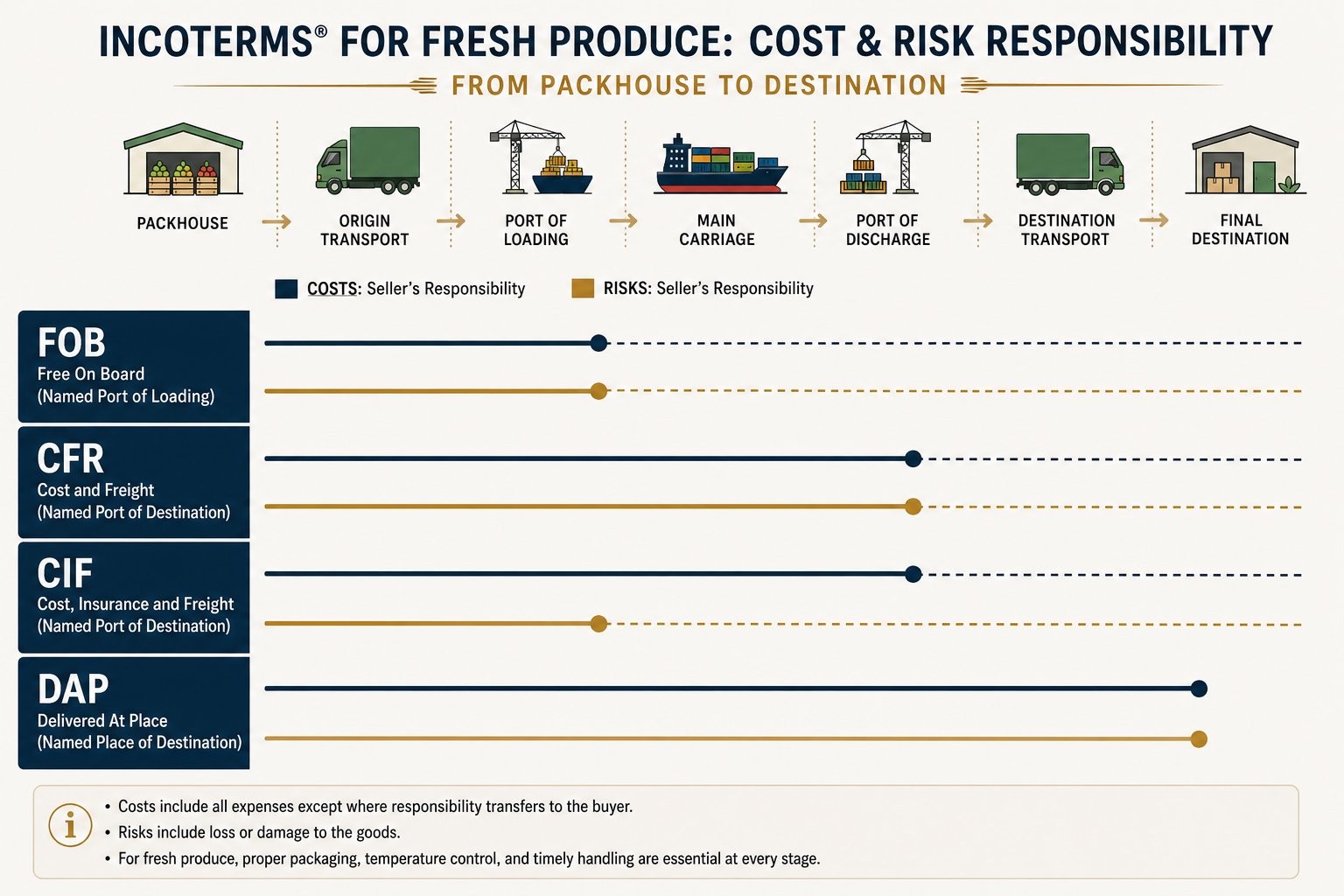
| Incoterm | Export clearance | Main freight | Insurance | Import clearance & duty | Risk passes at | Typically used when |
|---|---|---|---|---|---|---|
| EXW | Buyer | Buyer | Buyer | Buyer | Seller’s premises (packhouse) | Buyer wants full control from origin (rare in produce) |
| FOB | Seller | Buyer | Buyer | Buyer | On board at origin port | Experienced importer with own freight contracts |
| CFR | Seller | Seller | Buyer | Buyer | On board at origin port | Buyer wants seller to book freight but self-insures |
| CIF | Seller | Seller | Seller (minimum cover) | Buyer | On board at origin port | Buyer wants freight plus a baseline insurance policy |
| DAP | Seller | Seller | Seller bears risk | Buyer | Named place at destination | Buyer wants delivered pricing to a named place |
| DDP | Seller | Seller | Seller bears risk | Seller | Named place at destination | Buyer wants fully delivered, duty paid (rare in produce) |
When choosing Incoterms for fresh produce, the point of risk transfer matters far more than it does for non-perishable goods. Under FOB, CFR, and CIF, risk transfers at the origin port — the instant the cartons are loaded on board. That holds true under CFR and CIF even though the seller is paying for the ocean freight. So if a reefer’s compressor fails mid-voyage, or the vessel is delayed and the fruit ripens past spec, the loss falls on the buyer under all three terms, and the insurance claim is the buyer’s to make (or, under CIF, sits with the seller’s policy, but only to its limited cover).
Only under DAP (and DDP) does the seller carry the risk all the way to the destination place. For a perishable, high-value, time-sensitive cargo, that distinction can be the difference between a recoverable claim and an argument over who pays. Whichever Incoterm you choose, pair it with clear cold-chain specifications — see our Citrus Export Cold Chain Guide for target temperatures and reefer settings by product.
There is no single “best” Incoterm — the right choice depends on how much of the logistics and risk a buyer wants to control. As a starting point:
| Buyer profile | Recommended Incoterm | Why |
|---|---|---|
| New or smaller importer, no freight contracts | CIF or DAP | Exporter handles logistics and a baseline insurance policy |
| Experienced importer with own freight rates | FOB | Control of carrier and schedule, often lower freight cost |
| Buyer wanting delivery to a cold store or DC | DAP | One delivered price to a named place; exporter carries transit risk |
| Buyer consolidating cargo at origin | FOB or EXW | Maximum control of onward logistics and consolidation |
A common and costly assumption is that CIF insurance fully protects the shipment. It does not. Under Incoterms 2020, a CIF seller is obliged to provide only minimum cover — Institute Cargo Clauses (C) — for 110% of the contract value. Clauses (C) cover a narrow list of named perils and exclude much of what actually threatens perishables. Buyers who want genuine protection typically request Institute Cargo Clauses (A) (all-risks) and arrange their own top-up cover, or move to CFR or FOB and insure the cargo themselves.
| Insurance level | Cover | Notes |
|---|---|---|
| Institute Cargo Clauses (A) | Widest (all-risks) | Recommended for perishables; usually buyer-arranged |
| Institute Cargo Clauses (B) | Mid-level named perils | Intermediate option |
| Institute Cargo Clauses (C) | Minimum named perils | The CIF default under Incoterms 2020 |
PEI Trade quotes most Egyptian mango and citrus contracts FOB Damietta or FOB Alexandria, CIF to major European and Gulf ports, and DAP to selected EU destinations for buyers who want delivered pricing. For first-time importers we generally recommend CIF or DAP, so the logistics and baseline cover sit with us, then move experienced partners to FOB once they have their own freight rates. For product-specific export guidance, see our Egyptian Mango Export Guide and our Complete Guide to Egyptian Citrus Export.
This guide is based on the official Incoterms 2020 rules. For the authoritative text and licensing, see the International Chamber of Commerce.
PEI Trade. “Incoterms for Fresh Produce: FOB vs CIF vs CFR vs DAP Explained.” PEI Trade Export Knowledge Base. https://peitrade.com/knowledge-base/incoterms-for-fresh-produce/
Under FOB, the buyer arranges and pays for ocean freight and insurance, and risk passes when the goods are loaded on board at the origin port. Under CIF, the seller pays the freight plus minimum marine insurance to the destination port, but risk still passes to the buyer at the origin port on loading.
No. Under Incoterms 2020 a CIF seller must provide only minimum cover, Institute Cargo Clauses (C), for 110 percent of the contract value. Buyers of perishable produce usually arrange wider all-risks cover under Institute Cargo Clauses (A).
The seller pays the ocean freight, which includes carriage of the reefer container, but the buyer bears the risk if the cold chain fails in transit because risk passes at the origin port on loading.
New importers usually prefer CIF or DAP so the exporter handles logistics and baseline insurance. Experienced importers with their own freight rates often choose FOB for control of the carrier and lower freight cost.
At the port of shipment, when the goods are loaded on board the vessel, even though the seller pays the freight all the way to the destination port.
DAP stands for Delivered At Place. The seller delivers the goods to a named destination and bears all cost and risk to that point, while the buyer handles import clearance, duties, and taxes.