Address
Work Hours
Monday to Friday: 7AM - 7PM
Weekend: 10AM - 5PM
Address
Work Hours
Monday to Friday: 7AM - 7PM
Weekend: 10AM - 5PM


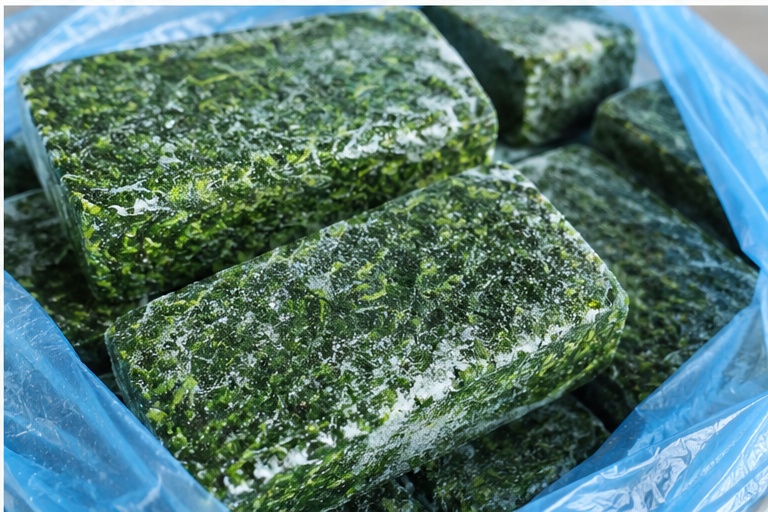
Saudi Arabia is a core market for Egypt’s frozen molokhia (jute mallow). Molokhia is a beloved dish across the Levant and Gulf, and Egypt is the world’s dominant origin for the frozen product — minced and whole-leaf — supplying Saudi retail and foodservice year-round. This is the frozen trade under HS 0710.80 (frozen vegetables, including molokhia), held at −18 °C. This guide covers formats, logistics, market requirements, seasonal availability, and how to open a supply program.
Molokhia is a cherished dish across Saudi Arabia, and frozen molokhia offers the convenience of ready-prepped, year-round supply — no washing, stripping or chopping. Egypt is the natural and dominant origin: molokhia is an Egyptian staple, its processors specialise in the minced and whole-leaf frozen product, and the short Red Sea route keeps the cold chain tight. Demand is steady year-round and lifts around Ramadan and gatherings.
For Saudi importers, an Egyptian program means authentic, consistent frozen molokhia in the exact cut and pack local kitchens want, with fast replenishment.
| Format | Profile | Typical Saudi use |
|---|---|---|
| Minced (fine) | Classic finely-chopped leaf, frozen | ★★★ The traditional molokhia stew |
| Whole-leaf | Whole young leaves, frozen | ★★ Levantine-style & premium |
| Block vs IQF | Block (bricks) or free-flowing IQF | Retail bricks; catering IQF |
Specifications are set per buyer: cut, blanching, colour, foreign-material and micro limits, residue compliance. For product background see the Egyptian molokhia export guide and the Egyptian Frozen & IQF Export Report.
| Period | Activity | Saudi notes |
|---|---|---|
| May–Oct | Molokhia harvest & freezing | New-crop freezing; contract for the season |
| Year-round | Shipping from cold storage | Continuous supply; pre-Ramadan demand peaks |
Molokhia (jute mallow) is a leafy green cooked into a signature stew. Egypt — the dominant global origin — exports it frozen as minced (classic fine cut) and whole-leaf, in block or IQF form, at −18 °C under HS 0710.80.
Molokhia is a Gulf staple, and frozen molokhia offers convenient, year-round, ready-prepped supply. Egypt is the natural and dominant origin, with authentic minced and whole-leaf product and short Red Sea transit.
By reefer sea freight via Sokhna/Red Sea to Jeddah and Dammam, held at −18 °C throughout, in retail bricks/bags or 10 kg catering cartons on pallets.
SFDA/SASO compliance (SABER as applicable), a phytosanitary/health certificate, Arabic labeling (Halal on request), certificate of origin, commercial invoice, packing list, cold-chain logs, and farm/processing food-safety certification.
Building a Saudi frozen-molokhia program? PEI Trade supplies minced and whole-leaf frozen molokhia (block or IQF) to your spec, with −18 °C cold-chain management, SFDA/SASO-aligned documentation, Arabic labeling (Halal on request) and fast Red Sea delivery to Jeddah and Dammam. Tell us your format, packing and delivery window for a compliant offer.
PEI Trade. “Egyptian Frozen Molokhia Exports to Saudi Arabia: IQF Guide.” peitrade.com, 2026, https://peitrade.com/egyptian-frozen-molokhia-exports-to-saudi-arabia/
Sources: PEI Trade Egyptian Molokhia & Spinach Export Guide and Frozen & IQF Export Report (Egypt the dominant global origin of frozen molokhia); trade classified under HS 0710.80. Country-level molokhia volume qualitative (grouped in HS 0710.80). HS code 0710.80.
PEI Trade · New Cairo, Egypt · [email protected] · WhatsApp +20 109 911 1918 · www.peitrade.com · Brand: nile-prime.com · Ports: Alexandria, Damietta, Sokhna, Port Said (Incoterms 2020)