Address
Work Hours
Monday to Friday: 7AM - 7PM
Weekend: 10AM - 5PM
Address
Work Hours
Monday to Friday: 7AM - 7PM
Weekend: 10AM - 5PM


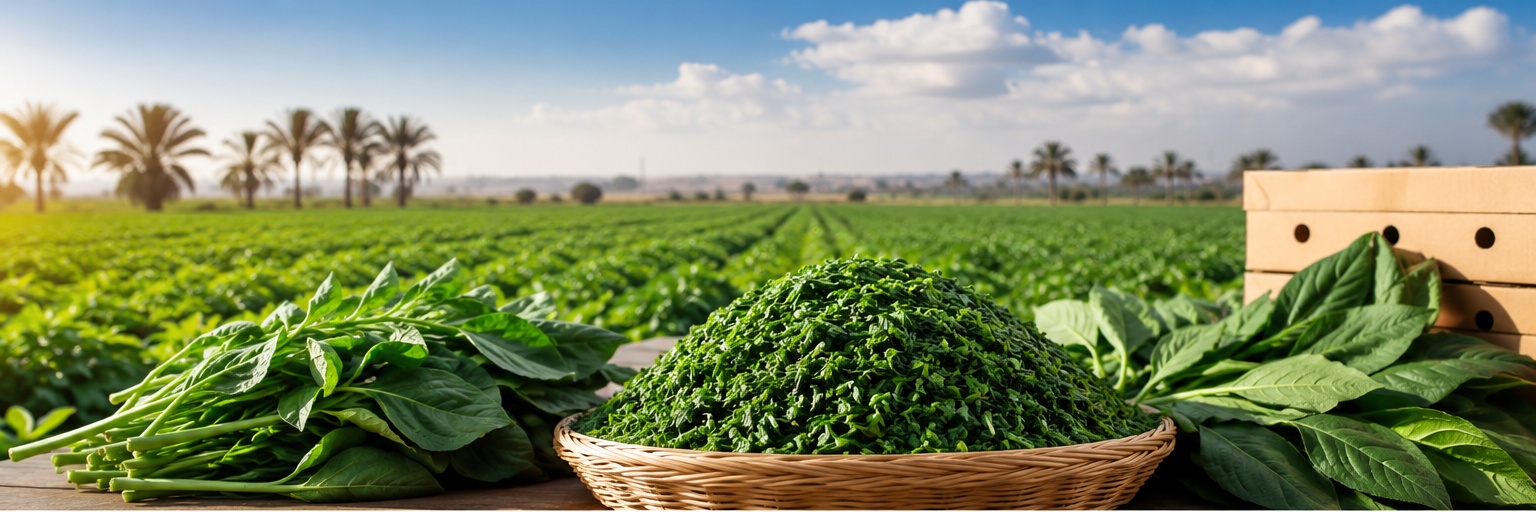
Egypt is, for all practical purposes, the world’s source for molokhia (jute mallow, “Egyptian spinach”) — the leaf behind the iconic green soup — and a strong supplier of frozen spinach. Both are leafy greens, frozen at peak freshness to serve the Gulf, the Middle East and the global Egyptian and Levantine diaspora year-round. This guide is the hub for importers: what Egypt supplies, when it ships, the markets it serves, the specifications buyers ask for and the compliance behind every consignment.
Quick answer: Egypt is the world’s dominant origin for molokhia (jute mallow — minced or whole-leaf, frozen; also dried) and a major supplier of frozen spinach (chopped/leaf). The two crops have opposite seasons: molokhia is a warm-season summer crop (about June–September), while spinach is a cool-season winter crop (about November–March). Both are frozen in season and shipped year-round. Frozen spinach trades under HS 0710.30 and fresh spinach under HS 0709.70; frozen molokhia under HS 0710.80, fresh molokhia under HS 0709.99, and dried leaf under HS 0712.90. The core market is the Gulf, Middle East and diaspora communities worldwide. (Sources: ITC Trade Map, 2025; Egyptian Ministry of Agriculture.)
| Product | Form | Main use |
|---|---|---|
| Molokhia, minced (frozen) | Finely chopped leaf | Classic molokhia soup/stew |
| Molokhia, whole-leaf (frozen) | Whole leaves | Levantine-style dishes |
| Molokhia, dried | Dried leaves | Shelf-stable pantry |
| Spinach (frozen) | Chopped or whole leaf (IQF/block) | Cooking & foodservice |
The two crops occupy opposite seasons. Molokhia is a warm-season crop, harvested through the Egyptian summer (roughly June to September). Spinach is a cool-season crop, harvested over winter (roughly November to March). Because the dominant form is frozen, leaves are processed at peak in their respective seasons and held at −18°C for year-round supply; dried molokhia is shelf-stable year-round. Growing spans the Delta, Beheira and Upper Egypt. Exact windows shift year to year with planting and weather.
Frozen spinach trades under HS 0710.30 (fresh spinach HS 0709.70); frozen molokhia under HS 0710.80 (fresh molokhia, as an “other” leafy vegetable, HS 0709.99); and dried leaf under HS 0712.90.
As leafy greens, molokhia and spinach face strict residue scrutiny — destination MRLs (EU: Regulation (EC) No 396/2005) are a key checkpoint — plus microbiological control (leafy crops can carry pathogens) and thorough washing. Frozen products need HACCP plus a GFSI scheme (BRCGS / ISO 22000) and an unbroken cold chain; GLOBALG.A.P. at farm level and ISPM 15 packaging apply. Egyptian molokhia and spinach are not on the EU’s enhanced official-controls list (Regulation (EU) 2019/1793), so they are not subject to increased border checks — though, as leafy greens, rigorous residue and microbiological management remains essential.
Jute mallow (“Egyptian spinach”), the leaf behind the classic green soup – exported frozen (minced or whole-leaf) and dried.
Frozen minced and whole-leaf molokhia, dried molokhia, and frozen chopped or leaf spinach.
They have opposite seasons: molokhia is a summer crop (about June-September) and spinach a winter crop (about November-March). Frozen products ship year-round.
The Gulf, Middle East and Egyptian/Levantine diaspora worldwide.
Frozen spinach HS 0710.30 (fresh 0709.70); frozen molokhia HS 0710.80 (fresh 0709.99); dried leaf HS 0712.90.
How to cite this page. Reusing a figure from this guide? Please cite it and link to this page as the source.
PEI Trade. “Egyptian Molokhia & Spinach Export: The Complete Guide.” peitrade.com, 2026. https://peitrade.com/egyptian-molokhia-spinach-export-guide/
Source Egyptian molokhia and spinach with PEI Trade. Frozen minced and whole-leaf molokhia, dried molokhia, and frozen spinach, to Gulf, Middle East and diaspora buyers, with thorough washing, MRL-compliant production, GLOBALG.A.P. handling and HACCP/BRCGS cold chain. Contact: [email protected] · WhatsApp +20 109 911 1918 · www.peitrade.com