Address
Work Hours
Monday to Friday: 7AM - 7PM
Weekend: 10AM - 5PM

Address
Work Hours
Monday to Friday: 7AM - 7PM
Weekend: 10AM - 5PM


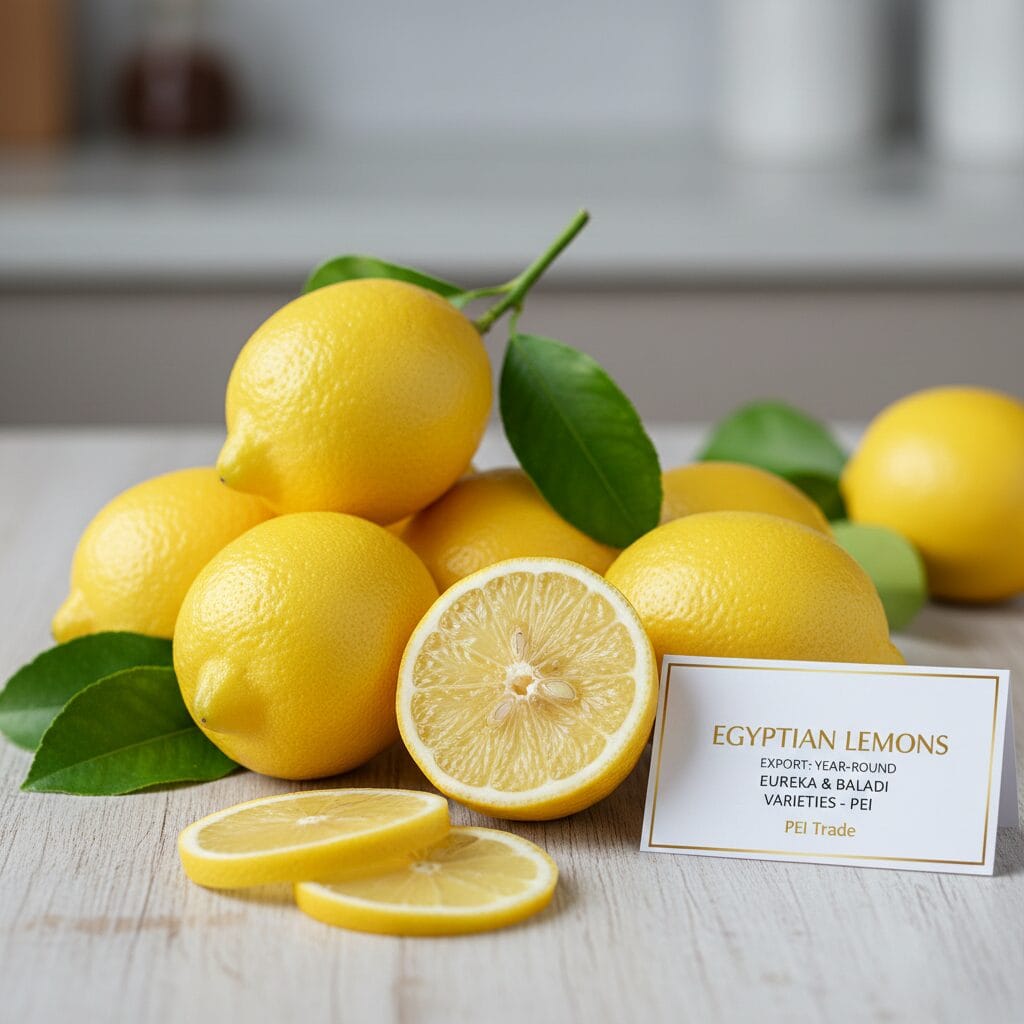
Russia is the second-largest destination for Egyptian lemons after Saudi Arabia, taking on the order of 10,000 tonnes in a typical season. With no domestic citrus of its own, Russia relies on imported lemons for its retail and foodservice trade, and Egypt’s winter main crop lands exactly when demand peaks. This guide covers varieties, cold-chain logistics, EAEU/Rosselkhoznadzor requirements, seasonality and pricing for Russian importers sourcing Egyptian lemons (HS 0805.50).
Russia is Egypt’s #2 lemon market (~10,000 t/season). Peak supply is November–April, aligned with Russian winter demand. Main varieties: Eureka (Adalia, thick-peel, retail) and Baladi (round, high-juice). Transit is 7–12 days by reefer to Novorossiysk or St Petersburg. Imports need a phytosanitary certificate and must meet EAEU technical regulations and MRLs, checked by Rosselkhoznadzor.
Russia is a citrus-deficit market with strong year-round lemon consumption in tea culture, cooking and foodservice. Egypt is a trusted supplier: bilateral agri-trade is well established, freight through the Black Sea is direct, and Egypt’s supply calendar covers the Russian winter when Turkish and Spanish volumes tighten. Payment and logistics channels between the two countries are mature, making Egypt a dependable origin for Russian distributors and retail chains.
| Market snapshot | Detail |
|---|---|
| Rank for Egyptian lemons | #2 destination (~10,000 t) |
| HS code | 0805.50 (lemons & limes) |
| Main entry ports | Novorossiysk, St Petersburg |
| Transit time | 7–12 days by sea |
| Peak window | November–April |
| Key varieties | Eureka (Adalia), Baladi |
Eureka (Adalia): the export-standard lemon — elongated, thick-skinned, bright yellow, with the shelf life Russian long-haul and retail distribution require. Baladi: the round Egyptian lemon with very high juice content, favoured by juicing and foodservice. Graded by calibre (counts of 80–150 per carton), packed in 15 kg or 10 kg telescopic cartons. Grade A is smooth and colour-uniform; Grade B serves juice/industry at lower FOB.
Shipments sail from Alexandria or Damietta to Novorossiysk (Black Sea) and St Petersburg (Baltic), with transit of roughly 7–12 days. Lemons travel in reefer containers at 10–13°C — warmer than oranges to prevent chilling injury — at 85–90% RH. Fruit is pre-cooled, waxed and treated within permitted fungicide limits before loading; the thicker Eureka peel makes it well suited to the longer Baltic route.
Russian imports require a phytosanitary certificate from Egyptian plant quarantine and compliance with EAEU technical regulation TR CU 021/2011 on food safety, plus a certificate of origin. Pesticide residues must meet EAEU MRLs, verified by Rosselkhoznadzor sampling. Labelling must be in Russian (product, origin, packer, net weight, lot). Most organised Russian buyers require GLOBALG.A.P certification at farm level and full lot traceability on cartons.
| Period | Availability |
|---|---|
| November–April | Peak — winter main crop (retail demand high) |
| May–July | Summer Eureka (Adalia) crop |
| August–October | Cold-store & late fruit — continuity supply |
Egypt’s winter main crop aligns precisely with Russia’s peak lemon demand, while summer cropping and cold storage extend availability across the year.
Source & data: Egyptian lemon exports ~100,000 tonnes (2023); Russia #2 market, ~10,000 t. Source: FreshPlaza, 2024. HS code 0805.50 (lemons & limes). Figures are Egypt-market trade data; per-shipment specifications are confirmed at contracting.
PEI Trade — New Cairo, Egypt. Request a quote or lemon spec sheet →