Address
Work Hours
Monday to Friday: 7AM - 7PM
Weekend: 10AM - 5PM

Address
Work Hours
Monday to Friday: 7AM - 7PM
Weekend: 10AM - 5PM


Russia is an emerging market for Egyptian fresh okra (HS 0709.99), driven by growing demand from its Middle-Eastern, Caucasian and Central-Asian communities and expanding foodservice. Okra is not grown domestically at scale, so Russia imports, and Egypt — with established Black Sea trade links — is well placed to supply tender fine-grade pods. This guide covers grades, cold-chain logistics, EAEU/Rosselkhoznadzor requirements and seasonality.
Russia is an emerging fresh-okra market supplied via the Black Sea. Egypt offers tender fine and baby pods (HS 0709.99). Grades: baby, fine, medium. Ships by air (2–3 days) for premium or reefer sea to Novorossiysk (8–12 days), with the sea leg carried in reefer containers at the temperature set for the product. Imports need a phytosanitary certificate and EAEU TR CU 021/2011 compliance, verified by Rosselkhoznadzor.
Okra demand in Russia comes from diaspora communities and a broadening restaurant scene, and the country has negligible domestic production. Egypt is a natural supplier: bilateral agri-trade is well established, Black Sea reefer freight is direct, and Egypt grows the tender grades these buyers want. As a niche but growing line, fresh okra suits importers looking to diversify their Egyptian vegetable programmes.
| Market snapshot | Detail |
|---|---|
| Market profile | Emerging; diaspora + foodservice |
| HS code | 0709.99 (other fresh vegetables — okra) |
| Preferred grade | Fine / baby (small, tender) |
| Routes | Air (2–3 days); reefer sea to Novorossiysk (8–12 days) |
| Cold chain | Reefer at the temperature set for the product |
| Peak window | Broad supply; summer main crop |
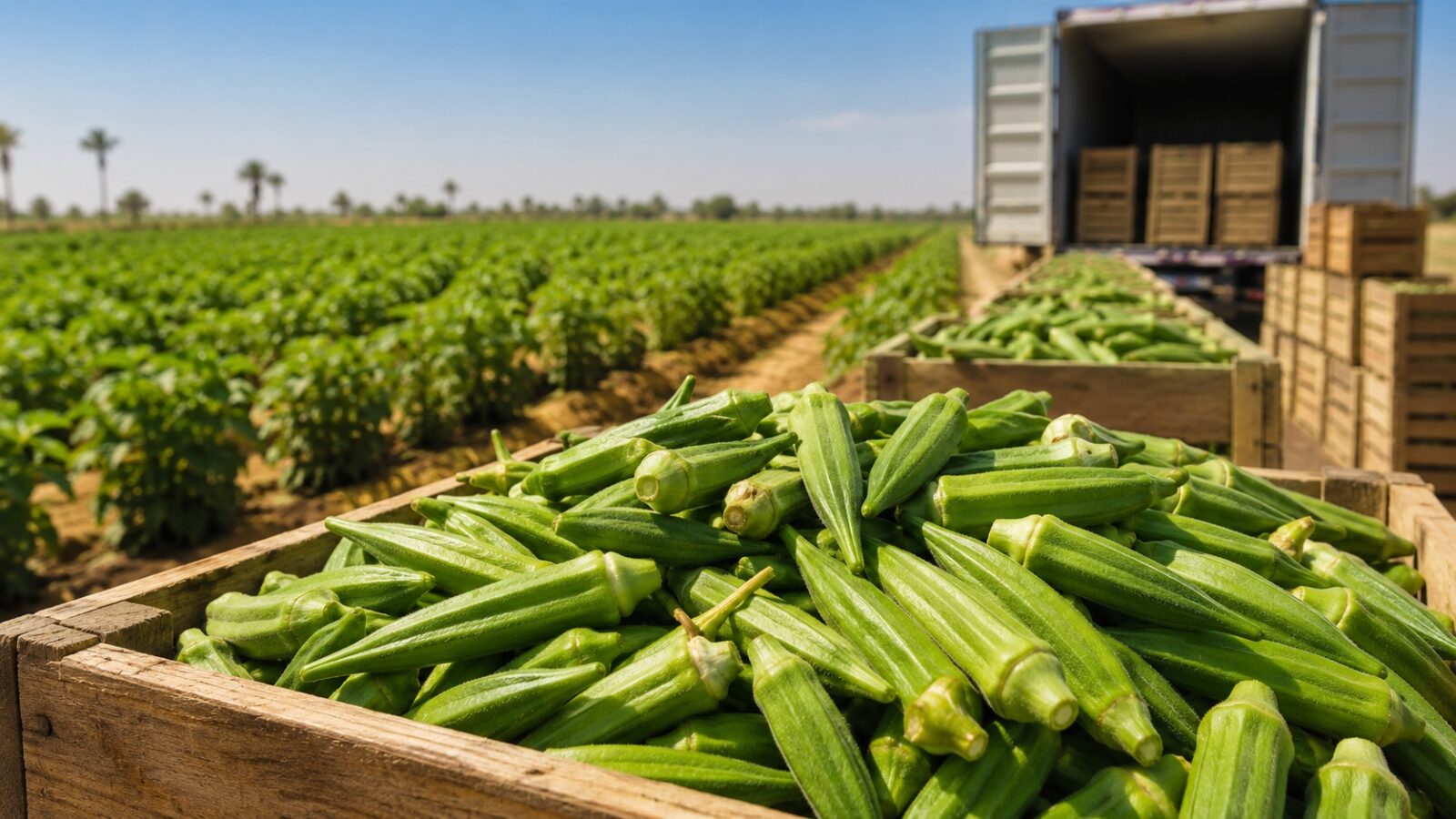
Baby okra: premium, very small pods, tender and uniform. Fine okra: small, the mainstream size. Medium okra: larger pods for value/foodservice. Fruit is bright green, firm, blemish-free and non-woody. Packed in ventilated cartons or punnets, pre-cooled and kept cold to protect shelf life over the longer route.
Fresh okra is perishable and chilling-sensitive; premium baby grade moves by air (2–3 days) and volume by reefer sea to Novorossiysk (8–12 days). By sea it is carried in reefer containers at the temperature set for the product, as okra is chilling-sensitive. Because the sea route is longer, rapid pre-cooling, correct packing and an unbroken cold chain are essential to land pods in saleable condition.
Russian imports require a phytosanitary certificate and compliance with EAEU technical regulation TR CU 021/2011, plus a certificate of origin. Pesticide residues must meet EAEU MRLs — a key okra control — verified by Rosselkhoznadzor sampling. Labelling is in Russian (product, origin, packer, net weight, lot). Organised buyers require GLOBALG.A.P at farm level and full lot traceability.
| Period | Availability |
|---|---|
| May–October | Peak — open-field summer main crop |
| November–April | Protected-cultivation & southern supply |
Egypt’s summer main crop plus protected and southern cultivation give Russian buyers fresh okra across much of the year via the Black Sea.
Diaspora communities (Middle-Eastern, Caucasian, Central-Asian) and a growing foodservice sector; Russia has negligible domestic production.
By air (2–3 days) for premium grade or reefer sea to Novorossiysk (8–12 days), with the sea leg carried in reefer containers at the temperature set for the product.
Okra is chilling-sensitive and darkens and pits if held too cold, so it is carried in reefer containers at the temperature set for the product.
A phytosanitary certificate, EAEU TR CU 021/2011 compliance, MRL conformity checked by Rosselkhoznadzor, and Russian labelling. GLOBALG.A.P is expected.
Source & data: Egypt is an established fresh-okra exporter with Black Sea trade links to Russia. Source: Tridge fresh-okra market overview, 2025–26. HS code 0709.99 (other fresh vegetables, incl. okra). Country-level volumes vary seasonally and are confirmed at contracting.
PEI Trade — New Cairo, Egypt. Request a quote or okra spec sheet →