Address
Work Hours
Monday to Friday: 7AM - 7PM
Weekend: 10AM - 5PM

Address
Work Hours
Monday to Friday: 7AM - 7PM
Weekend: 10AM - 5PM


The Egyptian date harvest runs August to October. A working reference on Siwi, Medjool, Zaghloul and Barhi, with grades, carton formats, pallet configuration, temperature and the documents each shipment carries.
The Egyptian date harvest opens in August and runs through October, which makes the next eight weeks the practical booking window for importers who want fruit from the current crop rather than carry-over stock. Egypt is among the largest date producers in the world, and the exported share is small relative to what is grown, so availability is rarely the constraint. Variety selection, grade definition and handling temperature are where most orders succeed or go wrong.
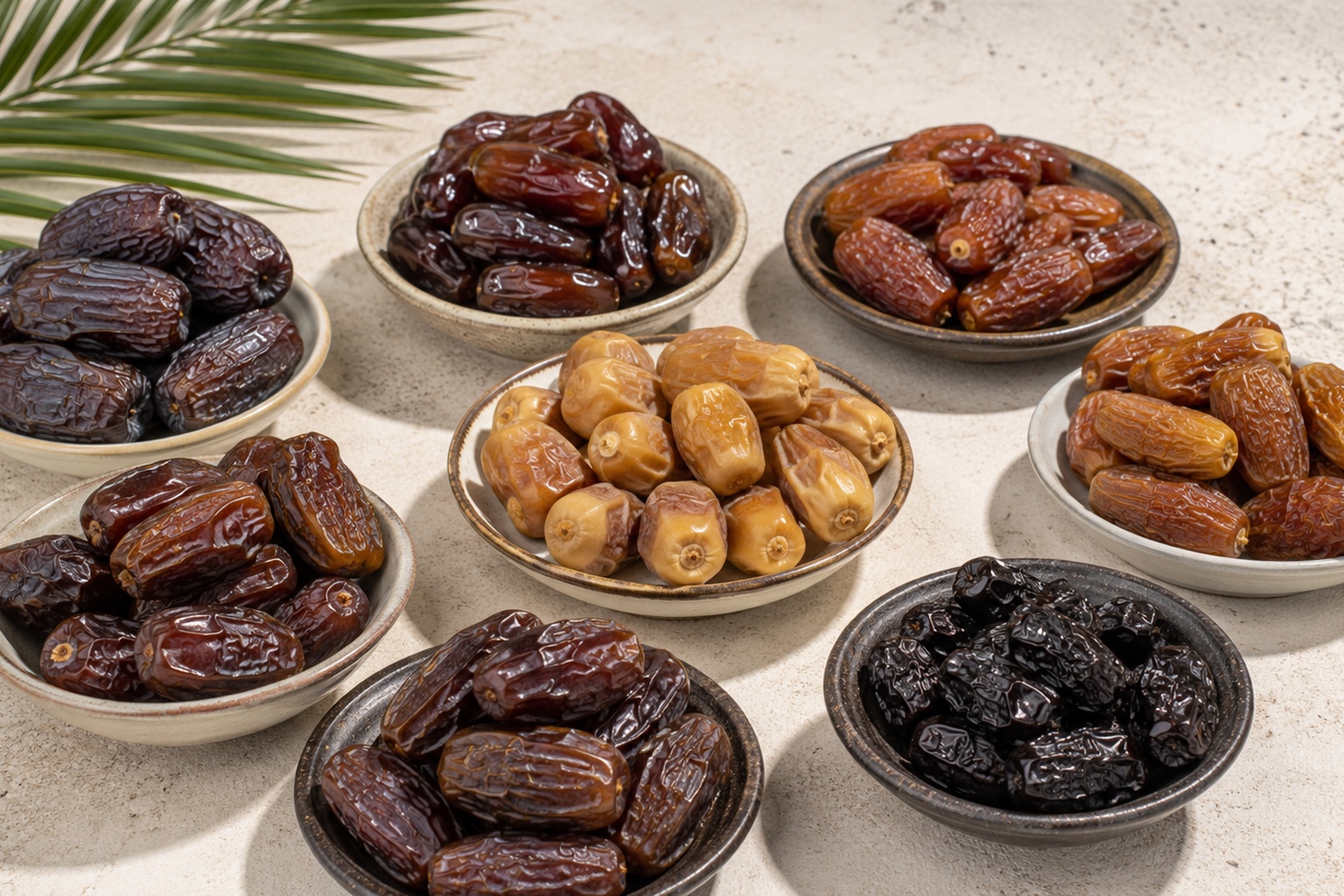
Siwi is the workhorse of the export trade. Grown mainly in Siwa Oasis and the New Valley, it is a semi-dry date with moisture in the region of 18 to 22 percent, firm flesh and a long shelf life at ambient temperature. It moves in volume to North Africa, South and Southeast Asia and the Gulf, and it is the variety most often quoted when a buyer simply asks for Egyptian dates.
Medjool is the premium line. Egyptian Medjool comes largely from reclaimed desert land around Nubaria, Toshka and the Bahariya area. It is sold on individual fruit weight rather than count per kilo, and it commands a different price band from Siwi entirely.
Zaghloul and Hayany are fresh soft dates with short windows. Zaghloul, harvested around Rashid and the northern Delta from mid September, ships chilled and sells mostly into Gulf markets. Hayany, dark red to near black when fresh, runs August into October and needs the same care as any soft fresh fruit.
Barhi sells in the khalal stage, yellow and crisp, often presented on the strand. It ships chilled and carries the shortest window of the four, roughly August into early September.
Medjool grading follows fruit weight. Jumbo runs above 23 g per date, Large 18 to 23 g, Medium 14 to 18 g and Small 11 to 14 g. Specify the grade and the agreed tolerance for skin separation and surface blemish in writing, because those two points are behind most arrival disputes on Medjool.
Semi-dry Siwi is offered pitted or unpitted, in 5 kg and 10 kg bulk cartons with a food grade liner, or in 500 g and 1 kg consumer packs at twelve units to a carton. Fresh Barhi and Zaghloul ship in 5 kg ventilated cartons, tray packed or strand packed depending on the destination.
On 100 x 120 cm export pallets, 10 kg bulk cartons usually give 80 to 100 cartons per pallet, with 20 pallets in a 40ft reefer. Dates are dense, so a 20ft container often reaches its payload limit well before it fills on volume. Confirm the gross weight per container before the equipment is fixed.
Semi-dry dates travel at ambient or at 5 to 10 C depending on destination and transit time. Fresh soft varieties need 0 to 4 C held continuously from the packhouse to arrival. Disinfestation is normally handled by freezing at minus 18 C for 48 to 72 hours before packing, an approach most destination markets accept and one that avoids chemical residue questions later.
A date consignment carries the same core paperwork as any other Egyptian produce shipment: commercial invoice, packing list, bill of lading, certificate of origin and phytosanitary certificate. Gulf and South Asian buyers frequently add a halal certificate and a health certificate issued by the competent authority. Our reference on export documentation for Egyptian produce sets out what each document proves and who issues it, and the note on certification on Egyptian produce shipments explains where GLOBALG.A.P, BRCGS and ISO 22000 apply on packed and processed lines.
Siwi and Medjool can be contracted as a season programme with monthly call-offs through to the following spring, since both hold well in storage. Barhi, Zaghloul and Hayany cannot. Those need a fixed shipping week agreed in advance, because the fruit will not wait for a vessel. Buyers taking fresh soft dates for the first time should start with a single container and a defined arrival inspection protocol rather than a programme.
To discuss varieties, grades and availability from the current harvest, or to receive a specification sheet and quotation, contact the PEI Trade export desk on WhatsApp at +20 10 9911 1918.
