Address
Work Hours
Monday to Friday: 7AM - 7PM
Weekend: 10AM - 5PM

Address
Work Hours
Monday to Friday: 7AM - 7PM
Weekend: 10AM - 5PM


Saudi Arabia is the single largest destination for Egyptian lemons, absorbing roughly half of Egypt’s export volume in a typical season. For Saudi importers, wholesalers and HORECA distributors, Egyptian lemons (HS 0805.50) combine year-round availability, short Red Sea transit and competitive FOB pricing. This guide covers varieties, logistics, SFDA import requirements, seasonality and pricing for buyers sourcing from Egypt.
Saudi Arabia is Egypt’s #1 lemon market (~half of export volume). Peak supply runs October–April with year-round backup from cold storage. Main varieties are Eureka (Adalia, thick-peel, retail) and Baladi (round, high-juice, foodservice). Transit is 3–7 days via Jeddah/Dammam. Imports require an SFDA health certificate, phytosanitary certificate and Halal-compliant handling; MRL compliance is checked at port.
Saudi Arabia has limited domestic citrus production and high fresh-lemon consumption driven by its foodservice sector, juice demand and household cooking. Egypt is the natural supplier: a short sea route through the Red Sea, matching quality tiers for both retail and wholesale, and a supply window that covers the Kingdom’s demand almost year-round. Egyptian lemons compete with South African and Turkish fruit but win on freight cost and calendar coverage, which is why Egypt and South Africa together dominate the Saudi lemon shelf.
| Market snapshot | Detail |
|---|---|
| Rank for Egyptian lemons | #1 destination (~50% of volume) |
| HS code | 0805.50 (lemons & limes) |
| Main entry ports | Jeddah, Dammam |
| Transit time | 3–7 days by sea |
| Peak window | October–April |
| Key varieties | Eureka (Adalia), Baladi |
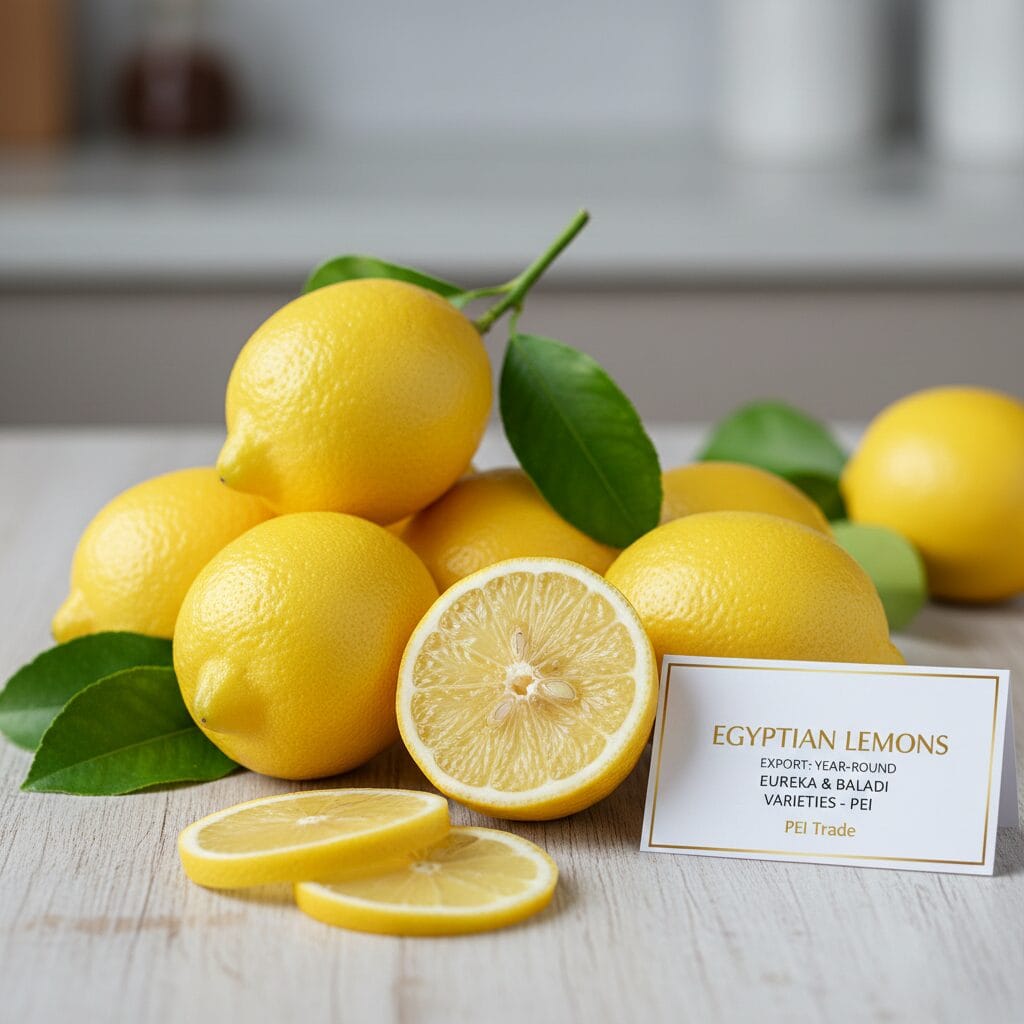
Eureka (Adalia): the export-standard lemon — elongated, thick-skinned, bright yellow, with good shelf life for retail and long-haul. Baladi: the traditional round Egyptian lemon, thinner skin, very high juice content, favoured by juicing and foodservice buyers. Both are graded by calibre (typically counts of 80–150 per carton) and packed in 15 kg or 10 kg telescopic cartons. Grade A fruit is smooth, blemish-free and colour-uniform; Grade B (industry/juice) tolerates minor cosmetic defects at a lower FOB.
Shipments leave Alexandria, Damietta or Port Said for Jeddah (Red Sea) and Dammam (via Suez/Gulf), with transit of roughly 3–7 days depending on the port pair. Lemons ship in reefer containers held at 10–13°C — warmer than oranges, to avoid chilling injury — at 85–90% relative humidity. Overland reefer trucking via the land bridge is also used for time-sensitive orders. Fruit is pre-cooled, waxed and fungicide-treated within permitted limits before loading.
Saudi imports require a phytosanitary certificate from Egypt’s Central Administration of Plant Quarantine, an SFDA-recognised health/food-safety certificate, and a certificate of origin. Pesticide residues must meet Saudi/GSO MRLs, verified by sampling at the port of entry. Consignments must follow Halal-compliant handling and labelling in Arabic (product, origin, packer, net weight, lot). Cartons carry the exporter code and traceability lot. GLOBALG.A.P certification at farm level is expected by most organised Saudi buyers.
| Period | Availability |
|---|---|
| October–April | Peak — Baladi & Eureka main crop |
| May–July | Summer Eureka (Adalia) crop |
| August–September | Cold-store & late fruit — continuity supply |
Egypt’s dual main/summer cropping plus cold storage gives near 12-month availability — the core reason Saudi buyers rely on Egyptian lemons to bridge gaps left by Northern-Hemisphere suppliers.
Source & data: Egyptian lemon exports ~100,000 tonnes (2023), Saudi Arabia largest market. Source: FreshPlaza, 2024. HS code 0805.50 (lemons & limes). Figures are Egypt-market trade data; per-shipment specifications are confirmed at contracting.
PEI Trade — New Cairo, Egypt. Request a quote or lemon spec sheet →