Egyptian citrus leads agricultural exports as the country’s most valuable fruit commodity, with over 2 million tons shipped to global markets in 2025, positioning Egypt as one of the world’s top citrus suppliers. This guide provides B2B importers with essential insights into sourcing bulk Egyptian oranges for export, including variety specifications, harvest windows, quality protocols, and wholesale pricing trends for 2026.
Why Egyptian Citrus Dominates Global Markets
Egypt’s strategic location, favorable climate, and developed agricultural infrastructure have made it a key player in the global citrus trade. With extensive cultivation across the Nile Delta, the country ranks among the top citrus producers worldwide and is a leading exporter to major international markets. Continuous expansion of cultivation areas and strong trade relationships have consistently supported growth in citrus exports.
Primary export destinations:
European Union (35%) – Netherlands, Italy, Germany
Russia (28%) – Egypt’s largest single market
Saudi Arabia and Gulf States (18%)
China and Southeast Asia (12%, rapidly growing)
The citrus quality Egypt produces has gained international recognition for consistent sweetness, vibrant color, minimal seeds, and exceptional cold storage tolerance. Citrus exports generated approximately $650 million USD in 2025, making it Egypt’s top agricultural export by value.
Premium Egyptian Citrus Varieties: Specifications for Importers
Valencia Oranges (January – August)
Egypt’s flagship export variety, accounting for 40% of total shipments. Brix levels reach 10-12° with about 70% juice and 1.5% acidity. Available in counts 48-113 per 15kg carton. Best-quality window: January-April. Ideal for European summer programs when Spanish production concludes.
Navel Oranges (mid-December – 1 March)
Completely seedless with easy-peel characteristics. Brix levels 10-12°, shelf life 30-45 days in cold storage, not counting transit (about 20 days at sea). Counts 32-88 per 15kg carton (most requested 48-88). Best quality early in the season. Russian and Middle Eastern markets show particularly strong demand for large-count Egyptian Navels.Explore Now: Navel vs Valencia – Egyptian Orange Import Guide 2026
Mandarins (from December)
Clementine and Fremont cultivars with exceptional sweetness (11-14° Brix). Seed content 0-2 seeds. Peak window: December-January. Premium positioning in European and Gulf markets.
Lemons (end of September – May)
Exports from the end of September to May. Acid content 5-6%, juice content 35-42%. Counts 95-140 per 15kg carton.
Quality Assurance: Meeting International Standards
When you import citrus fruits from Egypt through PEI Trade, every container undergoes rigorous quality control exceeding international standards.
Export Compliance
Egyptian AEC Standards: All shipments comply with Egyptian citrus export standards established by the Agricultural Export Council and enforced through CAPQ. Pre-export inspection covers varietal authenticity, pest absence, maturity requirements, and phytosanitary certification.
Quality Control Process
Pre-Harvest Assessment (7-10 days before picking): Agronomists measure Brix levels and fruit size distribution
Selective Hand Harvesting: Transport to facilities within 4 hours
Cold Storage: 4-8°C for 12-24 hours before pre-cooled container loading
Documentation: Complete packing records, temperature logs, phytosanitary certificates
Seasonal Availability: 2026 Export Calendar
Understanding Egypt citrus season 2026 timing enables optimal procurement planning.
Mid-December:Navel and mandarin exports open when the Export Council announces the season. Best pricing window. Highest export volumes begin to Russia and EU.
January-February: Peak Navel production. Egyptian citrus export window for EU at maximum capacity. Transit to Rotterdam: 7-9 days.
January-April: Valencia in its best-quality window; May is the last fresh month. Extended EU demand as European production decreases. Favorable pricing due to reduced competition.
June-August: Valencia from cold storage, subject to the Export Council’s notice. Strategic window for summer programs without alternate suppliers.
August-October: Industry gap period; lemon exports open at the end of September. Planning period for upcoming season.
Logistics & Shipping Solutions
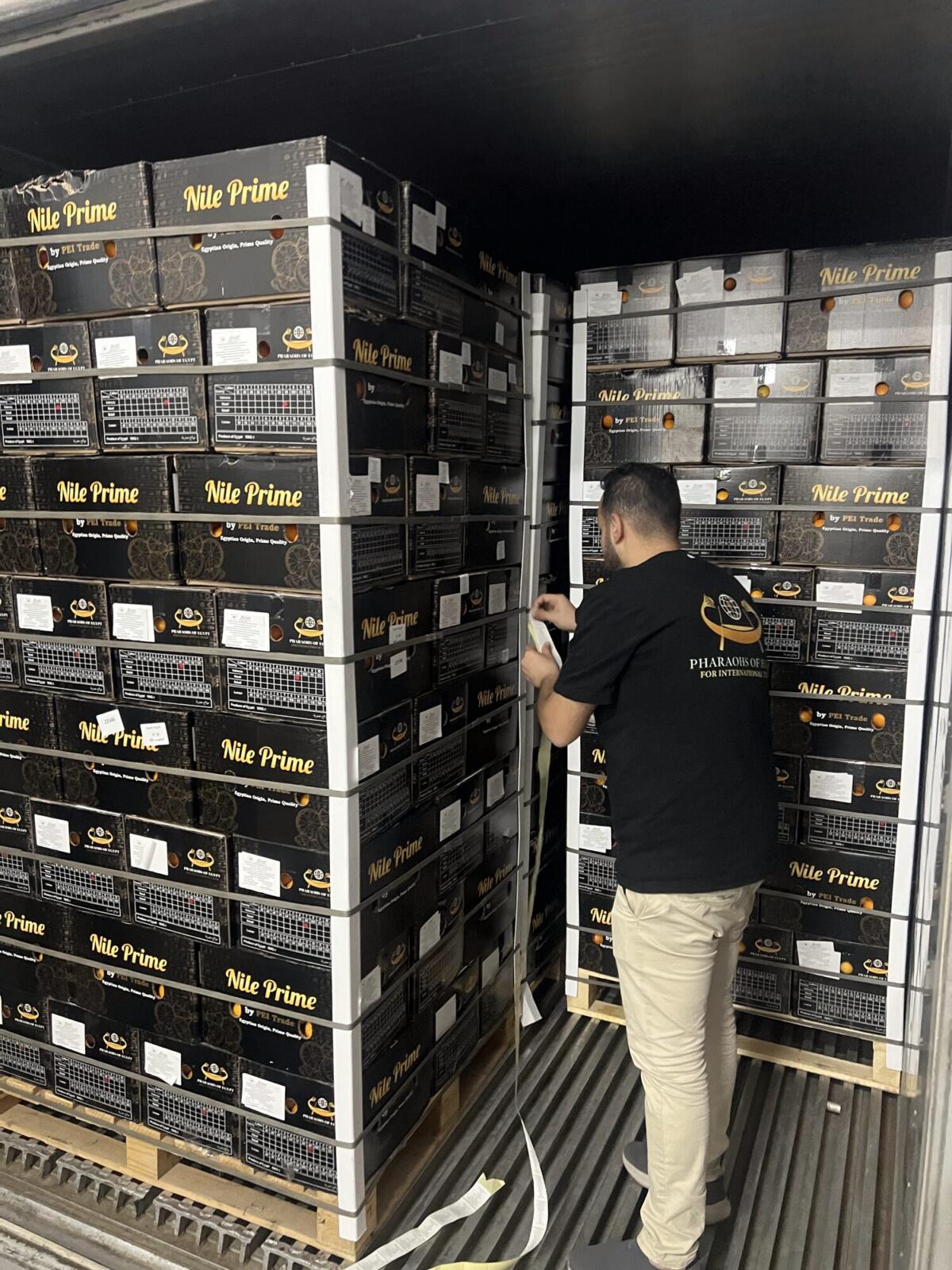
Alexandria Port handles 60% of citrus exports with weekly EU sailings, established cold chain infrastructure, and 2-3 day processing. Damietta Port processes 25% with specialized agricultural facilities and 2-4 day turnaround.Pallets are strapped against the sea leg — a shifted tier arrives as a claim.
Container Specifications
40-foot High Cube Refrigerated: 1,600 cartons (24 metric tons), temperature 4-8°C, standard 15kg cartons.
Transit Times from Alexandria
Netherlands (Rotterdam): 7-9 days
Italy (Genoa): 5-7 days
Russia (Novorossiysk): 10-12 days
China (Shanghai): 18-22 days
Middle East (Jeddah): 5-6 days
Cold Chain Management
Pre-cooling within 6 hours of harvest, cold storage at 4-8°C until loading, container pre-cooling minimum 2 hours, continuous temperature monitoring with automated alerts throughout transit.Documentation: Commercial Invoice, Packing List, Bill of Lading, Phytosanitary Certificate (CAPQ), Certificate of Origin, EUR 1 Certificate for EU.
Pricing & Market Intelligence for 2026
Understanding wholesale price trends for Egyptian citrus in 2026 enables strategic procurement. Pricing is influenced by multiple factors including quality grade (premium fruit commands higher margins), fruit size specifications, volume commitments (multi-container programs often secure discounts), payment terms, and seasonal timing.
2026 Market Outlook
Egyptian citrus production continues to grow at an annual rate of 8–10%. The 2 million tons exported in 2025 demonstrates expanding capacity and strong global positioning. European demand remains stable with a growing preference for Mediterranean imports, while Asian markets represent the fastest-growing segment with projected annual growth of 15–20%.
Strategic Timing
Early Season (November–mid-December): Navel contracts open in early November, before exports open in mid-December.
Mid-Season (January to 1 March): Procurement benefits from peak production volumes.
Extended Season (April–August): Valencia remains available for summer programs, from cold storage after May.
Why Choose PEI Trade
Direct Grower Relationships: citrus growers across Egypt’s production regions, eliminating intermediaries while ensuring orchard-to-container quality control.
Real-Time Availability: “Live from the Packing Facility” platform provides real-time inventory visibility, harvest schedules, and container loading status.
Quality Guarantee: Commercial compensation or replacement if product arrives not meeting agreed specifications due to our handling deficiencies.
Conclusion
Egyptian citrus leads agricultural exports with proven quality, competitive pricing, and reliable infrastructure. The 2 million tons exported in 2025 demonstrates Egypt’s commitment to serving global B2B importers with premium varieties throughout extended harvest windows. PEI Trade delivers comprehensive solutions with transparent quality control and responsive service. Our direct grower partnerships and real-time availability system eliminate import complexities while ensuring consistent specifications.Ready to import premium Egyptian citrus? Contact PEI Trade today for quotations, harvest calendars, and availability confirmation.
FAQs
What is the minimum order quantity?
One full 40 ft reefer container (1,664 cartons, 24.96 t), including trials. Oranges are never loaded with mandarins or lemons; other mixes are on request, subject to approval.
How is the fruit tested for residues?
Fruit is tested against the MRLs of the destination market, with residue reports available per lot.
What are payment terms?
Our payment terms: 50% in advance and 50% against copy of the shipping documents.
How long is delivery to Europe?
7-9 days to Rotterdam, 5-7 days to Italy. Total lead time: 18-25 days from order to destination.
What if quality doesn’t meet specifications?
Quality guarantee provides compensation if issues stem from our handling deficiencies.
Manage your privacy
We use technologies like cookies to store and/or access device information. We do this to improve browsing experience and to show (non-) personalized ads. Consenting to these technologies will allow us to process data such as browsing behavior or unique IDs on this site. Not consenting or withdrawing consent, may adversely affect certain features and functions.
Functional
Always active
The technical storage or access is strictly necessary for the legitimate purpose of enabling the use of a specific service explicitly requested by the subscriber or user, or for the sole purpose of carrying out the transmission of a communication over an electronic communications network.
Preferences
The technical storage or access is necessary for the legitimate purpose of storing preferences that are not requested by the subscriber or user.
Statistics
The technical storage or access that is used exclusively for statistical purposes.The technical storage or access that is used exclusively for anonymous statistical purposes. Without a subpoena, voluntary compliance on the part of your Internet Service Provider, or additional records from a third party, information stored or retrieved for this purpose alone cannot usually be used to identify you.
Marketing
The technical storage or access is required to create user profiles to send advertising, or to track the user on a website or across several websites for similar marketing purposes.
To provide the best experiences, we use technologies like cookies to store and/or access device information. Consenting to these technologies will allow us to process data such as browsing behavior or unique IDs on this site. Not consenting or withdrawing consent, may adversely affect certain features and functions.
Functional
Always active
The technical storage or access is strictly necessary for the legitimate purpose of enabling the use of a specific service explicitly requested by the subscriber or user, or for the sole purpose of carrying out the transmission of a communication over an electronic communications network.
Preferences
The technical storage or access is necessary for the legitimate purpose of storing preferences that are not requested by the subscriber or user.
Statistics
The technical storage or access that is used exclusively for statistical purposes.The technical storage or access that is used exclusively for anonymous statistical purposes. Without a subpoena, voluntary compliance on the part of your Internet Service Provider, or additional records from a third party, information stored or retrieved for this purpose alone cannot usually be used to identify you.
Marketing
The technical storage or access is required to create user profiles to send advertising, or to track the user on a website or across several websites for similar marketing purposes.