Address
Work Hours
Monday to Friday: 7AM - 7PM
Weekend: 10AM - 5PM

Address
Work Hours
Monday to Friday: 7AM - 7PM
Weekend: 10AM - 5PM



Key definition: quality control (QC) is the set of checks that confirm produce meets the agreed specification, and a pre-shipment inspection (PSI) is an independent check — often by a third party — carried out at the packhouse or before loading to verify the consignment before it ships. Together they give the buyer confidence that what was ordered is what will arrive.
For perishable produce there is no second chance: once a container sails, quality problems are expensive and hard to fix. Quality control catches issues early, at each stage from harvest to loading, while a pre-shipment inspection provides a final, documented check that the consignment matches the contract. This reference explains where QC happens, what inspectors check, how sampling works, and how defect tolerances are agreed. For the wider process, see how to import Egyptian produce.
Quality control protects three things: the produce, by catching damage, immaturity or defects before they ship; the buyer relationship, by delivering exactly what was specified; and the claim risk, because a consignment that fails on arrival can mean rejection, price reduction or a dispute. Building QC into every stage — rather than checking only at the end — is what keeps rejections rare and repeat orders coming.
Effective QC is a chain of checks, not a single gate. Each stage removes problems before they reach the next:
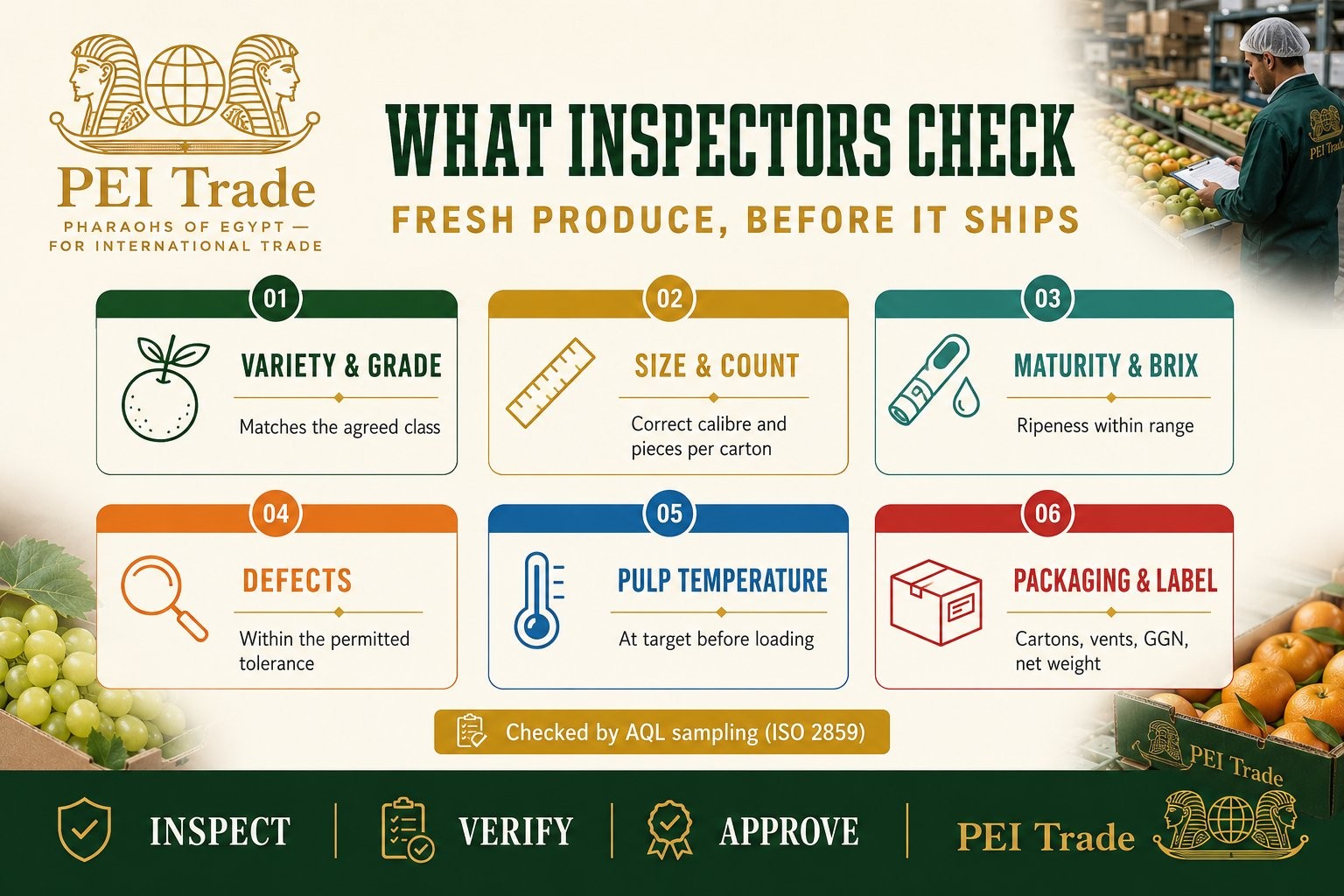
A produce inspection works through a consistent checklist, comparing the consignment against the agreed specification.
| Check | What it confirms |
|---|---|
| Variety & grade | Matches the agreed specification and class |
| Size / calibre & count | Correct size code and pieces per carton |
| Maturity / Brix | Ripeness and sugar within the agreed range |
| Defects | Within the permitted tolerance for the class |
| Foreign matter & pests | Absent — supports phytosanitary compliance |
| Pulp temperature | At the target before loading |
| Packaging & labeling | Correct cartons, vents, labels, GGN and net weight |
| Pallet & load | Stable, vent-aligned and within the load line |
A pre-shipment inspection (PSI) is a structured check at the packhouse or before loading that confirms the consignment matches the contract before it leaves Egypt. Many buyers run their own QC; others require an independent inspection by a third-party company such as SGS, Bureau Veritas or Intertek, who issue an inspection report or certificate the buyer can rely on — alongside the shipment’s certifications.
Inspectors rarely check every carton. Instead they use AQL (Acceptable Quality Limit) sampling under ISO 2859: a sample sized to the lot is drawn at random, and the consignment is accepted or rejected on the number of defects found against the agreed limit. This makes inspection fast, consistent and statistically fair.
Quality classes set how many defects are allowed. Higher classes permit fewer defects and demand tighter appearance: Class I (or Extra) is the premium grade, while Class II allows more variation. The exact tolerances come from the applicable standard — for example UNECE or Codex — and from the buyer’s specification, which takes precedence wherever it is stricter. Agreeing the class, the tolerances and the sampling level in advance is the simplest way to prevent disputes on arrival.
PEI Trade applies quality control at every stage — from harvest and packhouse intake through grading, packing and a final pre-loading check — and supports independent third-party inspection when a buyer requires it. To agree a quality specification and inspection plan for your market, contact the export desk at [email protected] or +20 109 911 1918, or see grading and size standards and the export glossary.
PEI Trade. “Quality Control and Pre-Shipment Inspection for Fresh Produce.” PEI Trade Export Knowledge Base. https://peitrade.com/knowledge-base/quality-control-pre-shipment-inspection/
It is an independent check of the produce at the packhouse or before loading, often by a third party, that confirms the consignment matches the agreed specification — variety, grade, size, maturity, packaging and labeling — before it ships.
Variety and grade, size or calibre and count, maturity or Brix, defects against the permitted tolerance, pulp temperature, foreign matter, and the packaging, labeling and pallet.
AQL (Acceptable Quality Limit) is a sampling method under ISO 2859 in which the inspector checks a sample sized to the lot and accepts or rejects the consignment based on the number of defects found.
It can be done by the exporter’s own QC team and, when the buyer requires independent assurance, by a third-party inspection company such as SGS, Bureau Veritas or Intertek.