Address
Work Hours
Monday to Friday: 7AM - 7PM
Weekend: 10AM - 5PM

Address
Work Hours
Monday to Friday: 7AM - 7PM
Weekend: 10AM - 5PM



In short: importing fresh produce from Egypt follows seven stages — (1) source and qualify a supplier, (2) agree commercial terms (Incoterms + payment method), (3) confirm product specification, grading and HS code, (4) verify certifications and food-safety compliance, (5) arrange cold-chain logistics, (6) prepare export documentation, and (7) clear customs and take delivery.
Egypt is one of the world’s major exporters of fresh fruit and vegetables, shipping fruits and vegetables to importers across Europe, the Gulf, Russia, the UK, Asia and beyond. For a first-time buyer the process can look complex, but it follows a clear, repeatable sequence. This guide walks through every stage, from choosing a supplier to clearing the cargo at destination, and links to the detailed reference page for each step. For market size and trade-flow data, see the State of Egyptian Agri-Export 2026 and the Fresh Produce Export Statistics.
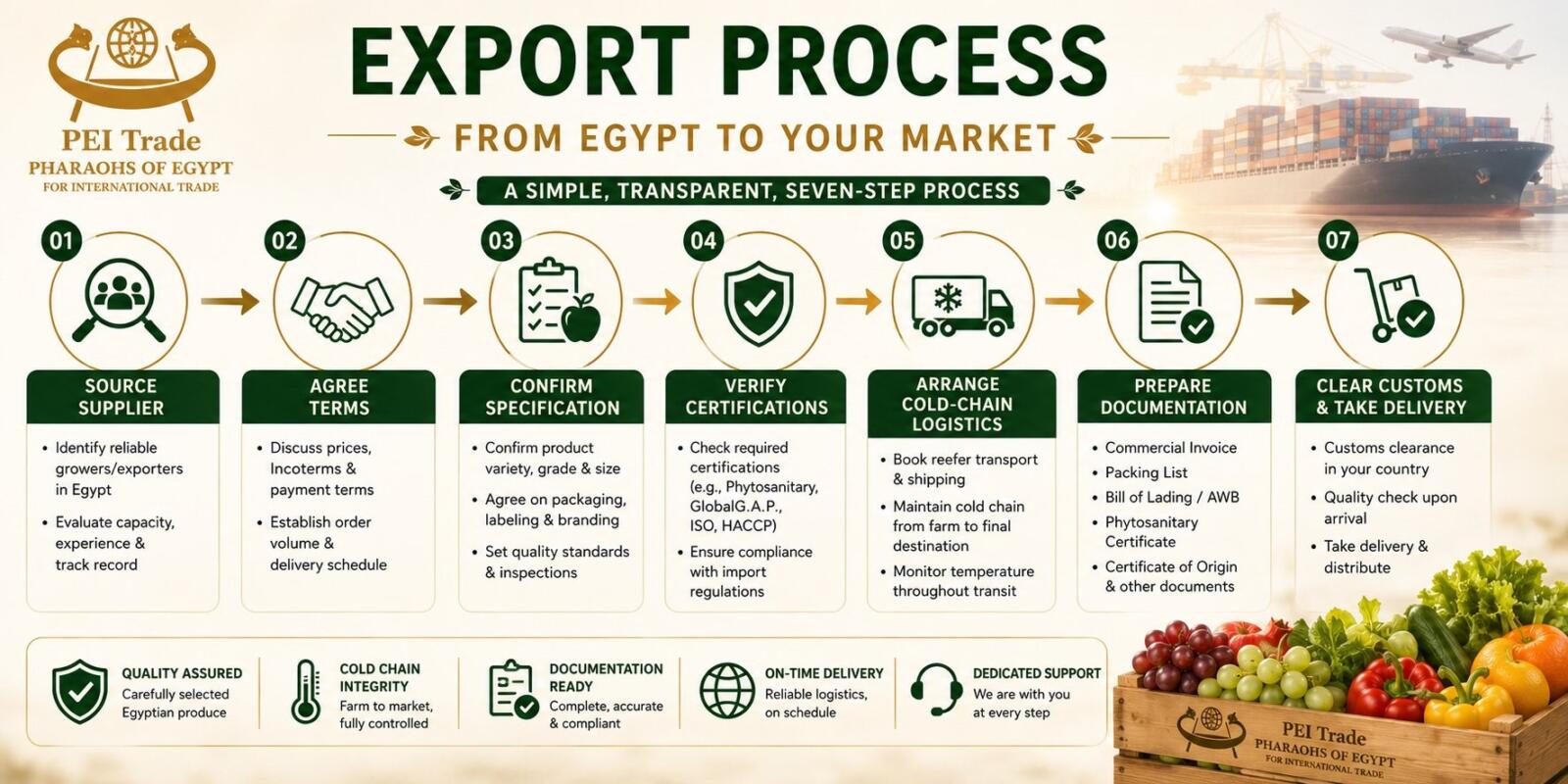
Start by identifying an exporter that handles your target crop, volume and destination. A reliable Egyptian produce exporter should be able to show its product range, packhouse and cold-store capability, export references, and the certifications its supply chain holds (covered in Step 4). Confirm the varieties available and the season window for each — Egyptian crops are highly seasonal — and ask for product photos, specifications and sample availability before committing to a first order.
Two separate things must be agreed in the sales contract. First, the Incoterm (such as FOB, CIF, CFR or DAP) defines who arranges and pays for transport and insurance and where the risk passes from seller to buyer. Second, the payment method — Letter of Credit (LC), Telegraphic Transfer (TT), Cash Against Documents (CAD) or Open Account — defines how and when you pay. A complete agreement states both, for example: CIF Rotterdam, 30% TT advance and 70% by irrevocable LC at sight.
Agree the exact product specification in writing: variety, size or calibre, packaging format, net weight per carton, and pallet configuration. Egyptian exporters grade to recognised standards — see grading and size standards — so specify the grade and count you require. Confirm the correct HS code for the commodity, as it determines the import duty and the documentation your customs authority will expect.
Most retail and wholesale buyers require proof of good agricultural practice and food-safety management. Review the supplier’s export certifications, which commonly include GLOBALG.A.P, HACCP and ISO 22000. Depending on the commodity and destination, a phytosanitary certificate is mandatory (Step 6), and some markets require a specific treatment — for example hot water treatment (HWT) or vapour heat treatment (VHT) for mango — to meet plant-health rules.
Fresh produce moves in temperature-controlled reefer containers, and holding the correct temperature from packhouse to destination is what protects shelf life. Each commodity has its own optimal range — see cold-chain storage temperatures. Agree who books the reefer (this follows from the Incoterm in Step 2), the sailing schedule and transit time to your port, and the pre-cooling and loading temperature. Build the perishable transit window into your planning so documentation is ready before the vessel arrives.
A fresh-produce shipment from Egypt typically travels with the following documents. Missing or inconsistent paperwork is the most common cause of customs delays — and, under a Letter of Credit, of payment delays.
| Document | What it is | Issued by | Why it matters |
|---|---|---|---|
| Commercial invoice | Value, quantity and terms of the sale | Exporter | Basis for customs valuation and duty |
| Packing list | Carton, pallet, weight and count detail | Exporter | Customs inspection and warehouse handling |
| Bill of lading (B/L) | Contract of carriage and title to the goods | Shipping line / forwarder | Needed to release the cargo at destination |
| Certificate of origin | Declares the country of origin | Chamber of commerce | Determines tariff treatment — details |
| Phytosanitary certificate | Confirms plant-health compliance | National plant-protection authority | Mandatory for plant products — details |
| Food-safety certificates | GLOBALG.A.P, HACCP, ISO 22000 | Accredited certification body | Required by most retail buyers — details |
| Treatment certificate | HWT / VHT or fumigation record | Treatment facility | Plant-health entry rule for some crops and markets |
| Insurance certificate | Cargo insurance cover | Insurer | Required under CIF; advisable otherwise |
At the destination port, your customs broker submits the import declaration with the documents above, pays any duty or VAT, and arranges any plant-health or food-safety inspection. Once released, the reefer is delivered to your cold store or distribution centre. Inspect the cargo on arrival against the agreed specification, and record temperature data from the container if available — this matters for both quality control and any future claim.
PEI Trade supplies importers worldwide with fresh Egyptian fruit and vegetables, full export documentation and end-to-end cold-chain handling, and can quote FOB, CIF or DAP to your market. For product-specific guidance see our Egyptian Mango Export Guide and Complete Guide to Egyptian Citrus Export. To start your first order, contact the export desk at [email protected] or +20 109 911 1918.
This guide draws on the international rules governing trade terms, plant health and customs classification.
PEI Trade. “How to Import Egyptian Produce: A Step-by-Step Export Process Guide.” PEI Trade Export Knowledge Base. https://peitrade.com/knowledge-base/how-to-import-egyptian-produce/
The core set is a commercial invoice, packing list, bill of lading, certificate of origin and phytosanitary certificate, usually with food-safety certificates such as GLOBALG.A.P and, where required, a treatment or insurance certificate.
Yes. A phytosanitary certificate, issued by the exporting country’s plant-protection authority, is mandatory for fresh plant products and confirms the consignment meets the importing country’s plant-health requirements.
Under FOB the buyer arranges and pays for sea freight and insurance from the Egyptian port; under CIF the seller includes freight and insurance to the destination port in the price. Both are Incoterms and are agreed separately from the payment method.
It is shipped in temperature-controlled reefer containers held at the commodity’s optimal storage temperature from packhouse to destination, preserving shelf life across the sea-transit window.
Look for GLOBALG.A.P for good agricultural practice and HACCP or ISO 22000 for food-safety management, plus the ability to provide a certificate of origin and phytosanitary certificate for each shipment.