Address
Work Hours
Monday to Friday: 7AM - 7PM
Weekend: 10AM - 5PM
Address
Work Hours
Monday to Friday: 7AM - 7PM
Weekend: 10AM - 5PM



Key definition: Export certifications are independent confirmations that a grower, packer, or shipment meets a defined food-safety, quality, or regulatory standard. For fresh produce the main ones are GLOBALG.A.P (good agricultural practice), HACCP and ISO 22000 (food-safety management), ISPM-15 (wood packaging), plus the shipment documents Certificate of Origin and Phytosanitary Certificate. Buyers and customs rely on them to confirm produce is safe, traceable, and legally importable.
International buyers rarely place an order on trust alone. Certifications give them independent proof that the produce is grown and handled safely, can be traced back to source, and meets the importing country’s rules. Some are commercial requirements set by retailers; others are official documents customs will ask for at the border. This hub explains each of the main export certifications for Egyptian fresh produce.
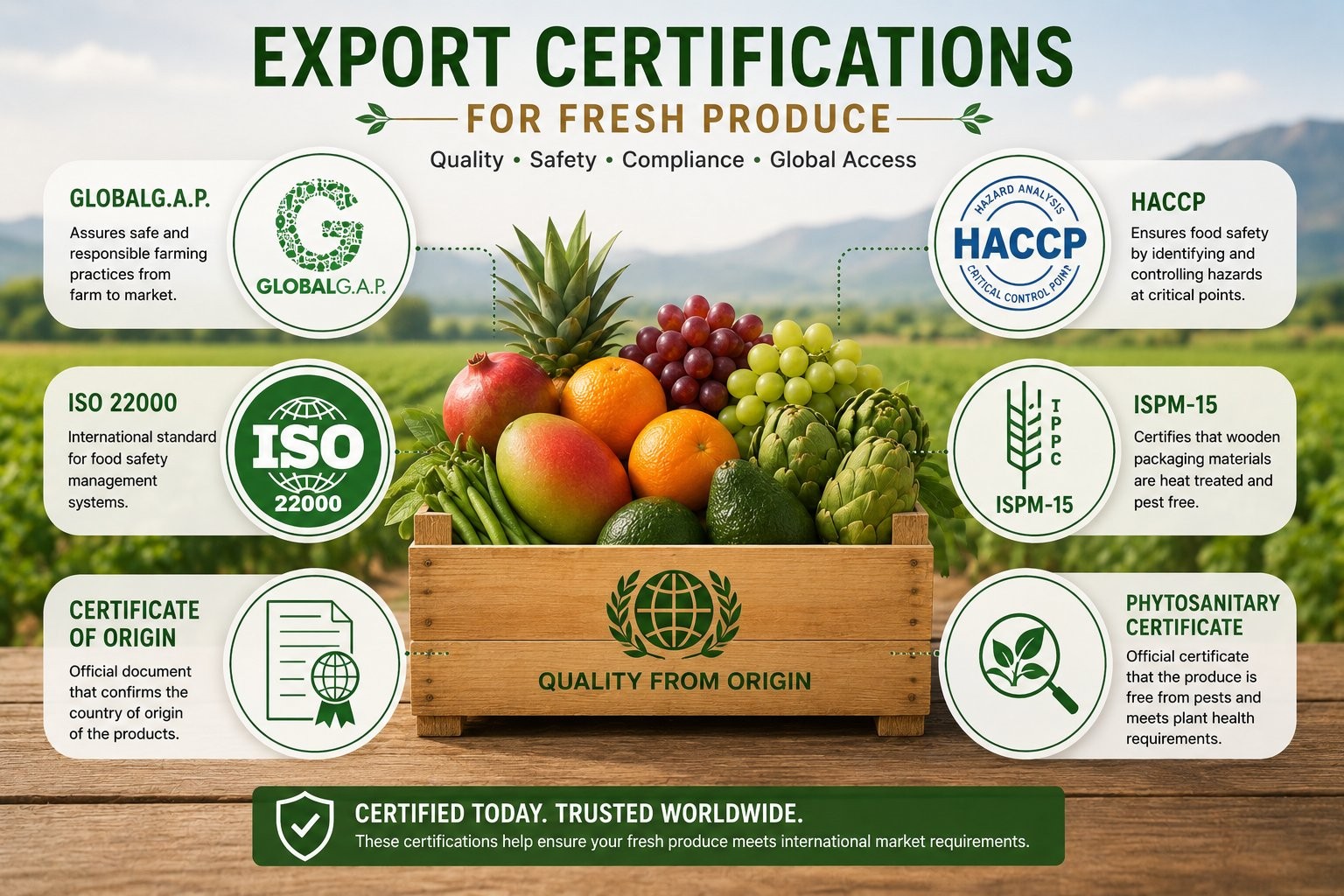
For fresh produce, export certifications do three jobs: they prove food safety (the produce is safe to eat), they prove traceability (every lot can be traced to its farm), and they satisfy regulatory entry (customs and plant-protection rules). Missing the right certification can stop a shipment at the border or disqualify a supplier before negotiations even start.
| Certification | What it covers | Typically required by |
|---|---|---|
| GLOBALG.A.P | Good agricultural practice — food safety, traceability, environment, worker welfare | EU / UK retailers & importers |
| HACCP | Hazard analysis for safe handling and packing | Importers, food authorities |
| ISO 22000 | Organisation-wide food-safety management system | Importers, large buyers |
| ISPM-15 | Heat-treated or fumigated wood packaging (pallets) | Customs (most countries) |
| Certificate of Origin | The country where the goods were produced | Customs, trade agreements |
| Phytosanitary Certificate | Official confirmation the consignment is free of quarantine pests | Importing plant-protection authorities |
PEI Trade. “Export Certifications for Fresh Produce.” PEI Trade Export Knowledge Base. https://peitrade.com/knowledge-base/certifications/
The main ones are GLOBALG.A.P (farm-level good agricultural practice), HACCP and ISO 22000 (food-safety management), ISPM-15 (wood packaging), and the shipment documents Certificate of Origin and Phytosanitary Certificate.
It is not a legal requirement, but most European and UK retailers require GLOBALG.A.P certification as a baseline before they will buy fresh produce.
HACCP is a food-safety method based on identifying and controlling hazards, while ISO 22000 is a broader food-safety management system for the whole organisation that incorporates HACCP principles.
A phytosanitary certificate is an official document issued by the exporting country’s plant-protection authority confirming that the consignment was inspected and is free of quarantine pests and diseases.