Address
Work Hours
Monday to Friday: 7AM - 7PM
Weekend: 10AM - 5PM

Address
Work Hours
Monday to Friday: 7AM - 7PM
Weekend: 10AM - 5PM



Key definition: Fresh produce for export is graded into quality classes — Extra, Class I and Class II under EU marketing standards — and sized by diameter, weight, or count per carton. Citrus is sized by fruit diameter (oranges have a 53 mm minimum; mandarins and lemons 45 mm) or by count per carton, while mango is graded by fruit weight and count. Each class sets the allowed defect tolerance, and a 10% size tolerance applies across all classes.
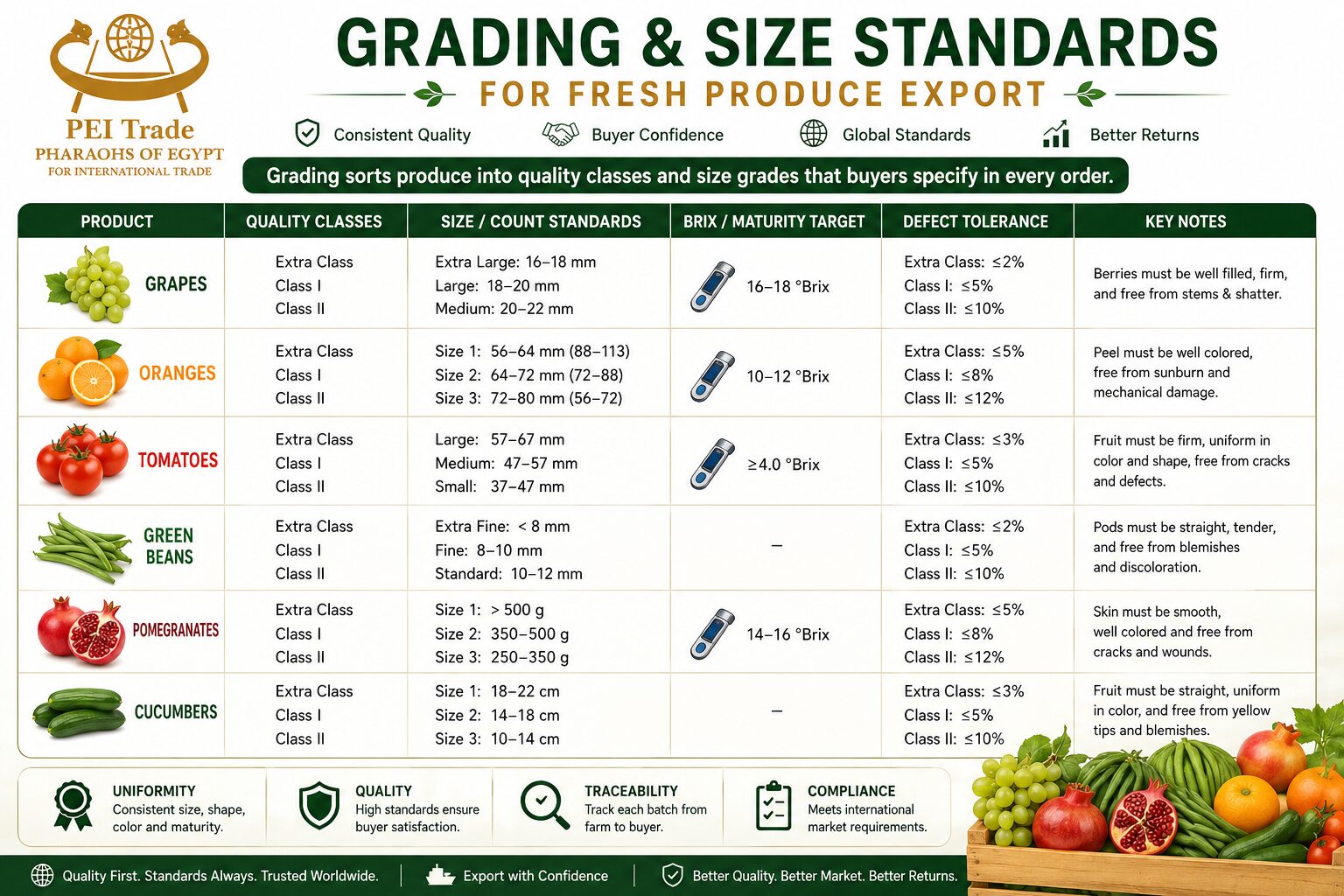
Grading is the sorting of harvested produce into uniform lots by quality and size so that buyers know exactly what they are purchasing. International trade in fruit and vegetables follows recognised marketing standards — principally the EU marketing standards under Commission Implementing Regulation (EU) No 543/2011, the Codex Alimentarius commodity standards, and the UNECE standards. These define quality classes, sizing methods, maturity, and the tolerances allowed at each marketing stage.
For an exporter, grading determines price, market access, and buyer satisfaction. A retail chain in the EU will specify a quality class and a size count; a juice processor will accept wider grades. This page summarises the grading framework for the produce Egypt exports most, and links to our product guides for variety-specific detail.
Under EU marketing standards, fresh produce is graded into three classes. The class determines how much visual imperfection is permitted while the fruit still retains its essential quality, keeping quality, and presentation.
| Class | Quality Level | Defects Allowed | Typical Use |
|---|---|---|---|
| Extra | Superior quality | Virtually none; only very slight superficial defects | Premium retail, quality-focused markets |
| Class I | Good quality | Slight defects in shape, colour or skin permitted | Mainstream supermarket retail |
| Class II | Marketable quality | More skin blemishes and shape variation; still sound | Wholesale, food service, processing |
Citrus is sized by the maximum diameter of the equatorial section of the fruit, or by count per carton. The EU assigns size codes referenced to diameter; in practice, importers order by count (the number of fruit in a standard carton). Smaller counts mean larger fruit.
| Citrus | Minimum Diameter (EU) | Typical Export Counts | Sizing Basis |
|---|---|---|---|
| Oranges | 53 mm | 36–113 per 15 kg carton | Diameter / count; EU size codes 0–10 |
| Mandarins & Clementines | 45 mm | Count per 10 kg carton | Diameter / count; EU size codes 1–10 |
| Lemons & Limes | 45 mm | Count per carton | Diameter / count |
| Grapefruit | Sized by diameter / count | Count per carton | Diameter / count |
For variety-by-variety specifications, sizing, and Brix detail, see our Complete Guide to Egyptian Citrus Export. The exact EU size-code to diameter table is set out in Annex I of Regulation 543/2011.
Mango is graded by fruit weight and by count per carton rather than by diameter. A standard 4 kg export carton holds a fixed count, and the count corresponds to an average fruit-weight band. Smaller counts mean larger fruit.
| Count (per 4 kg carton) | Approx. Fruit Weight | Size Grade |
|---|---|---|
| 6–7 | 550–650 g | Extra large |
| 8–9 | 450–550 g | Large |
| 10–12 | 330–450 g | Medium |
| 14–16 | 250–330 g | Small |
Mango grading also accounts for maturity, skin finish, and freedom from latent defects. See our Egyptian Mango Export Guide and Egyptian Mango Export Requirements for variety-specific grades and handling.
Brix measures total soluble solids (mainly sugars) and is a key maturity and sweetness indicator. Under EU standards, citrus maturity is defined by minimum juice content and a sugar-to-acid ratio rather than Brix alone, but commercial buyers commonly set Brix targets. The figures below are typical commercial targets, not regulatory minimums.
| Produce | Typical Brix Target | Notes |
|---|---|---|
| Oranges | 10–13° | EU also requires min. juice content & sugar/acid ratio |
| Mandarins | 10–12° | Sweet, easy-peel preferred |
| Mangoes | 12–16° | Rises during ripening; harvested mature-green |
| Table Grapes | 16–18° | Min. ~16° for export quality |
| Pomegranates | 15°+ | High Brix with balanced acidity |
| Strawberries | 7°+ | Flavour-driven; varies by variety |
| Watermelons | 10°+ | Key acceptance criterion |
Standards allow a defined percentage of a lot to fall short of its stated class or size — recognising that perfect uniformity is impossible. For citrus under Reg 543/2011:
In all classes the produce must be sound, clean, free of decay, pests, and abnormal external moisture. The exact tolerances differ slightly by commodity and standard.
To request produce to a specific class, size, and Brix specification, contact our export team at [email protected].
Under EU marketing standards, fresh produce is graded into three classes: Extra (superior quality, virtually no defects), Class I (good quality, slight defects allowed), and Class II (marketable quality with more blemishes). All classes must be sound, clean, and free of decay.
Oranges are sized by the maximum equatorial diameter or by count per 15 kg carton, with a 53 mm minimum diameter under EU standards. Popular export sizes are counts 48, 56 and 64 — a smaller count means larger fruit.
Mango is graded by fruit weight and count per 4 kg carton rather than by diameter. For example, a count of 6–7 corresponds to extra-large fruit of roughly 550–650 g, while a count of 14–16 is small fruit of around 250–330 g.
Brix targets vary by crop: roughly 10–13° for oranges, 12–16° for mangoes, 16–18° for table grapes, and 7°+ for strawberries. These are typical commercial targets; EU citrus maturity is defined by juice content and sugar-to-acid ratio rather than Brix alone.
Under EU citrus standards a total size tolerance of 10% by number or weight is allowed — fruit one size larger or smaller than the marked size. Within a package the diameter range is also limited (for example a maximum 10 mm spread for fruit under 60 mm).
PEI Trade. “Grading & Size Standards for Fresh Produce Export.” PEI Trade Export Knowledge Base. https://peitrade.com/knowledge-base/grading-size-standards/