Address
Work Hours
Monday to Friday: 7AM - 7PM
Weekend: 10AM - 5PM

Address
Work Hours
Monday to Friday: 7AM - 7PM
Weekend: 10AM - 5PM


Egypt's fig harvest peaks in August. Varieties, export grades, punnet and flat packing, pallet counts, cold chain settings and the documents that travel with each shipment.
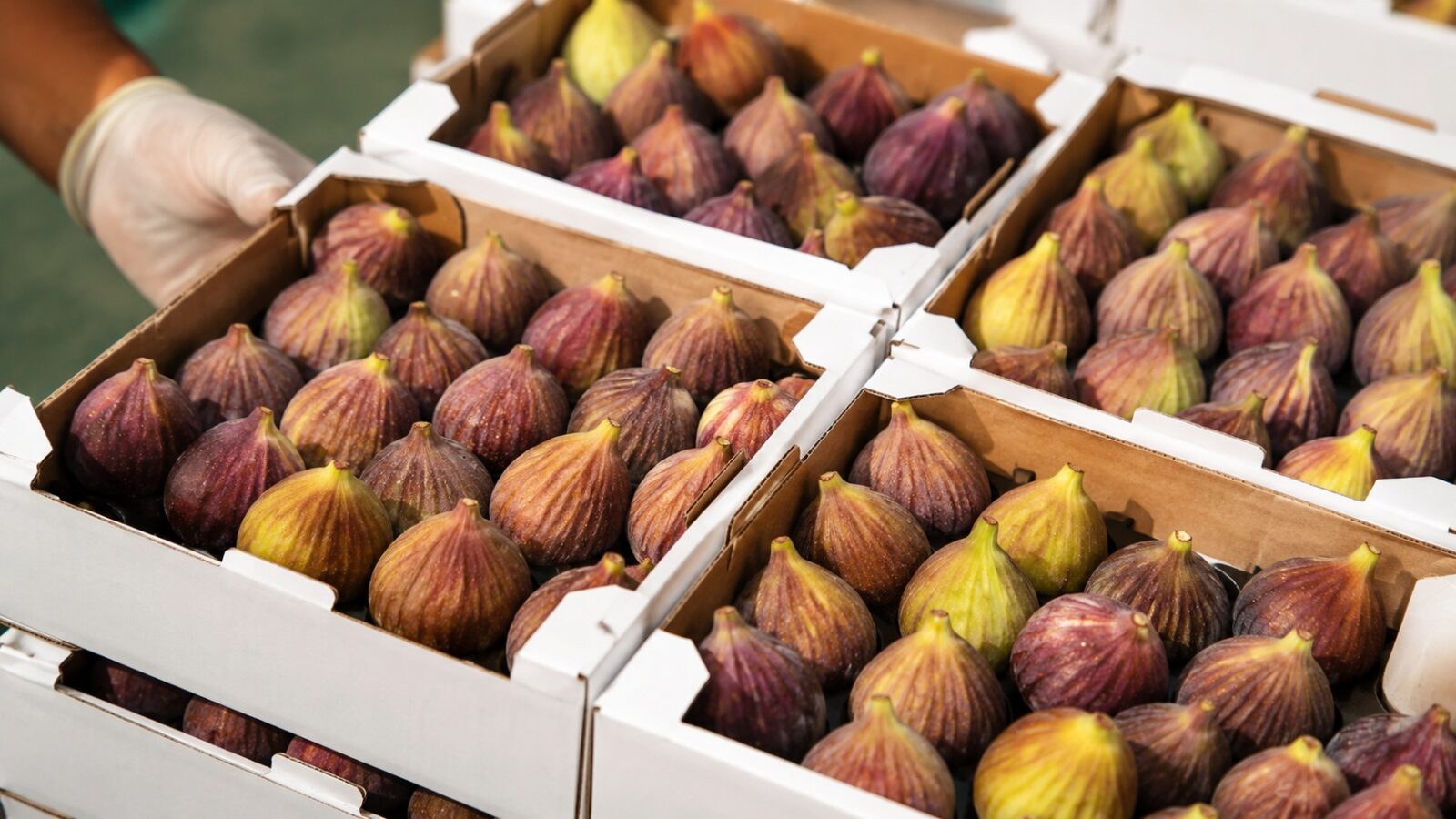
Egypt’s fig harvest reaches its heaviest weeks in August, and buyers taking volume this month are usually booking against fruit picked the same morning. Fig does not tolerate delay. That makes the commercial conversation shorter and far more precise than it is for citrus, onion or potato, where a few days either way changes very little. Below is the specification our export desk works to for the 2026 season.
Sultani accounts for the large majority of Egypt’s exportable fresh fig. It carries a green to yellow-green skin with pink to amber flesh, and it holds its shape better through handling than most local selections. Darker-skinned types, grouped commercially as Aswad, move in smaller volumes and are usually sold on specific request rather than offered as a standing programme.
The commercial window opens in late June and closes in early October. Supply is heaviest and most consistent from the first week of August through mid-September, which is where most export programmes sit. Fruit from the shoulder weeks tends to run smaller, with more variation in ground colour, and it should be quoted separately rather than blended into a main-season offer.
Fresh fig is graded on diameter and weight rather than count per carton. Export grade normally falls between 45 and 70 mm equatorial diameter, with individual fruit weights of roughly 45 to 90 grams. Class I permits slight skin marking and minor variation in colour, provided the fruit is intact and the neck is dry. Splitting at the ostiole is the single most common reason for downgrade, followed by pressure marks from over-filled punnets.
Soluble solids on properly matured export fruit generally read between 16 and 20 Brix. Anything picked below that range arrives soft without ever tasting sweet, which is why harvest timing matters more here than in almost any other Egyptian fruit category.
Two formats cover most orders. The first is a single-layer plastic punnet of 250 or 500 grams, with 8 or 12 punnets per vented carton, giving a net weight of 2 to 3 kilograms. The second is a single-layer flat with a foam or moulded pad, netting 1.5 to 2 kilograms, which suits wholesale markets that repack at destination.
Cartons are vented on all four sides and stacked with corner posts. Depending on carton height, a Euro pallet takes roughly 100 to 140 cartons in 10 to 12 tiers. Because the pack is light and the fruit is fragile, we do not build to the container ceiling. Stability is worth more than a few extra cartons.
Field heat has to come out fast. Our standard is forced-air precooling within four hours of picking, down to a pulp temperature of 0 to 1 degree Celsius, at 90 to 95 percent relative humidity. Held at that setting, fresh fig gives roughly 10 to 14 days of usable life from harvest.
That figure decides the mode. Air freight from Cairo is the normal route for EU and UK buyers who need the fruit on shelf in good condition. Sea reefer works for Gulf destinations on short transit out of Alexandria or Damietta, and it is worth reading our notes on reefer container loading and set points by crop before fixing a booking. Buyers running summer soft fruit alongside fig may also want our guava export guide, since the two categories share handling constraints.
Every shipment travels with a phytosanitary certificate, certificate of origin, commercial invoice and packing list. Farms supplying our fig programme are GLOBALG.A.P certified, and residue testing against the destination market’s MRL list is run before loading. Third party pre-shipment inspection by SGS or Intertek is available on request and is booked at the buyer’s instruction.
Fig allocation moves quickly during peak weeks. If you need a specific pack format or a fixed weekly quantity through September, send us the destination, the format and the volume and we will confirm availability the same day. Reach the export desk on WhatsApp at +20 10 9911 1918.
