Address
Work Hours
Monday to Friday: 7AM - 7PM
Weekend: 10AM - 5PM

Address
Work Hours
Monday to Friday: 7AM - 7PM
Weekend: 10AM - 5PM


Egyptian guava moves from August through December. Varieties, sizing, carton formats, reefer set points and booking lead times for importers in the Gulf and beyond.
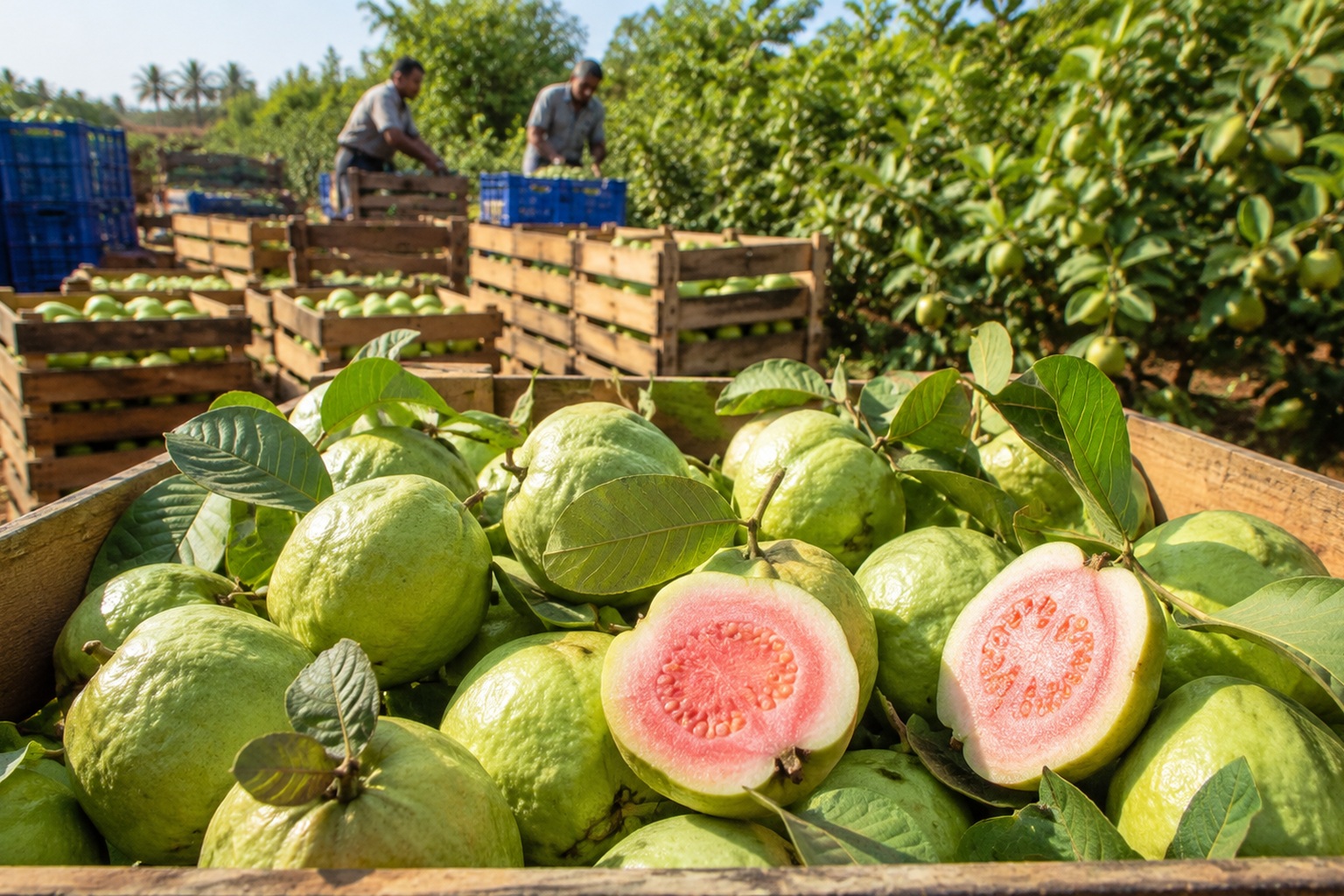
Guava is one of the shorter windows on the Egyptian export calendar, and it arrives just as the mango programme starts winding down. First commercial volumes come off the trees in the second half of August, the peak sits through September and October, and late orchards in the Delta and Ismailia keep supply running into December. Buyers who wait until the fruit is already on the ground usually find that the best grades are committed. Contracting in July and early August is the difference between a planned programme and a scramble.
Egypt grows both white-flesh and pink-flesh guava. White types, mainly the local Balady selections and improved white strains, dominate export volume. They hold firmer, carry better on a 20 to 25 day sea leg, and suit Gulf retail where the fruit is sold by the piece. Pink-flesh guava has a stronger aroma and softer texture, which makes it better suited to short-haul markets or air freight into premium retail. If you are shipping by sea to Jeddah, Jebel Ali or Doha, white flesh is normally the correct call.
Export selection targets fruit that is uniform in colour break, free of scarring, and picked at the light-green to first-yellow stage rather than fully coloured. Fully coloured fruit will not survive a sea transit.
| Spec | Detail |
|---|---|
| Grade | Class I (a grade tier from the applicable marketing standard, not a marketing term — see our Extra, Class I and Class II tolerances reference) and Class II, sorted by defect and shape uniformity |
| Fruit weight | 150 to 250 g typical export band, 250 g plus on request |
| Carton | 4 kg and 5 kg single-layer telescopic, tray or foam net per fruit |
| Pallet | Approximately 240 cartons of 4 kg per euro pallet, 20 pallets per 40ft reefer |
| Reefer set point | 8 to 10 C, 90 to 95 percent relative humidity, moderate ventilation |
Do not let a forwarder set guava at citrus temperatures. Below roughly 7 C the fruit picks up chilling injury that shows up as pitting and failure to ripen after arrival. Guava also responds to ethylene from other fruit, so it should not share a container with ripening mango or banana. Where a buyer wants a mixed autumn load, guava pairs better with pomegranate than with any climacteric fruit.
We load from Alexandria, Damietta and Port Said depending on the sailing. Transit to Jeddah and Jebel Ali is typically 7 to 12 days, to Northern Europe 12 to 16 days. Terms are quoted on FOB, CFR or CIF under Incoterms 2020. Every shipment travels with a phytosanitary certificate, certificate of origin, packing list and commercial invoice, and residue analysis or third-party inspection by SGS or Intertek is available on request. If you are new to Egyptian paperwork, our note on export documentation for Egyptian produce covers what each document should say before you release payment.
Weekly volumes are more useful to both sides than a single spot container. A programme of one to three reefers per week from early September lets us reserve orchard blocks and packhouse slots, and it smooths your landed cost across the season. Buyers running an autumn fruit rotation often follow guava straight on from the late Keitt shipments described in our late July mango season update.
To request current guava pricing, size availability and a proposed loading calendar, message our export desk on WhatsApp at +20 10 9911 1918. Send your destination port, preferred carton format and target weekly volume, and we will come back with a quotation and an inspection plan.
