Address
Work Hours
Monday to Friday: 7AM - 7PM
Weekend: 10AM - 5PM

Address
Work Hours
Monday to Friday: 7AM - 7PM
Weekend: 10AM - 5PM


Egyptian guava moves from August to December, with peak volume in September and October. Varieties, size grades, carton formats, pallet configuration, temperature limits and shipping options for importers and wholesalers.
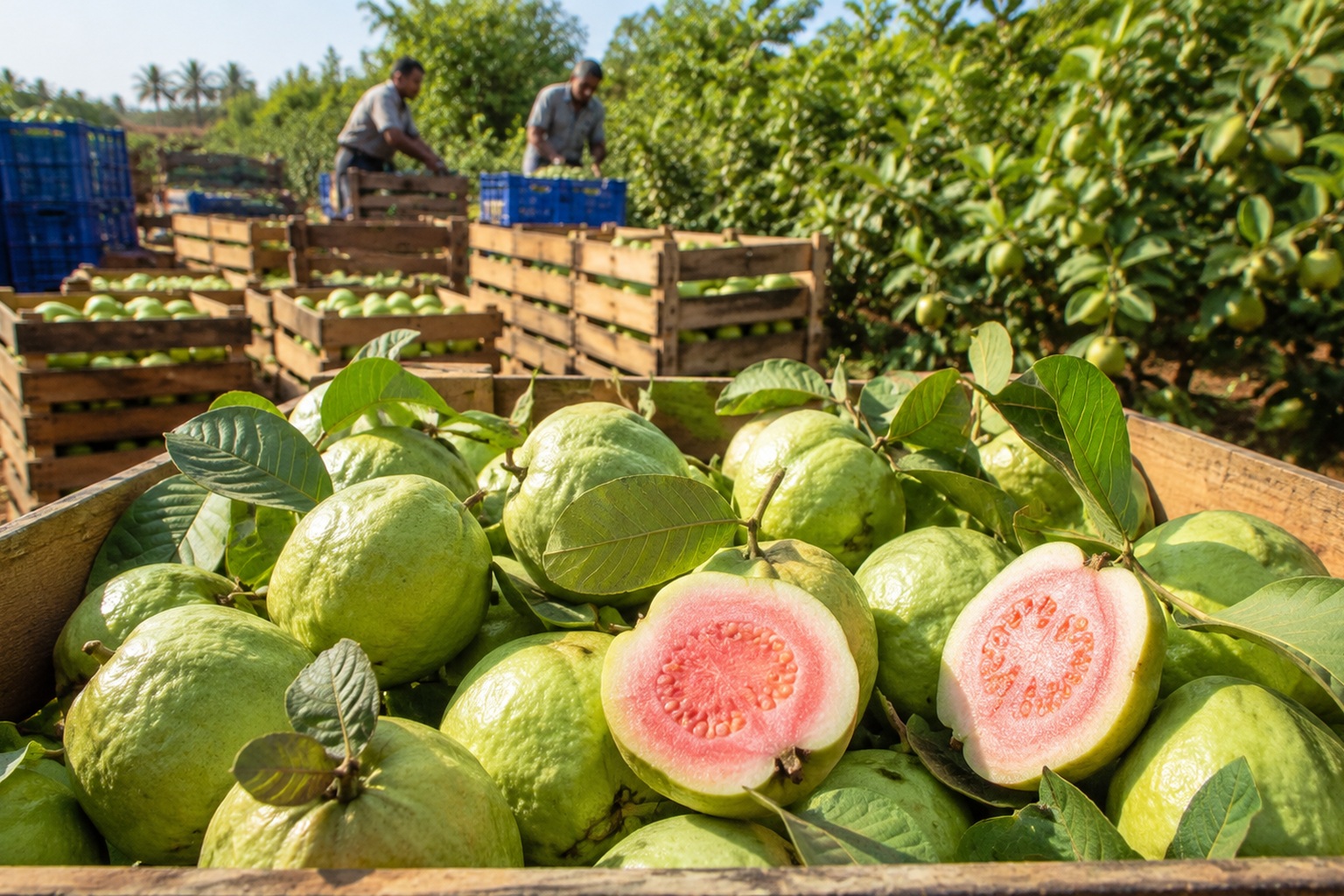
Guava is one of the crops that fills the awkward stretch of the Egyptian calendar between the end of stone fruit and the opening of citrus. Harvest starts in the second half of August, builds through September, and holds volume into November, with a lighter tail running to late December depending on the growing area and the season’s temperatures. Buyers planning autumn programmes should be talking to suppliers now, because the strongest sizing and the cleanest fruit come out of the September and October picks.
Most Egyptian export guava is white-fleshed Baladi type, grown in Qalyubia, Sharqia, Beheira and the reclaimed desert areas west of the Delta. Fruit is round to slightly pear-shaped, thin-skinned, and turns from deep green to a pale yellow-green as it matures. Red-fleshed selections exist but move mainly into the domestic and processing trade, so unless a buyer has specifically contracted red flesh, assume white.
Export fruit is picked at the mature green to breaker stage. Picked any riper, guava will not survive a fourteen to twenty day transit in acceptable condition. Brix on export lots typically sits between 9 and 12 degrees, and firmness at packing should be high enough that the fruit does not yield under thumb pressure.
Guava is sold by piece weight rather than by count in most Egyptian export contracts. The common bands are 150 to 200 g, 200 to 250 g, 250 to 300 g, and 300 g and above. Gulf wholesale markets tend to pull the 200 to 300 g range. Eastern European and Russian buyers often accept a wider band and price accordingly.
Class I (a grade tier from the applicable marketing standard, not a marketing term — see our Extra, Class I and Class II tolerances reference) tolerances allow slight skin blemish and minor shape variation but no bruising, no fruit fly sting marks, and no visible anthracnose lesions. Fruit fly damage is the single most common reason a guava lot is downgraded, so a field programme and a careful sorting line matter more here than on most crops.
Standard export packing is a 4 kg single-layer open-top carton with a moulded pulp tray or individual foam net sleeves, which keeps the thin skin off neighbouring fruit. Some Gulf buyers prefer a 5 kg two-layer carton with a corrugated divider. Cartons are ventilated on the sides and stacked on Euro pallets at 1200 by 800 mm or on 1200 by 1000 mm ISPM 15 heat-treated pallets, depending on destination.
A typical Euro pallet build runs 10 cartons per layer and 14 to 16 layers, corner-stacked and strapped with two horizontal bands plus corner protectors. A 40 ft high cube reefer takes 20 Euro pallets in a straight stow.
Guava is chilling sensitive. Carrying below 7 degrees Celsius produces pitting, dull skin and failure to ripen on arrival, and the damage does not show until the container is opened. The working range is 8 to 10 degrees Celsius with 90 to 95 percent relative humidity and moderate fresh air exchange to vent carbon dioxide. Our wider guidance on reefer set points by crop covers how these figures interact with mixed loads.
Sea freight to Jeddah or Jebel Ali runs about seven to ten days from Alexandria or Damietta, which suits guava well. Northern European and Russian routings of eighteen to twenty-five days are workable on early-picked fruit but tighter, and some buyers move first arrivals by air to open the season. Port selection changes both transit and cost, and is worth reviewing against the notes in our guide to choosing between Alexandria, Damietta, Port Said and Sokhna.
Every shipment travels with a phytosanitary certificate from the Egyptian Central Administration of Plant Quarantine, a certificate of origin, and residue documentation matched to the destination limits. Third party inspection by SGS or Intertek is available on request and is worth budgeting for on a first shipment with a new counterparty.
Guava volumes out of Egypt are smaller than citrus or onion, and packhouse capacity for single-layer tray packing is limited during the September peak, when mango tail volume is still moving through the same lines. Buyers who confirm quantities and pack format in August generally get their fruit; buyers who call in late September are working with whatever is left.
To request specifications, sizing availability and a quote on FOB, CFR or CIF terms under Incoterms 2020, contact the PEI Trade export desk on WhatsApp at +20 10 9911 1918.
