Address
Work Hours
Monday to Friday: 7AM - 7PM
Weekend: 10AM - 5PM

Address
Work Hours
Monday to Friday: 7AM - 7PM
Weekend: 10AM - 5PM


A crop by crop guide to reefer temperature, relative humidity and fresh air ventilation settings on Egyptian produce shipments, and what importers should specify on the booking.
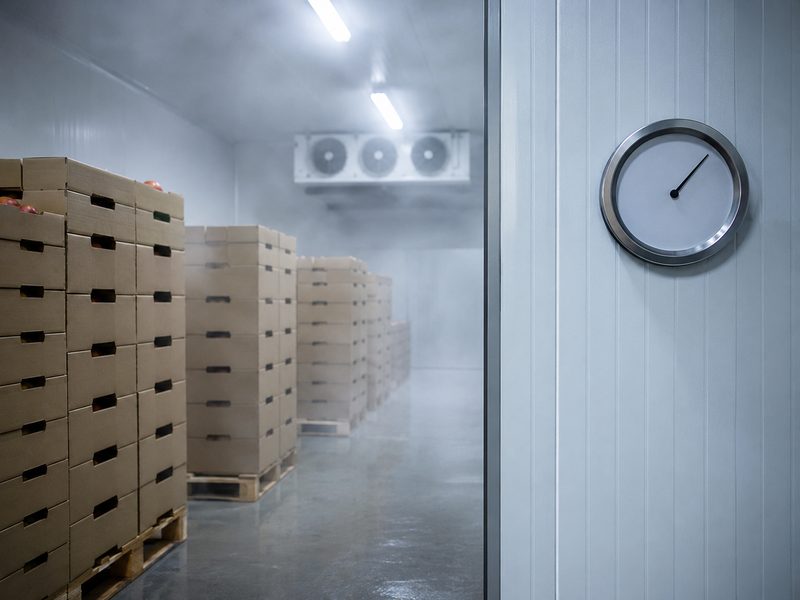
Most arrival quality problems on Egyptian produce are not caused by the fruit. They are caused by a set point that was copied from the previous booking. A reefer carries one temperature, one humidity target and one ventilation rate for the whole voyage, and the wrong combination will cost more than any grading dispute. This is the working reference our shipping desk uses when a buyer asks what to put on the booking note.
The figures below are carriage temperatures for sound fruit loaded at pulp temperature after proper pre-cooling. They are not pull-down instructions. A reefer is designed to hold a temperature, not to remove field heat from a warm pallet.
| Product | Set point | Relative humidity | Fresh air exchange |
|---|---|---|---|
| Valencia and Navel oranges | 4 to 5 C | 90 to 95 percent | 15 to 25 cbm per hour |
| Mandarins and easy peelers | 5 to 7 C | 90 to 95 percent | 15 to 20 cbm per hour |
| Mango, Keitt and Kent | 10 to 12 C | 85 to 90 percent | 20 to 25 cbm per hour |
| Pomegranate, Wonderful and 116 | 5 to 7 C | 90 to 95 percent | 10 to 15 cbm per hour |
| Table grapes | 0 to 1 C | 90 to 95 percent | closed |
| Onion, dry yellow and red | 1 to 4 C | 65 to 70 percent | 30 cbm per hour or higher |
| Potato, ware and processing | 5 to 8 C | 90 to 95 percent | 20 to 30 cbm per hour |
| Sweet potato, cured | 13 to 14 C | 85 to 90 percent | 15 to 20 cbm per hour |
| Green beans and snap peas | 7 to 8 C | 90 to 95 percent | 15 to 20 cbm per hour |
| IQF strawberry, okra, molokhia | minus 18 C or colder | not applicable | closed |
Chilling injury is the first. Mango held below 9 C for a long Atlantic or Far East transit arrives with grey lenticel spotting and flesh that never ripens evenly. Sweet potato below 12 C develops internal hardcore. Buyers sometimes ask for a colder set point believing it buys shelf life. On tropical and subtropical crops it does the opposite.
Ventilation is the second. Onions loaded at high humidity with closed vents will sweat and neck rot will appear within ten days. Citrus and mango both respire and produce carbon dioxide and ethylene, so vents stay open. Frozen loads and table grapes under sulphur pads run closed, and opening them wastes energy and destabilises the box temperature.
The third is pre-cooling. A pallet loaded at 26 C pulp into a reefer set at 5 C will take three to four days to reach set point, and the top layers of the outer cartons will already have lost condition. Forced air pre-cooling to within two degrees of the carriage temperature before stuffing is the only reliable answer. Ask for the pulp temperature at stuffing to be recorded on the loading report.
State the set point in Celsius, the humidity target, the fresh air exchange rate in cubic metres per hour, and whether controlled atmosphere is required. Add a temperature logger inside the load, positioned in the middle of a pallet rather than by the doors, and request the download at discharge. If the load is mixed, confirm that every product in the container tolerates the same temperature before the booking is placed.
Set points interact with routing. A fourteen day sailing gives less margin for error than a five day run to Jeddah, which is why the choice of load port matters. Our guide to Egyptian export ports for 2026 compares transit times from Alexandria, Damietta, Port Said and Sokhna. Availability windows by crop are set out in the 2026/2027 Egyptian produce export calendar.
PEI Trade supplies 35 crops for export with pre-cooling records, pulp temperature logs and third party inspection by SGS or Intertek on request. To discuss set points for a specific route and product, message our export desk on WhatsApp at +20 10 9911 1918.
