Address
Work Hours
Monday to Friday: 7AM - 7PM
Weekend: 10AM - 5PM

Address
Work Hours
Monday to Friday: 7AM - 7PM
Weekend: 10AM - 5PM



 ByHager
Egyptian oranges ready to import are now available through PEI Trade, your trusted partner for premium citrus exports from Egypt’s finest growing regions. With over 15 years serving EU, Russian, Chinese, and Southeast Asian markets, we’ve successfully shipped more than 50,000 metric tons of certified fresh citrus to discerning importers worldwide.
This comprehensive guide provides current availability, detailed specifications, and everything you need to confidently source Egyptian oranges for the 2026 season.
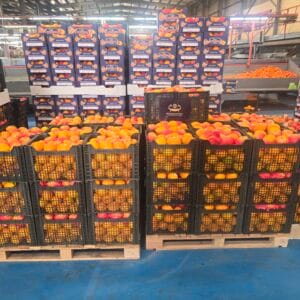
PEI Trade has premium Navel oranges at peak harvest with exceptional quality metrics. Our packing houses in Beheira and Ismailia governorates are operating at full capacity, processing fruit that meets export-grade specifications for international markets.
December 2025 – February 2026: Premium Navel Oranges
January 2026 – May 2026: Valencia Oranges (Pre-booking Open)
Our agronomists conduct weekly field assessments across our network of certified farms, monitoring fruit development, sugar accumulation, and maturity indices. This enables us to provide accurate availability forecasts and guarantee fruit quality specifications before you commit to purchase.
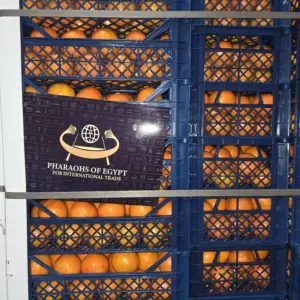
Egyptian Navel oranges represent the premium tier of citrus exports, prized by importers for their seedless convenience, excellent eating quality, and extended shelf life characteristics.
Harvest Window: November through February (peak quality: December-January)
Physical Characteristics:
Quality Specifications:
Packaging Specifications: We utilize internationally recognized carton standards that protect fruit integrity during transit while maximizing container utilization:

While Navel oranges dominate the fresh market, Egyptian Valencia oranges serve the dual purpose of fresh consumption and industrial juice processing, offering importers flexibility based on market conditions.
Harvest Window: January through May (optimal quality: February-April)
Physical Characteristics:
Quality Specifications:
Egyptian orange pricing reflects multiple variables that importers should understand for effective procurement planning.
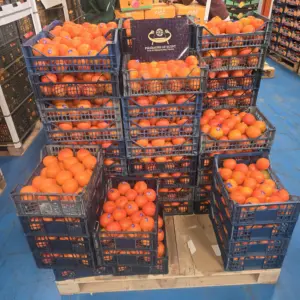
Successful citrus importing requires meticulous cold chain management and logistics coordination. PEI Trade’s operational infrastructure ensures fruit arrives in optimal condition.
Alexandria:
Port Said:
Egypt’s citrus industry includes hundreds of exporters, making supplier selection critical for long-term success. Here’s what distinguishes PEI Trade from competitors.
Unlike brokers who source from multiple farms with inconsistent practices, PEI Trade maintains direct relationships with 12 certified farms across Egypt’s primary citrus regions. This enables:
Our customer portal provides real-time information:
PEI Trade’s financial standing enables flexible payment terms:
Our banking relationships with Egyptian commercial banks (Commercial International Bank, Banque Misr) ensure smooth transaction processing and USD/EGP exchange execution without delays.
Despite rigorous quality control, occasional issues arise in international trade. PEI Trade’s approach:
Claims Process:
Historical Performance:
PEI Trade provides clients with quarterly market reports including:
This intelligence enables importers to make strategic purchasing decisions, optimizing procurement timing and volume commitments.
Starting a supply relationship with PEI Trade is straightforward.
Contact our export sales team via:
Within 24 business hours, you’ll receive:
Upon your acceptance:
As your shipment date approaches:
Throughout transit:
New to Egyptian citrus importing? PEI Trade provides:
Egyptian oranges combine exceptional quality, competitive pricing, and strategic seasonal timing that fills critical supply gaps in global markets. PEI Trade’s comprehensive certifications, transparent operations, and customer-first approach eliminate the typical risks associated with sourcing from new suppliers.
Contact our export sales team today:
Phone: +201099111918
WhatsApp: +201099111918
Online Form:Oranges
Importing oranges from Egypt starts with selecting a certified supplier like PEI Trade who handles export documentation and quality compliance. You’ll need to arrange payment terms (Letter of Credit or Cash Against Documents for first orders), specify your quality requirements and destination port, and coordinate with a customs broker in your country. We provide complete documentation packages including phytosanitary certificates, certificates of origin, packing lists, and commercial invoices. First-time importers receive additional support including market requirement briefings and quality inspection protocol guidance.
Yes, Egyptian oranges are currently ready to import. Navel oranges are available from November through February with peak quality in December-January. Valencia oranges become available from January through May. As of December 2025, we have premium Navel oranges with 12.2-12.8° Brix ready for immediate loading with 7-10 day lead time from order confirmation. Weekly vessel departures are available from Alexandria and Port Said ports.
You can source Egyptian oranges wholesale directly from certified exporters like PEI Trade. We offer FOB pricing from Alexandria and Port Said ports, with minimum orders of one 40ft reefer container (approximately 13,440-23,100kg depending on carton size). Wholesale buyers benefit from volume discounts for contract programs of 20+ containers per season. Contact our export sales team through this form for current wholesale pricing and availability.
The minimum order is one 40ft reefer container. This equals approximately 1,540-1,680 cartons depending on whether you choose 15kg or 8kg packaging. We do not consolidate shipments from multiple buyers to maintain traceability and quality control standards. For large retail chains or distributors, we recommend starting with 2-3 trial containers to verify quality before committing to larger seasonal programs.
All Egyptian oranges ready to import from PEI Trade meet international export grade standards with Global GAP and GRASP certifications. Navel oranges guarantee minimum 11° Brix (exceeding the EU minimum of 10°), while Valencia oranges guarantee minimum 12° Brix. We provide laboratory test certificates documenting brix levels, acidity ratios, and juice content from representative samples. Our quality control ensures maximum 5% minor blemishes per carton for premium grade, and fruit maintains eating quality for 35-45 days under proper cold storage.
Egyptian Navel oranges (November-February) are seedless, easier to peel, and command 15-25% retail price premiums, making them ideal for fresh retail markets. Valencia oranges (January-May) contain 5-12 seeds but offer superior juice content (48-52% vs 38-42%) and are preferred for juice extraction and markets where seeded oranges are acceptable. Navel varieties suit European and premium Asian markets, while Valencia works well in Southeast Asia, Middle East, and processing applications. Both varieties are certified and ready to import with complete documentation.
Legitimate Egyptian orange exporters must provide Global GAP certification for food safety compliance, phytosanitary certificates issued by Egypt’s CAPQ (Central Administration of Plant Quarantine), and certificates of origin. For EU markets, GRASP social compliance certification is increasingly required. For US shipments, FDA facility registration and FSMA compliance documentation are mandatory. PEI Trade maintains all these certifications with annual renewal and provides complete documentation packages with every shipment of Egyptian oranges ready to import.
Currently, PEI Trade does not maintain organic certification, though we’re developing organic production partnerships targeting 2026 season availability. Most Egyptian orange exports focus on conventional production with integrated pest management (IPM) protocols under Global GAP standards. If organic certification is critical for your market, contact us to be notified when certified organic Egyptian oranges become available, or we can connect you with the limited organic-certified suppliers in Egypt.
The total cost to import oranges from Egypt includes FOB product pricing (fruit, packing, inland transport to port, and export documentation), ocean freight (varies by destination: $1,500-3,500 per container depending on route), marine insurance (0.3-0.5% of cargo value), and destination port charges plus customs duties. FOB pricing fluctuates based on season, quality grade, variety, and volume commitments. Contact PEI Trade for current quotations specific to your destination and requirements. Early season (November-December) and late season (April-May) typically command premium pricing.
New importers typically use Letter of Credit (LC) or Cash Against Documents (CAD) payment terms for initial shipments. After 5+ successful shipments, established customers may qualify for 30-day open account terms subject to credit approval. Large-volume contracts offer customized payment structures including partial pre-payment with balance on delivery. We work with major Egyptian banks (Commercial International Bank, Banque Misr) to ensure smooth USD transaction processing.
No, standard FOB (Free on Board) pricing includes only product cost, packing house processing, packaging materials, inland transportation to Alexandria or Port Said port, port handling, container loading, and Egyptian export documentation. Ocean freight, marine insurance, and destination port charges are additional costs borne by the importer. We can also quote CIF (Cost, Insurance, Freight) pricing that includes ocean freight and insurance to your destination port for all-inclusive convenience.
Shipping times for Egyptian oranges vary by destination: Northern Europe (Rotterdam, Hamburg, Antwerp) takes 8-10 days, Mediterranean ports 5-7 days, UK 9-11 days, Russia (Novorossiysk) 7-9 days, UAE (Jebel Ali) 7-9 days, Singapore 14-16 days, China (Shanghai) 18-21 days, and Southeast Asia 16-19 days. All shipments travel in temperature-controlled reefer containers maintained at 5-7°C. Transit time begins from vessel departure, and we provide temperature data logs documenting cold chain integrity throughout the journey.
The optimal timing depends on variety: Navel oranges peak from December-January for best quality and availability, while Valencia oranges peak from February-April. For competitive pricing, January-March represents peak season with maximum availability and optimal wholesale pricing. Early season (November-December) and late season (April-May) command premium prices due to limited global supply. Egypt’s extended Valencia season into May fills a critical supply gap when Spanish and Moroccan competitors conclude their harvests.
Required documentation for importing Egyptian oranges includes: phytosanitary certificate (issued by Egypt’s CAPQ verifying pest-free status), certificate of origin (confirming Egyptian origin), commercial invoice (detailing product specifications and pricing), packing list (listing carton counts and weights), Bill of Lading (shipping document from carrier), and Global GAP certification (for retail buyers requiring food safety verification). For specific destinations, additional documents may include fumigation certificates, preferential tariff certificates (for countries with Egypt trade agreements), or halal certification for Islamic markets.
No, Egyptian fresh orange exports follow natural harvest seasons: November through May. Outside this window (June-October), Egyptian oranges are not available as fresh exports, though processed products (juice concentrate, frozen segments) remain available year-round. For continuous citrus supply, importers typically combine Egyptian oranges (November-May) with Southern Hemisphere suppliers like South Africa (July-November) to maintain year-round availability.
PEI Trade provides weekly availability updates showing current inventory levels, brix measurements, sizing distribution, and available loading slots. Our customer portal features “Live from the Packing House” updates during peak season, plus container booking system showing vessel schedules. Contact our export sales team at export@peitrade.com or +20 100-123-4567 (WhatsApp) for real-time availability confirmation. We guarantee 7-10 day lead time from order confirmation to loading during peak season.
Reliable Egyptian orange exporters demonstrate several key qualities: active Global GAP certification (verifiable at globalgap.org), membership with Egypt’s Agricultural Export Council (AEC), established banking relationships for smooth payment processing, temperature-controlled storage facilities at ports, and documented export history to your target market. Request references from current customers, verify certification numbers independently, and start with trial shipments before committing to large volumes. PEI Trade offers first-time importers complimentary pre-shipment samples and third-party inspection options.