Address
Work Hours
Monday to Friday: 7AM - 7PM
Weekend: 10AM - 5PM

Address
Work Hours
Monday to Friday: 7AM - 7PM
Weekend: 10AM - 5PM



Key definition: a Maximum Residue Limit (MRL) is the highest level of a pesticide residue legally permitted in or on food, set by each market’s authorities to protect consumers. To be imported, fresh produce must comply with the destination country’s MRLs — which is why exporters control which products are sprayed, respect the pre-harvest interval, and test residues before shipping.
For markets like the EU and UK, pesticide residues are one of the strictest gates a shipment must pass. A consignment that exceeds an MRL can be rejected at the border, destroyed, or trigger increased checks on future shipments. Meeting MRLs is therefore both a food-safety duty and a commercial necessity. This reference explains what an MRL is, how the limits differ by market, and how exporters keep produce safely within them. For the wider process, see how to import Egyptian produce.
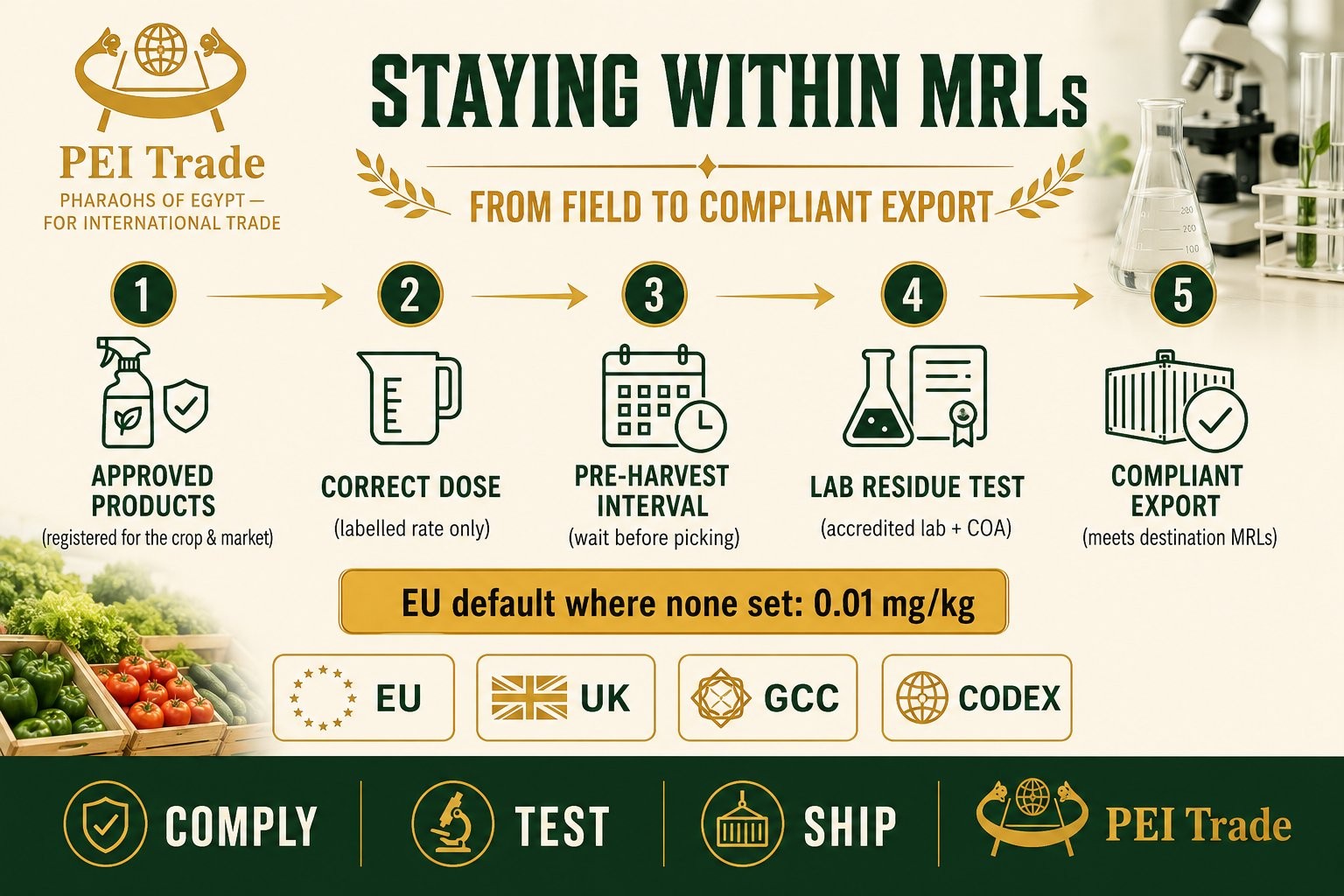
An MRL is set for a specific combination of a pesticide (active substance) and a crop, and is expressed in milligrams of residue per kilogram of produce (mg/kg). It is derived from supervised field trials and a dietary-safety assessment, so a residue at or below the MRL is considered safe to eat. MRLs are not a measure of how much pesticide was used — they are a legal ceiling on what may remain on the harvested crop. Where no specific MRL has been set, most markets apply a low default limit.
Every market sets its own MRLs, so the same fruit can be compliant in one country and not in another. Exporters check the limit for each active substance and crop in the destination market before shipping.
| Market | Framework | Authority |
|---|---|---|
| European Union | Regulation (EC) 396/2005; default 0.01 mg/kg where none is set | European Commission / EFSA |
| United Kingdom | Retained (GB) MRL regime | HSE |
| Gulf (GCC) | GSO standards | GSO / national authorities |
| United States | EPA tolerances | EPA / FDA |
| International reference | Codex MRLs (CXLs) | Codex Alimentarius |
Compliance is built in the field, not discovered at the lab. The core practices are:
Most EU retailers and many other buyers require a residue test from an ISO/IEC 17025-accredited laboratory before they accept produce. The result is summarised in a Certificate of Analysis (COA) listing the substances screened and the levels found against the destination market’s MRLs. The COA travels with the shipment alongside its other documents and certifications, and complements the pre-shipment inspection.
If a residue exceeds the limit, the consignment can be rejected or destroyed at the border. In the EU, the finding is posted on the Rapid Alert System for Food and Feed (RASFF), and repeated problems with a country or crop can trigger increased official controls, under which a set percentage of consignments is tested on arrival — adding cost and delay for every exporter of that crop. The safest commercial position is to stay comfortably below MRLs, not merely at them.
PEI Trade works with GLOBALG.A.P-certified growers, controls the approved-product list and pre-harvest intervals, and arranges accredited residue testing so produce meets the MRLs of its destination market — EU, UK, Gulf or beyond. To confirm the requirements for your market, contact the export desk at [email protected] or +20 109 911 1918, or see the export glossary and the full Export Knowledge Base.
PEI Trade. “Maximum Residue Limits (MRLs) and Pesticide Compliance for Produce Export.” PEI Trade Export Knowledge Base. https://peitrade.com/knowledge-base/mrls-pesticide-compliance/
An MRL is the highest level of a pesticide residue legally permitted in or on food. It is set by each market’s authorities to protect consumers, and produce must comply with the destination country’s MRLs to be imported.
Where no specific MRL has been set for a pesticide and crop combination, the EU applies a default limit of 0.01 mg/kg. Always check the EU pesticides database for the specific substance and crop.
By using only approved plant protection products at the labelled dose, respecting the pre-harvest interval, working to a GAP standard such as GLOBALG.A.P, and testing residues at an accredited laboratory before shipping.
The pre-harvest interval is the minimum time that must pass between the last application of a pesticide and harvest, set so residues fall to a safe level by the time the crop is picked.