Address
Work Hours
Monday to Friday: 7AM - 7PM
Weekend: 10AM - 5PM

Address
Work Hours
Monday to Friday: 7AM - 7PM
Weekend: 10AM - 5PM



Key definition: Egypt ships fresh produce from its Mediterranean ports — Alexandria, Damietta and Port Said — for Europe, the UK and the Mediterranean, and from the Red Sea port of Ain Sokhna for the Gulf and Asia. By sea reefer, typical transit runs from about 4–7 days to the western Mediterranean up to 3–4 weeks to the Far East, depending on the port, the destination and the service.
Choosing the right port and route is part of getting fresh produce to market in condition. Egypt has a strong geographic advantage: it sits on both the Mediterranean and the Red Sea, with the Suez Canal between them, so it can reach Europe, the Gulf and Asia efficiently. This reference lists Egypt’s main export ports, gives typical sea-freight transit times, and explains what affects them. For the wider process, see how to import Egyptian produce and the cold chain that protects produce in transit.
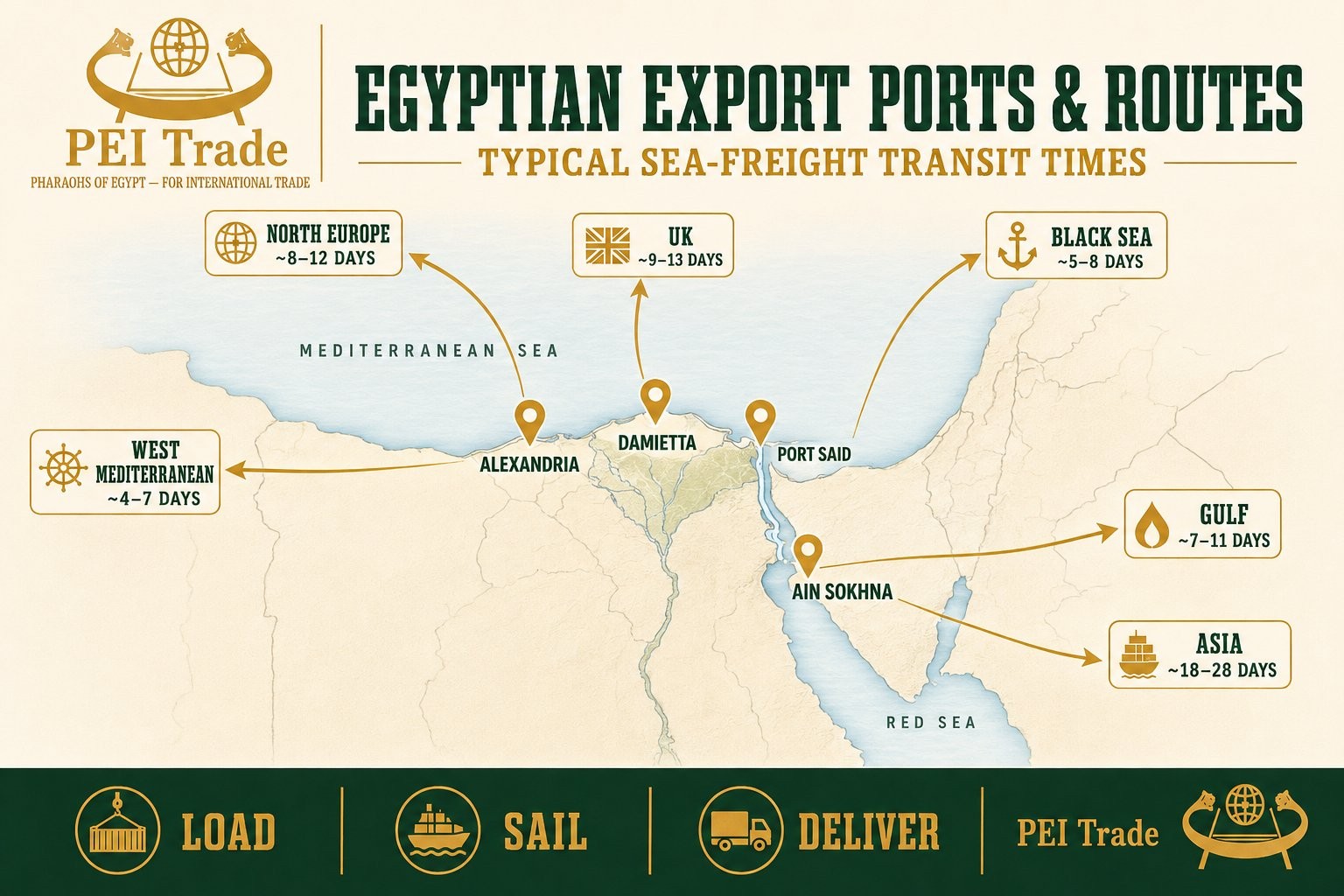
Four ports handle the bulk of Egypt’s fresh-produce exports, split between the Mediterranean and Red Sea coasts.
| Port | Coast | Best suited for |
|---|---|---|
| Alexandria / El Dekheila | Mediterranean | Europe, UK, Mediterranean |
| Damietta | Mediterranean | Europe and transshipment |
| Port Said (East) | Mediterranean, at the Suez Canal mouth | Europe and global transshipment |
| Ain Sokhna | Red Sea | Gulf, Asia, East Africa |
The figures below are approximate reefer transit times in normal conditions, from Egypt’s Mediterranean ports for European destinations and from Ain Sokhna for the Gulf and Asia.
| Destination | Typical transit (sea reefer) |
|---|---|
| Western Mediterranean (Italy, Spain) | ~4–7 days |
| North Europe (Rotterdam, Hamburg) | ~8–12 days |
| United Kingdom | ~9–13 days |
| Black Sea (Russia, Novorossiysk) | ~5–8 days |
| Gulf (Jebel Ali) | ~7–11 days |
| South & East Asia | ~18–28 days |
These are typical ranges only. Actual transit depends on the specific service and can change with routing conditions — for example, vessels re-routing away from the Red Sea — so always confirm the current schedule and transit time with the shipping line before you plan.
Three things usually decide the port: the destination (Mediterranean ports for Europe; Ain Sokhna on the Red Sea for the Gulf and Asia, which avoids a Suez Canal transit); the reefer service frequency on the lane, since a more frequent service means less waiting and fresher arrival; and proximity to the growing region, which shortens the inland leg and keeps the cold chain tighter. The Incoterm agreed with the buyer also sets who chooses the port and books the freight.
Transit time is rarely a single fixed number. It depends on whether the service is direct or routed through a transshipment hub (where the container changes vessel), the sailing schedule and frequency, the specific port pair, and broader routing conditions that can lengthen some lanes. Building a realistic transit window into the plan — and pre-cooling and loading correctly so the packed pallets hold temperature — is what protects shelf life on the longer routes.
For high-value or time-critical produce — early-season fruit, berries, herbs — air freight from Cairo International Airport reaches Europe and the Gulf in one to two days, at a much higher cost per kilogram. Most volume still moves by sea reefer, with air freight reserved for premium or urgent consignments.
PEI Trade ships from the port and on the route that best suits each market, books reefer space at the correct temperature, and manages the cold chain from packhouse to destination. To plan a route and schedule for your market, contact the export desk at [email protected] or +20 109 911 1918, or see the export glossary and the full Export Knowledge Base.
PEI Trade. “Egyptian Export Ports and Sea-Freight Transit Times.” PEI Trade Export Knowledge Base. https://peitrade.com/knowledge-base/egyptian-export-ports-transit-times/
Mainly the Mediterranean ports of Alexandria (with El Dekheila), Damietta and Port Said for Europe, the UK and the Mediterranean, and the Red Sea port of Ain Sokhna for the Gulf and Asia.
By sea reefer, roughly 4 to 7 days to the western Mediterranean and about 8 to 12 days to North Europe, depending on the port, the destination and the service. Always confirm the schedule with the carrier.
Usually by reefer from the Red Sea port of Ain Sokhna, reaching Jebel Ali in roughly 7 to 11 days under normal conditions.
Whether the service is direct or via a transshipment hub, the sailing schedule and frequency, the specific port pair, and current routing conditions, which can lengthen times on some lanes.