Address
Work Hours
Monday to Friday: 7AM - 7PM
Weekend: 10AM - 5PM

Address
Work Hours
Monday to Friday: 7AM - 7PM
Weekend: 10AM - 5PM


Where Egyptian Galia, cantaloupe and watermelon stand in early August 2026, with export sizes, carton formats, pallet configurations, reefer set points and the autumn crop window.
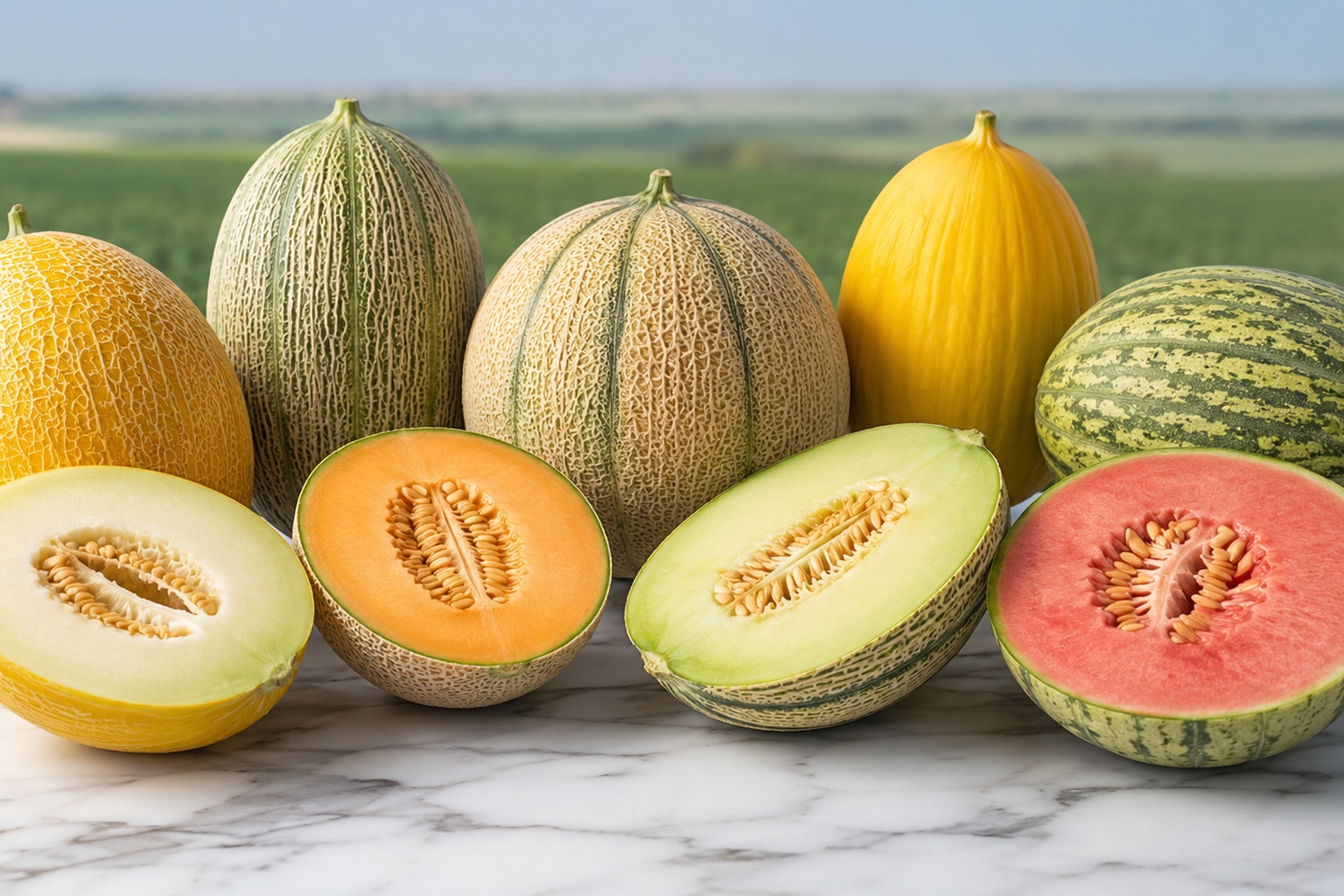
Melon and watermelon leave Egypt on a longer calendar than most buyers assume. The main open field crop from the Nile Delta, Nubaria and Ismailia runs from late April through August. A second planting in Upper Egypt and the reclaimed desert areas carries smaller volume into late September and October. Early August therefore sits at the tail of the main crop, which is the point in the year when importers either close out the remaining summer requirement or begin pricing the autumn window.
Galia is the workhorse export melon out of Egypt. The fruit is netted, breaks from green to yellow at maturity, and is cut for sea freight at a firmer stage than the domestic crop. Cantaloupe of the Ananas and Ivanhoe types goes mainly to Gulf markets, where buyers accept a larger fruit and a heavier net. Charentais is grown on contract for French and Swiss programmes and is almost always air freighted or shipped in short-transit reefer. On watermelon, Crimson Sweet and Sugar Baby types cover the seeded requirement, while seedless hybrids are grown for European retail and for the Gulf hospitality trade.
Export Galia is graded at 800 g to 1.6 kg per fruit, packed 5, 6, 7 or 8 per carton depending on the destination. Cantaloupe runs heavier, typically 1.2 to 2.2 kg, packed 4 to 6 per carton. Brix at cutting is the number that decides whether the fruit arrives well. Galia and cantaloupe intended for sea freight should be cut at 10 degrees Brix or above, with flesh firmness high enough to survive 8 to 14 days. Watermelon is sorted into 4 to 6 kg for retail packs, 6 to 9 kg for general wholesale and 9 to 13 kg for the juice and catering trade.
Galia and cantaloupe are packed in single-layer telescopic cartons of 5 to 8 kg net, with a moulded pulp or plastic tray to stop movement in transit. A standard configuration is 80 cartons per Euro pallet, 20 pallets in a 40ft high cube reefer, giving roughly 8 to 10 tonnes of net product depending on carton weight. Watermelon ships either in bulk on the container floor or, increasingly, on pallets with corner posts and top boards. Palletised watermelon loads at 20 to 22 tonnes in a 40ft reefer. Bulk loading gains a little weight but costs more in labour and in arrival bruising.
Galia and cantaloupe travel at 5 to 7 degrees Celsius with 90 to 95 percent relative humidity and fresh air exchange open. Watermelon is different and must not be treated the same way. Hold watermelon at 10 to 12 degrees Celsius, since anything below about 8 degrees will produce chilling injury and pitting that shows up only after arrival. Melons also respond strongly to ethylene, so they should not share a container with bananas, avocado or ripening stone fruit. Our note on reefer container loading and set points by crop covers the compatibility rules in more detail.
Melon volume moves through Alexandria and Damietta for European and Mediterranean destinations, and through Ain Sokhna for Gulf and Red Sea buyers. Transit is typically 4 to 7 days to Italy and Greece, 8 to 12 days to northern Europe, and 5 to 9 days to Jeddah, Jebel Ali and Doha. Because melon is a short shelf-life item once cut, the port choice matters more here than on citrus or onion. The comparison in our guide to Egyptian export ports sets out the sailing frequencies behind those numbers.
Buyers who need melon in late September and October should indicate volume now rather than in September. Autumn plantings are made against confirmed demand, and the acreage is a fraction of the spring crop. Availability in that window is genuinely limited and is allocated to buyers already on programme.
Tell us the variety, the count per carton, the destination port and the Incoterms 2020 basis you work on, and we will come back with availability and a price. Pre-shipment inspection by SGS or Intertek can be arranged at your cost on any load. Reach the export desk on WhatsApp at +20 10 9911 1918.
