Address
Work Hours
Monday to Friday: 7AM - 7PM
Weekend: 10AM - 5PM

Address
Work Hours
Monday to Friday: 7AM - 7PM
Weekend: 10AM - 5PM


Egypt's fresh mango exports in numbers — volumes, destination markets, varieties, production base and the July-to-November season window.
Egyptian mango exports are growing off one of the largest production bases in the Mediterranean, yet only a thin top layer of the crop reaches world markets today — and that gap is the opportunity. This report compiles Egypt’s fresh mango export volumes, destinations and varieties into one citable reference, updated annually at season open. For the orange and soft-citrus equivalent, see the Egyptian citrus export guide. Sourcing now? See the best mango export companies in Egypt.
Mango is already Egypt’s second-most-exported fruit by volume after citrus, with double-digit export growth, a long July-to-November season that fills the Northern-Hemisphere summer window, and a variety range spanning premium local cultivars and internationally familiar export types. The numbers below set out where that fruit goes, what it earns, and where the next growth is coming from.
Last Updated: June 2026 — 2026 edition. Figures are directional for the mango group (HS 080450); see Sources & Methodology.
The headline numbers an importer, journalist or analyst can quote directly:
Global mango-group trade is worth on the order of USD 1.66 billion a year. The leading exporters under HS 080450 are Mexico, the Netherlands (largely an EU re-export and distribution hub rather than a producer), Brazil, India, Thailand (whose ranking is influenced by mangosteen exports) and Peru. Egypt sits just behind this group, at roughly a 3.7% share and around seventh place — well positioned as a counter-seasonal and regional supplier rather than a global volume leader.
| Metric | Value | Year / basis |
|---|---|---|
| Mango production (industry estimate) | ~2.0 million tonnes | recent seasons |
| Cultivated area | 100,000+ hectares | recent seasons |
| Fresh mango export volume | 72,520 tonnes | 2023 · HS 080450 |
| Fresh mango export value | USD 133.57 million | 2023 · HS 080450 |
| Export volume growth (YoY) | +20.2% | 2023 vs 2022 |
| Global export share / rank | ~3.7% / rank ~7 | 2023 · HS 080450 |
| Rank among Egypt’s fruit exports | #2, after citrus | recent seasons |
Sources: Tridge / ITC Trademap (HS 080450); EastFruit; FreshPlaza.
Industry sources put recent Egyptian mango production at over two million tonnes on more than 100,000 hectares, while audited fresh-export figures sit near 72,500 tonnes (2023). In other words, the overwhelming majority of Egypt’s crop is consumed or processed domestically — mango is a deeply popular fruit at home — and only a thin top layer reaches export markets today. As newer orchards on reclaimed land come into full bearing and export packing and cold-chain standards improve, that exportable share has clear room to grow.
Russia is the standout single market, taking close to 30% of Egypt’s fresh-mango exports and pulling large volumes through its supermarket channels. The Gulf — led by Saudi Arabia, with the UAE, Oman, Kuwait and Bahrain — is the traditional heartland, with demand peaking in the hot summer months. The Netherlands serves as the European gateway via Rotterdam, feeding onward distribution into France, Germany and the UK, while the Levant (Jordan, Syria, Lebanon) rounds out the regional base.
| Market | Position | Notes |
|---|---|---|
| Russia | #1 — ~29.5% of exports | Largest single market; strong supermarket demand |
| Saudi Arabia | Gulf #1 | Traditional destination; summer demand peak |
| Jordan, UAE, Oman | Top 5–6 | Core Gulf / Levant base |
| Syria, Kuwait, Lebanon, Bahrain | Top 10 | Established regional markets |
| Netherlands (Rotterdam) | EU gateway | Onward distribution to the EU |
| France, Germany, UK | EU / UK | Retail and wholesale programmes |
| Turkey | Fastest-growing | See the emerging-markets table |
| Morocco | Emerging | Notable recent destination |
Sources: Tridge (destination share, 2023); IndexBox (Russia); EastFruit; FreshPlaza. Russia share is firm; other positions ranked from destination listings.
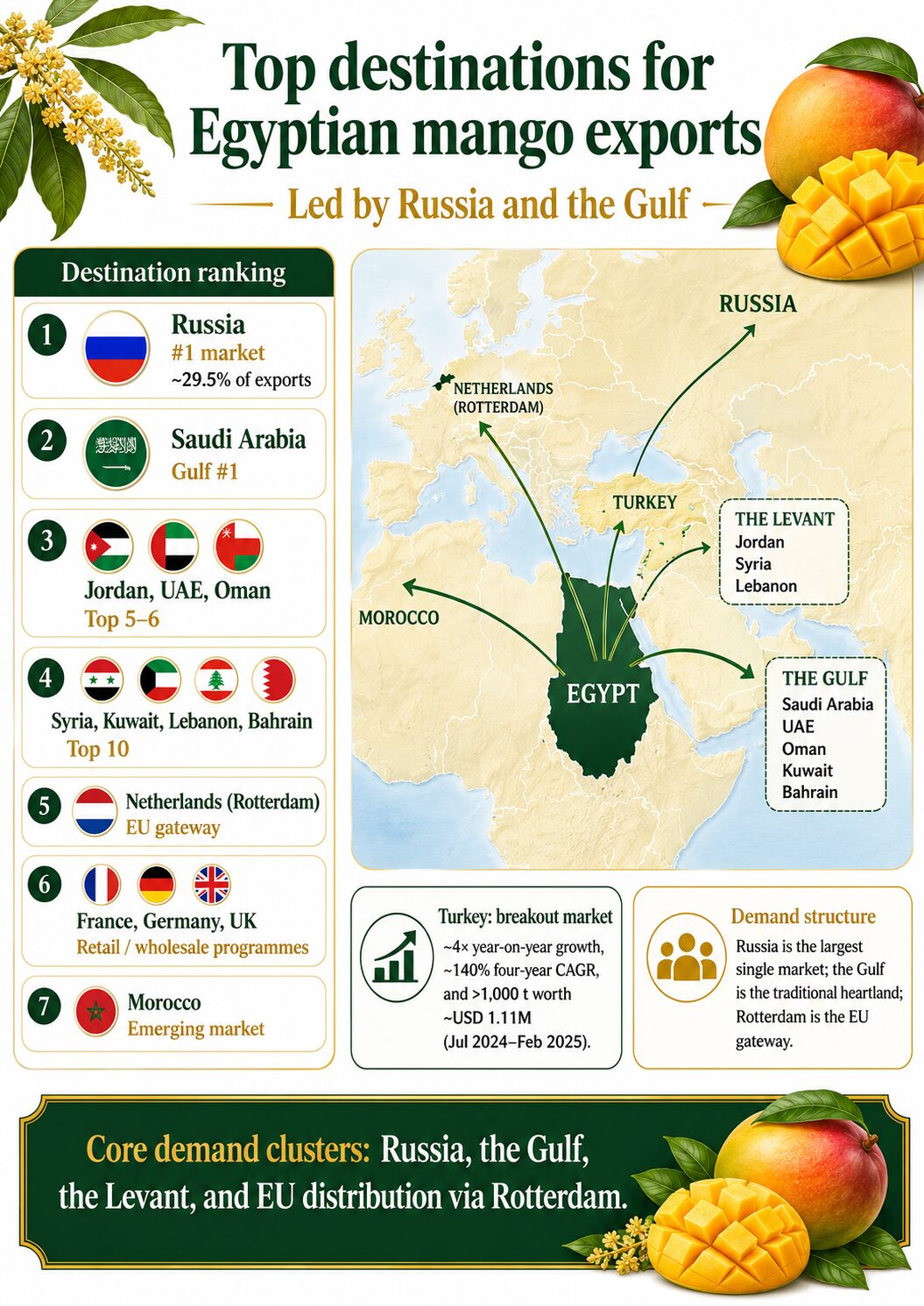
The clearest growth story is Turkey, where proximity and longer-shelf-life varieties have driven a step-change in volumes. Beyond that, Egyptian exporters have used abundant production to push into Morocco and a widening set of African and Asian markets, supported by better packaging and fruit quality.
| Market | Growth signal | Source |
|---|---|---|
| Turkey | ~4× year-on-year; ~8× vs 2022/23; ~140% four-year CAGR; >1,000 t worth ~USD 1.11M (Jul 2024–Feb 2025) | EastFruit / GTT |
| Morocco | Notable new destination in recent seasons | FreshPlaza |
| New African & Asian markets | Expansion supported by improved packaging and quality | FreshPlaza |
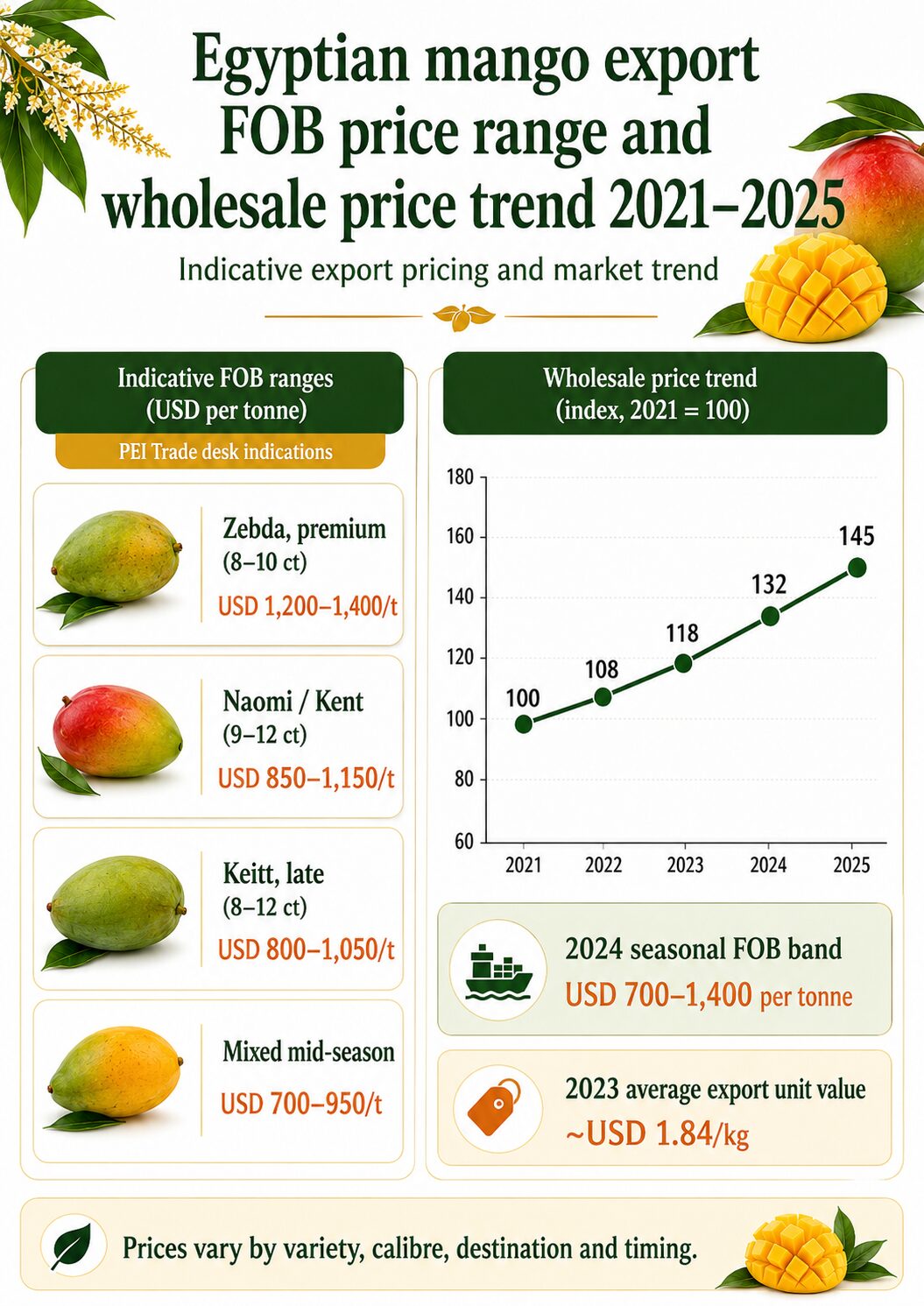
This report does not publish FOB price ranges. Egyptian mango FOB moves week to week with variety, count, grade and vessel space, and a figure fixed at publication misleads more than it helps. What is stable enough to state is the shape of the market: premium and export-grade fruit prices above the rest of the crop, late-season fruit prices above peak-season fruit, and Russia and the Gulf support the market through the tail of the season. Domestic wholesale prices have also trended firmly upward over five years, which lifts the floor under export offers. For a current number against your variety, count and destination port, see Egyptian mango prices or ask the export desk.
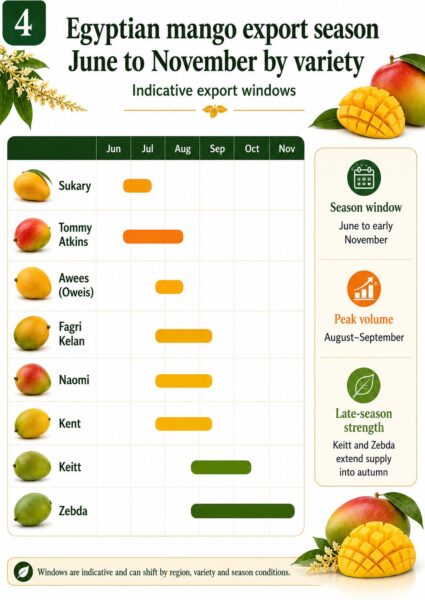
Egypt grows a wide spread of local and international cultivars, which is part of what lets it supply continuously across a long season. Premium Egyptian varieties such as Zebda command strong regional demand, while internationally familiar Keitt, Kent and Tommy Atkins suit European supermarket specifications and longer sea-freight transit. Windows below are indicative; for full variety detail and calibres, see Egyptian mango varieties and the season calendar.
| Variety | Type | Indicative window | Export profile |
|---|---|---|---|
| Sukary | Egyptian, very sweet | Early (Jul) | Premium local favourite; delicate handling |
| Awees (Oweis) | Egyptian, aromatic | Mid (Aug) | Strong Gulf demand |
| Fagri Kelan | Egyptian | Mid–late (Aug–Sep) | Export-grade, good size |
| Naomi | Grown in Egypt | Mid (Aug–Sep) | Firm, colourful, good shelf life |
| Kent | International | Mid–late | Low-fibre; EU-favoured |
| Tommy Atkins | International | Mid | Durable colour; ships well |
| Keitt | International | Late (Sep–Oct) | Late season; extends the window |
| Zebda | Egyptian, premium | Late (Sep–Nov) | Prestige; rich, low-fibre; Gulf/Russia |
Production estimates for Egyptian mango vary widely by source and methodology: industry sources cite around two million tonnes, while FAOSTAT’s mango-guava-mangosteen item has historically recorded lower figures. This report leads with the audited HS 080450 export figure as the firm number and treats production as an industry estimate. Cultivation is concentrated in Ismailia (home of the long-running mango festival), Sharqia, Beheira and the newer reclaimed lands of the Nubaria corridor — each covered in the Egyptian mango growing regions guide.
| Metric | Value | Basis / source |
|---|---|---|
| Production (industry estimate) | ~2.0 million tonnes | EastFruit / FreshPlaza / Tridge |
| Production (FAOSTAT, item 0571) | ~0.9–1.5 million tonnes (varies by year) | FAOSTAT |
| Cultivated area | 100,000+ hectares | FreshPlaza / EastFruit |
| Main regions | Ismailia, Sharqia, Beheira, Nubaria / New Lands | industry |
| Domestic vs export | Majority consumed / processed domestically | derived |
The Egyptian mango season opens around July and runs to early November, with the bulk of volume in August and September and late varieties extending shipments into October–November. Refrigerated sea freight serves Russia, the Gulf and the EU (via Rotterdam), while premium, time-sensitive consignments can move by air. Late, longer-shelf-life varieties are central to reaching more distant markets reliably. For phytosanitary and documentation requirements by market, see Egyptian mango export requirements.
The 2026 season is opening now. Building on a commercially successful recent season with firm prices for premium and export-grade fruit, Egyptian exporters are signalling a deliberate tilt toward late varieties and continued expansion into new African and Asian markets, alongside the core Gulf, Russian and Eastern-European demand. Managed supply timing — concentrating volume where late-season demand and prices are strongest — is the recurring theme.
| Indicator | Signal |
|---|---|
| Season window | ~July to early November |
| Variety strategy | Tilt toward late varieties |
| Core markets | Gulf, Russia, Eastern Europe |
| Expansion | New African and Asian markets; improved packaging/quality |
| Prices | Firm for premium / export-grade sizes |
Source: FreshPlaza exporter interviews (2025–2026).
For importers, Egypt offers a long, reliable summer-into-autumn window, a broad variety range spanning premium regional and supermarket-spec fruit, and competitive pricing backed by deep production. The practical levers are variety and calibre selection matched to the destination, booking premium late varieties such as Zebda and Keitt early, and aligning shipment timing with the late-season price strength in the Gulf and Russia. PEI Trade supplies across these varieties and markets and can advise on calibre, packing and Incoterms by destination — see our ranking of the best mango export companies in Egypt for how to qualify any supplier.
This report does not publish FOB ranges. Mango prices move week to week with variety, count, grade and vessel space, and a figure fixed at publication misleads more than it helps. For a current number against your variety, count and destination port, ask the export desk.
Important data note. There is no clean, mango-only official trade series. International trade data are reported under HS 080450 — “guavas, mangoes and mangosteens, fresh or dried” — which is the closest global proxy for mango trade but also includes guavas and mangosteens and does not separate fresh from dried. Production data use the FAOSTAT mango-guava-mangosteen item and diverge significantly from industry production estimates. Figures should therefore be read as directional for the mango group rather than mango-exact, and we lead with the audited HS 080450 export value/volume as the firmest available number.
Key references used in this edition:
Edition: 2026 · Compiled: June 2026 · Update cadence: annually at season open. Year-on-year figures compare consecutive calendar years unless a season range is stated.
Reusing a figure from this report? Please cite it and link to this page as the source.
PEI Trade (2026). Egyptian Mango Export Report 2026. PEI Trade. https://peitrade.com/egyptian-mango-export-report-2026/
Egypt exported about 72,520 tonnes of fresh mango, worth roughly USD 133.57 million, in 2023 (HS 080450), with export volume up around 20% year-on-year. This is a small share of total production, which industry sources estimate at about two million tonnes.
Russia is the largest single destination at about 29.5% of fresh-mango exports, followed by Gulf markets led by Saudi Arabia, with the Netherlands (Rotterdam) acting as the EU gateway. Turkey is the fastest-growing market.
The Egyptian mango season runs from around July to early November, with peak volume in August and September and late varieties extending shipments into October and November.
Premium Egyptian varieties include Zebda, Awees, Fagri Kelan and Sukary, alongside internationally grown Naomi, Kent, Keitt and Tommy Atkins suited to supermarket programmes and longer transit.
This report does not publish FOB figures. Egyptian mango FOB is quoted per kilogram of net fruit weight and moves week to week with variety, calibre, grade, available volume, destination and vessel space, so any figure fixed at publication is misleading within weeks. Ask the export desk for the current number against your specification.
Want a supplier who manages variety selection, calibre, treatment, documentation and cold chain end to end across the Gulf, Russia and the EU? Let’s build a compliant, well-timed program for your market.
Request a quote, see the best mango export companies in Egypt, or explore the Egyptian mango export guide, varieties, the season calendar and export requirements.
