Address
Work Hours
Monday to Friday: 7AM - 7PM
Weekend: 10AM - 5PM

Address
Work Hours
Monday to Friday: 7AM - 7PM
Weekend: 10AM - 5PM


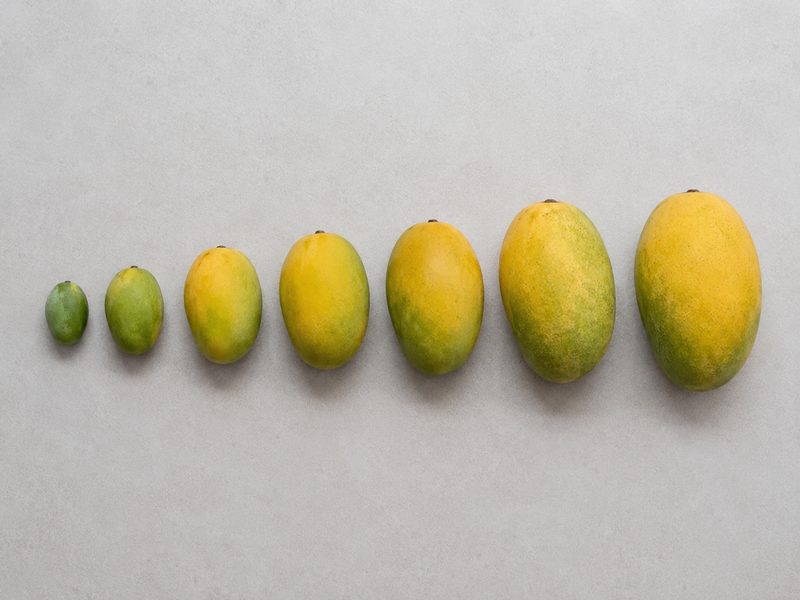
Mango size chart for Egyptian export: count 6 = 775-900 g, count 12 = 385-460 g in a 5 kg carton. Count-to-weight conversion, variety size bands and container loads.
This mango size chart converts carton count to fruit weight. A 5 kg Egyptian export mango carton holds 6 to 16 fruit — 6 to 12 on the main export varieties, down to count 16 on the small indigenous types. The count is the size: count 6 means six mangoes of roughly 775–900 g each, count 12 means twelve of roughly 385–460 g. Below is the full conversion, the size band each Egyptian mango variety naturally produces, which count each destination market buys, and how count converts into a container load.
By the PEI Trade export desk · Reviewed by Ahmed Mostafa, Board Member · Last updated 26 August 2026 · Reading time 8 minutes
Mango is not sold by a size letter in the Egyptian export trade. Mango is sold by count per carton — the number of fruit that fills a fixed-weight box. Divide the carton net weight by the count and you have the average fruit weight. The count is only meaningful when the carton format is stated with it, because the same fruit is a count 7 in a 5 kg carton and a count 6 in a 4.5 kg carton.
| Count (5 kg carton) | Average fruit weight | Typical weight range | Commercial description |
|---|---|---|---|
| 6 | 833 g | 775–900 g | Extra large |
| 7 | 714 g | 670–775 g | Large |
| 8 | 625 g | 590–670 g | Large |
| 9 | 556 g | 530–590 g | Medium-large |
| 10 | 500 g | 460–530 g | Medium — retail standard |
| 12 | 417 g | 385–460 g | Small — pre-pack and punnet |
| 14 | 357 g | 335–385 g | Small — indigenous varieties only |
| 16 | 313 g | 295–335 g | Small — indigenous varieties only |
The relationship is arithmetic, not a grading opinion. Counts 11, 18 and 20 are not packed on Egyptian export mango, and count 16 is the smallest unit — fruit under about 295 g falls below the smallest packed count and goes to the domestic market or to processing. Buyers comparing offers across suppliers should convert to grams before comparing price, because a count quoted without its carton format is meaningless.
6–16
Fruit per 5 kg carton
10–12 °C
Reefer carrying temperature
14 %
Minimum dry matter at harvest
20.8 t
Net load, 40 ft reefer, 5 kg carton
Size is a varietal characteristic before it is a grading decision. A Sedeeka block will not produce count 6 fruit in commercial quantity no matter how it is managed, and a Keitt block will always throw a share of fruit above 800 g. Specifying a count the variety does not naturally make is the most common reason a mango order cannot be filled.
| Variety | Fruit weight | Counts (5 kg) | Brix | Fibre | Peak | Best channel |
|---|---|---|---|---|---|---|
| Keitt | 500–900 g | 6, 7, 8, 9, 10 | 13–15° | None | Sep–Nov | EU, UK, Russia — sea programmes |
| Fagri Kelan | 500–900 g | 6, 7, 8, 9, 10 | 15–18° | Some | Jul–Aug | Gulf and local premium |
| Zebda | 400–800 g | 6, 7, 8, 9, 10, 12 | 16–20° | Very low | Aug–Sep | Gulf and diaspora; limited fresh export |
| Kent | 450–700 g | 7, 8, 9, 10, 12 | 14–16° | Minimal | Aug–Oct | EU, Gulf, Russia retail and ripening |
| Shelly | 450–650 g | 8, 9, 10, 12 | 14–16° | None | Sep–Oct | EU and UK retail |
| Naomi | 400–600 g | 8, 9, 10, 12 | 13–15° | None | Jul–Aug | EU retail punnets and pre-pack, Gulf |
| Tommy Atkins | 400–600 g | 8, 9, 10, 12 | 12–14° | Some | Jul–Sep | Russia and Eastern Europe |
| Timour | 350–550 g | 9, 10, 12, 14 | 16–19° | Low | Jul–Aug | Gulf |
| Owaisi (Ewais) | 300–500 g | 10, 12, 14, 16 | 18–22° | Low | Aug–Sep | Gulf premium, EU specialty and gifting |
| Sedeeka | 250–450 g | 12, 14, 16 | 17–20° | Low | Aug–Sep | Gulf |
Full profiles are in the Egyptian mango varieties guide, with dedicated pages for Keitt, Kent and Naomi and Owaisi (Ewais).
Count is a commercial decision about who eats the fruit and how it is sold, not a quality grade. Oversized fruit sits on a retail shelf because it pushes the unit price past the point the shopper recognises; undersized fruit is refused by foodservice because a kitchen cannot portion it. Both errors are expensive. The fruit weight is what each channel is actually buying — the count follows from the carton format.
| Channel / market | Fruit weight bought | Count (5 kg carton) | Why |
|---|---|---|---|
| EU and UK retail | 385–530 g | 10–12 | Single fruit sold loose or in a two-piece punnet at a recognised unit price |
| Gulf (GCC) wholesale | 530–775 g | 7–9 | Large fruit signals quality and carries a visible premium in that trade |
| Foodservice and hotel | 460–590 g | Fixed 9 or 10 | Consistency above all — a kitchen portions to a predictable unit |
| Retail pre-pack / punnet | 335–460 g | 12–14 | Multi-piece packs need a smaller, uniform fruit |
| Processing and pulp | Any | Count not specified | Bought on Brix, flesh recovery and total weight, not on count |
A single-count carton should be exactly that. Standard Egyptian export practice allows a small share of the adjacent count — commonly 5 to 10 per cent by piece — and that tolerance belongs in the contract rather than in an assumption. Anything looser and the receiver is buying a mixed carton at a single-count price.
Write it down. Mixed-count loads are legitimate and often cheaper — but a mixed load must be described as mixed on the offer, the packing list and the carton label. A mixed carton sold as a single count is a claim waiting to happen, and it is one of the easiest disputes to avoid at the specification stage.
Early in a variety window the crop skews small. As harvest progresses through the block, average fruit weight rises. Large counts — 6 and 7 — are therefore easiest to secure in the middle and back end of a variety window, and a buyer who needs count 6 Keitt should book against the later picks rather than the opening ones.
| Position in the variety window | Size skew | Counts most available | Booking advice |
|---|---|---|---|
| Opening picks | Small | 12, 14 | Good for pre-pack and punnet programmes |
| Mid window | Balanced | 9, 10, 12 | The widest choice; best for retail programmes |
| Late picks | Large | 6, 7, 8 | Book count 6 and 7 here, not at the opening |
The practical consequence: fix the count against a week, not against a season. Week-by-week variety availability is in the Egyptian mango season calendar.
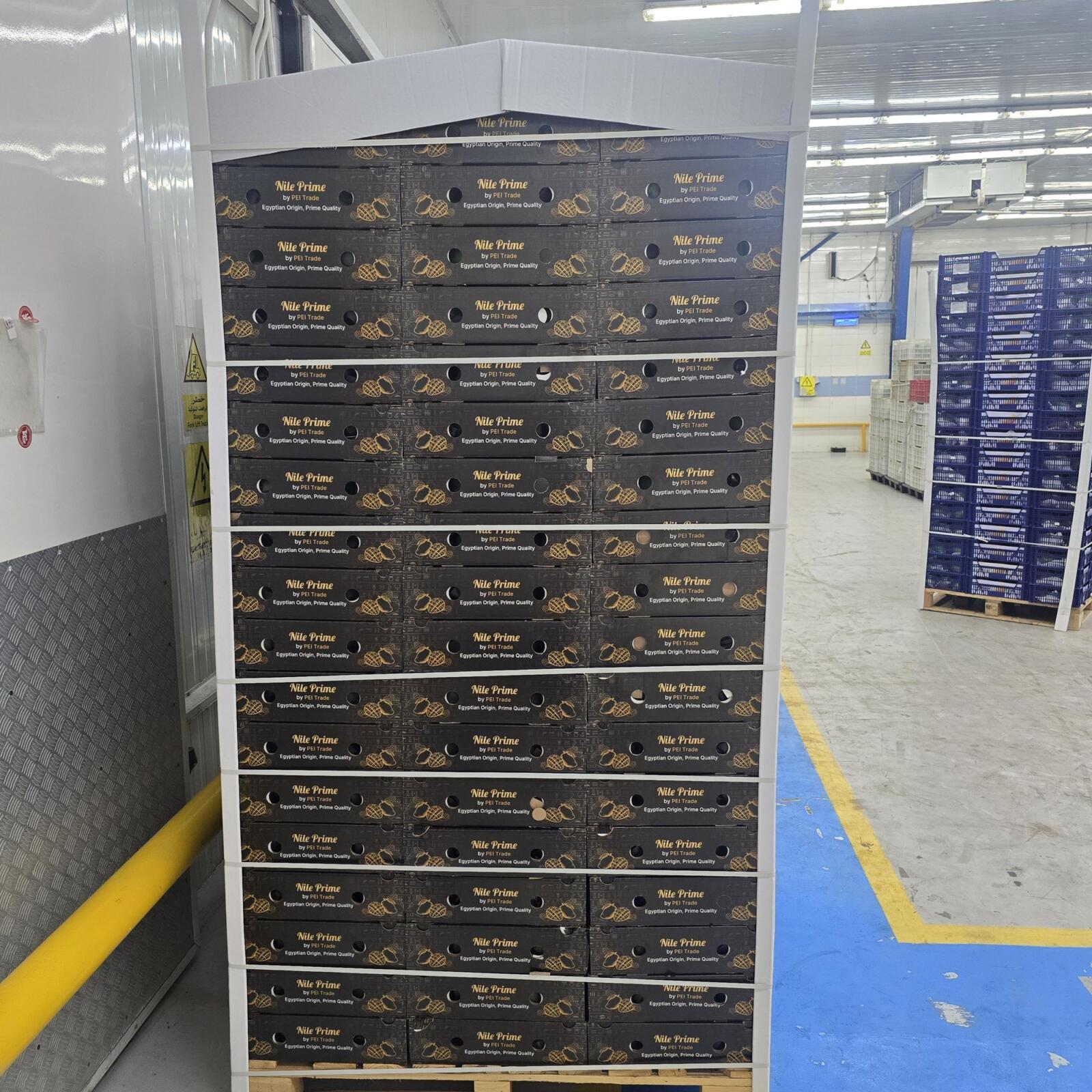
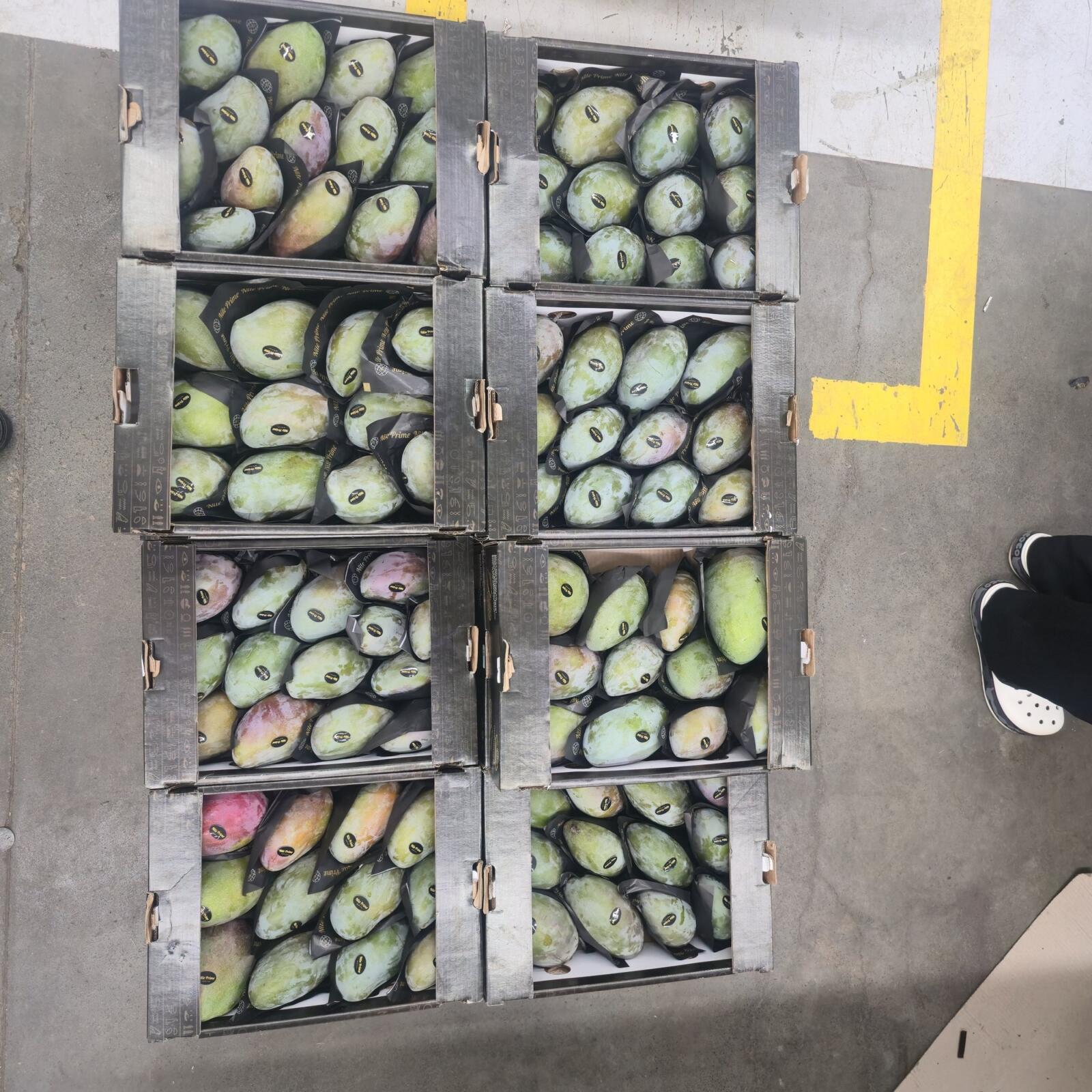
Cartons are corner-posted and strapped, with vent alignment maintained through the stack so that cold air reaches the centre of the pallet rather than travelling around it. A misaligned stack is one of the quieter causes of uneven arrival temperature.
Each fruit sits in a foam sleeve to guard against pressure marks.
| Format | Net weight | Gross weight | Counts carried | Cartons per standard pallet | Typical use |
|---|---|---|---|---|---|
| 5 kg telescopic carton | 5 kg | 5.5 kg | 6–16 | 200 | The standard export unit — retail and wholesale |
| 5 kg box | 5 kg | 5.5 kg | 6–16 | 180 | Same fruit, lower packaging cost, fewer cartons per pallet |
| 4.5 kg carton | 4.5 kg | 5 kg | 6–14 | 200 | On request — buyers running an existing 4.5 kg specification |
The carton count follows from the pallet build, not from an estimate. A 40 ft reefer takes 20 standard pallets plus one euro pallet — 21 in total. A 20 ft reefer takes 10 standard pallets. Maximum payload is 25 tonnes on every unit.
| Format | Cartons per standard pallet | 40 ft reefer — cartons | 40 ft reefer — net weight | 20 ft reefer — cartons | 20 ft reefer — net weight |
|---|---|---|---|---|---|
| 5 kg carton | 200 | 4,160 | 20,800 kg | 2,000 | 10,000 kg |
| 5 kg box | 180 | 3,744 | 18,720 kg | 1,800 | 9,000 kg |
| 4.5 kg carton | 200 | 4,160 | 18,720 kg | 2,000 | 9,000 kg |
For road freight into the Gulf and the Levant, a road reefer carries 26 pallets: 4,940 cartons and 24,700 kg net in the 5 kg carton, or 4,680 cartons and 23,400 kg in the 5 kg box — both held below the 25 tonne payload limit.
For part-load and mixed-container buyers, a full pallet of 5 kg cartons is 200 cartons at 1,000 kg net, and a half pallet is 100 cartons at 500 kg — the practical minimum below which handling cost per carton stops making sense.
Chilling injury does not show at loading. Chilling injury appears as grey lenticel spotting and blotchy, uneven ripening days after the buyer has accepted the fruit — which is why it so often becomes a dispute rather than a rejection.
| Product | Carrying temperature | Compatible with mango? |
|---|---|---|
| Mango | 10–12 °C | — |
| Guava | 8–10 °C | Yes |
| Cucumber and pepper lines | 8–12 °C | Yes |
| Pomegranate | 5–7 °C | Marginal |
| Green beans | 6–8 °C | Marginal |
| Citrus | 4–6 °C | No — chilling injury |
| Table grapes | 0–1 °C | No — chilling injury |
A correctly sized mango that was cut before it was physiologically mature will soften in transit, look ripe on arrival, and never develop proper sugar or aroma. Once the fruit is picked, no ripening-room work fixes it. Size and maturity are separate specifications and both belong in the contract.
| Measure | How it is taken | What it governs | Reliability |
|---|---|---|---|
| Dry matter | Slice from the cheek, weighed, dried, weighed again | The harvest decision | Highest — reflects starch and sugar accumulated on the tree |
| Brix | Refractometer on expressed juice | Eating quality, once ripe | Weak on hard green fruit; meaningful only at eating-ripe |
| Firmness | Penetrometer on two opposite cheeks | The shipping decision | High for transit suitability |
| Skin colour | Visual | Nothing | Not a maturity test. Keitt stays green at full maturity; Naomi colours before it matures |
Ask for the maturity record to be issued with the shipping documents. It costs the packhouse nothing to share and it gives both sides a factual reference if arrival quality is questioned later.
The count on the carton is the only number both sides agree on before the fruit moves. Fix it in writing together with the weight band, and most arrival disputes never start.
Ahmed Mostafa, Board Member, PEI Trade
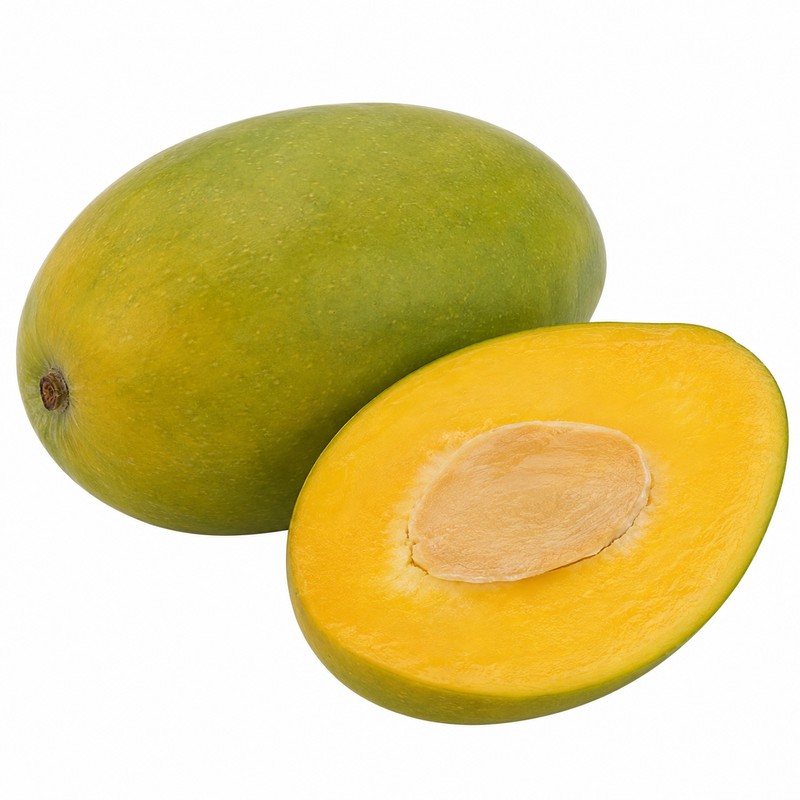
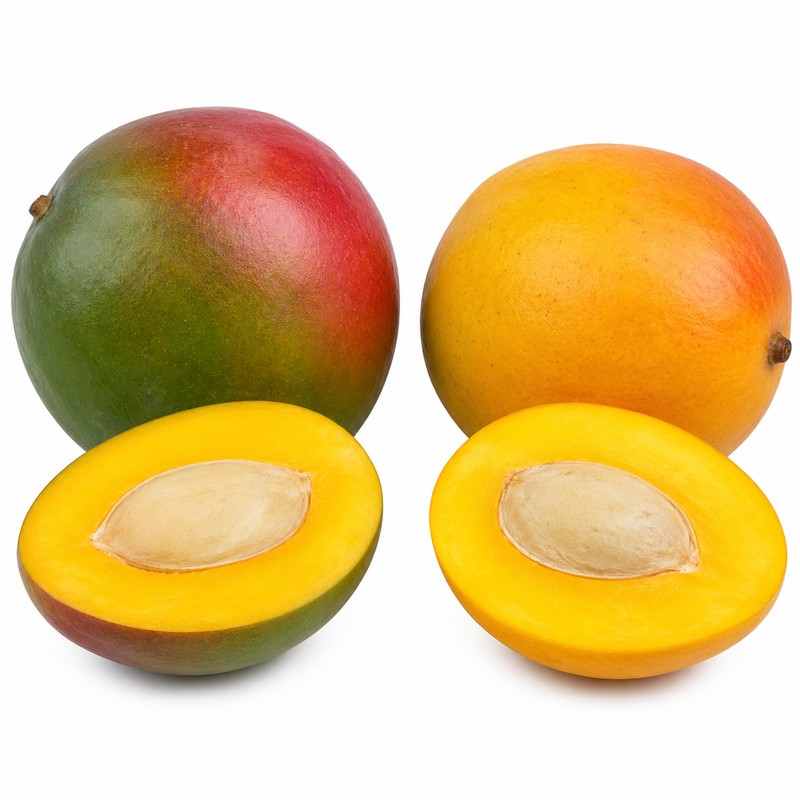
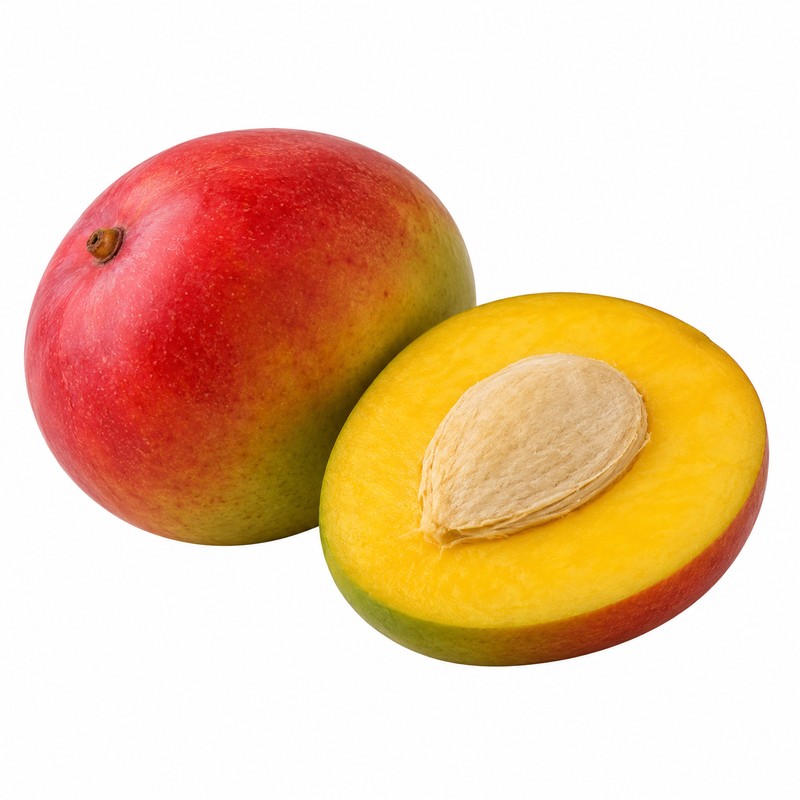
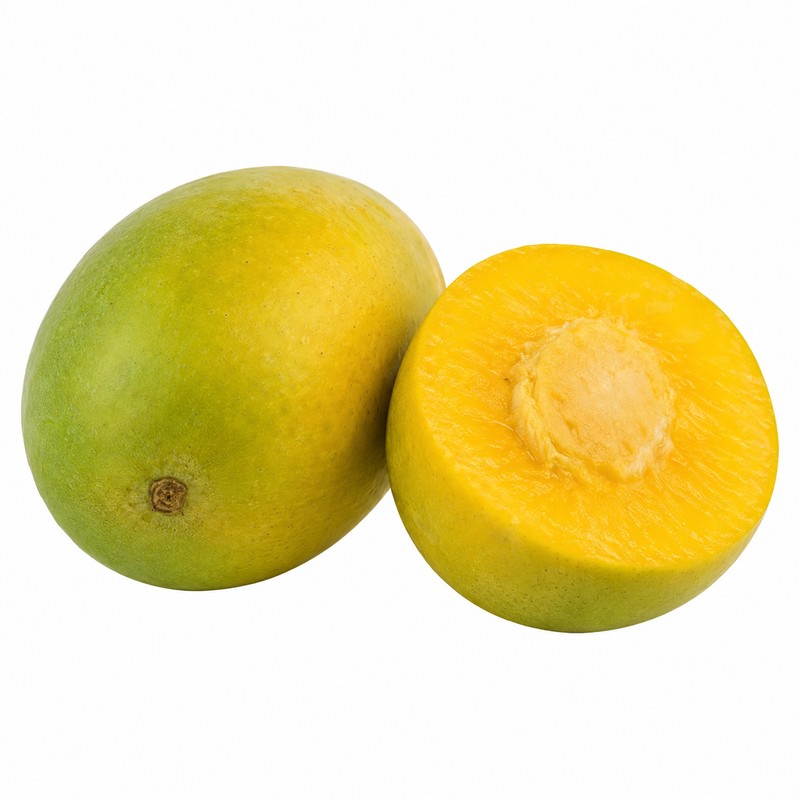
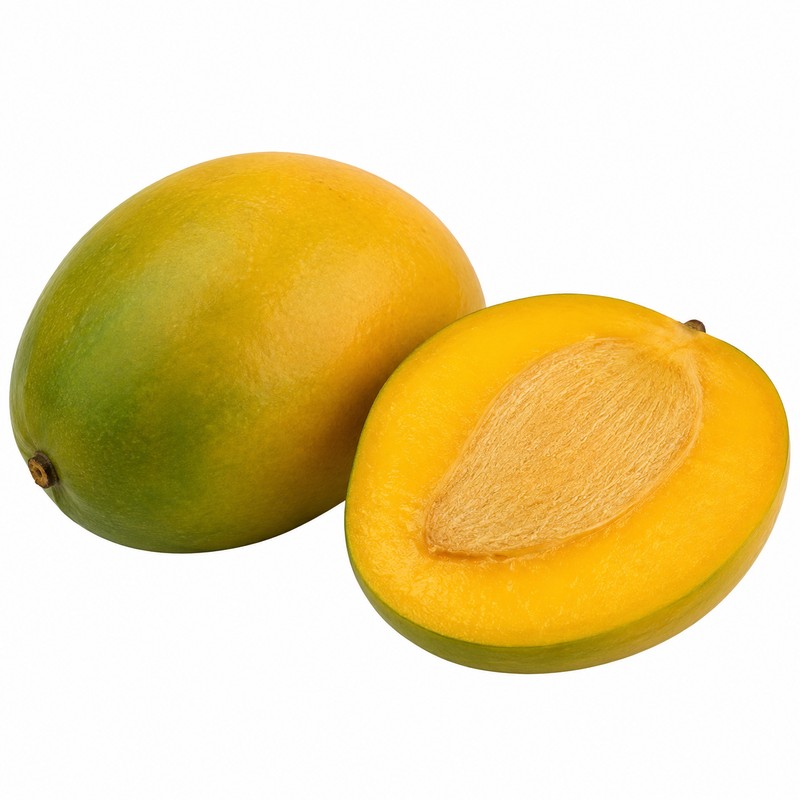
A buyer switching origin mid-season needs to know that the count convention travels but the fruit does not. The same mango size chart arithmetic applies everywhere — what changes is which counts each origin can actually supply, and in which weeks.
| Origin | Main export window | Flagship varieties | Overlap with Egypt |
|---|---|---|---|
| Egypt | Jul–Nov, peak Aug–Sep | Keitt, Kent, Naomi, Owaisi | — |
| India | Apr–Jul | Alphonso, Kesar, Banganapalli | Minimal — India exits as Egypt opens |
| Pakistan | May–Aug | Sindhri, Chaunsa | Early overlap in the Gulf |
| Peru | Dec–Mar | Kent | Meets the tail of the Egyptian Keitt window |
| Brazil | Aug–Nov | Tommy Atkins, Palmer | Direct overlap on the EU lane |
| West Africa | Mar–Jul | Kent, Keitt | Exits before Egyptian peak |
Count 10 means ten fruit fill the carton. On the mango size chart, count 10 in a 5 kg carton is an average fruit weight of 500 g, typically 460–530 g. In a 4.5 kg carton, count 10 would be 450 g fruit — which is why the carton format must always be stated alongside the count.
The standard Egyptian export format is the 5 kg single-layer carton, with each fruit foam-netted. A 5 kg box is offered as an alternative at the same net weight and a lower packaging cost, and a 4.5 kg carton is available on request for buyers running an existing specification.
European and UK retail generally buys fruit of 385 to 530 g — counts 10 to 12 in the 5 kg carton. The reason is the shelf unit price: fruit above roughly 600 g pushes the retail price past the point the shopper recognises and slows sell-through.
A 40 ft reefer is built as 20 standard pallets plus one euro pallet. In the 5 kg carton at 200 cartons per standard pallet that is 4,160 cartons and 20,800 kg net. In the 5 kg box at 180 cartons per pallet it is 3,744 cartons and 18,720 kg net. A 20 ft reefer takes 10 standard pallets — 2,000 cartons or 1,800 boxes.
Yes. Mixed-count loads are legitimate and usually cheaper than a single-count specification. Mixed-count loads must be declared as mixed on the offer, the packing list and the carton label, so that the receiving buyer is not paying a single-count price for a mixed carton.
Early picks in any variety window skew small, and average fruit weight rises as harvest moves through the block. Counts 6 and 7 — fruit above 670 g — become available in the middle and back end of a variety window, so large-count orders should be booked against later picks.
Keitt and Fagri Kelan both run 500 to 900 g, which fills counts 6 to 10 in the 5 kg carton. Zebda reaches 800 g. At the other end, Sedeeka runs 250 to 450 g and Owaisi 300 to 500 g — both indigenous varieties that fill counts 12 to 16.
No. Mango carries at 10–12 °C, citrus at 4–6 °C and table grapes at 0–1 °C. Setting a shared container to the colder temperature causes chilling injury in the mango, which appears as grey lenticel spotting and blotchy ripening days after arrival. Guava, cucumber and pepper lines are compatible.
Egyptian export practice grades by count per carton rather than by the letter size codes in the international standards. The UNECE standard FFV-45 and the Codex standard for mangoes remain the reference for quality classes and tolerances, and Class I and Class II designations are used normally alongside the count.
Tell us your destination port, target count and volume, and we will confirm what is packing this week and prepare an offer under Incoterms 2020. We can also send the current size distribution from live lots, so you can fix a count against real fruit rather than against a chart.
WhatsApp / Office: +20 109 911 1918 · Email: sales@peitrade.com · Loading from Alexandria, Damietta, Sokhna and Port Said.
The PEI Trade export desk prepares specifications, offers and shipping documentation for Egyptian fresh and frozen produce, loading from Alexandria, Damietta, Sokhna and Port Said. PEI Trade is the trading name of Pharaohs of Egypt for International Trade. PEI Trade is the exporter, not a neutral reviewer — the specifications on this page describe fruit we sell.
How to cite this page: PEI Trade (2026). Mango Size Chart: Counts, Weights and Carton Formats. https://peitrade.com/mango-size-chart/ — tables and figures on this page may be reproduced with attribution to PEI Trade.
All figures are indicative and describe normal Egyptian export practice. Fruit weights, counts and container loads are confirmed per booking. Ask for a live specification before contracting.
