Address
Work Hours
Monday to Friday: 7AM - 7PM
Weekend: 10AM - 5PM

Address
Work Hours
Monday to Friday: 7AM - 7PM
Weekend: 10AM - 5PM


Season windows, variety split, size counts, carton formats and pallet configuration for Egyptian pomegranate shipments in the 2026/2027 campaign.
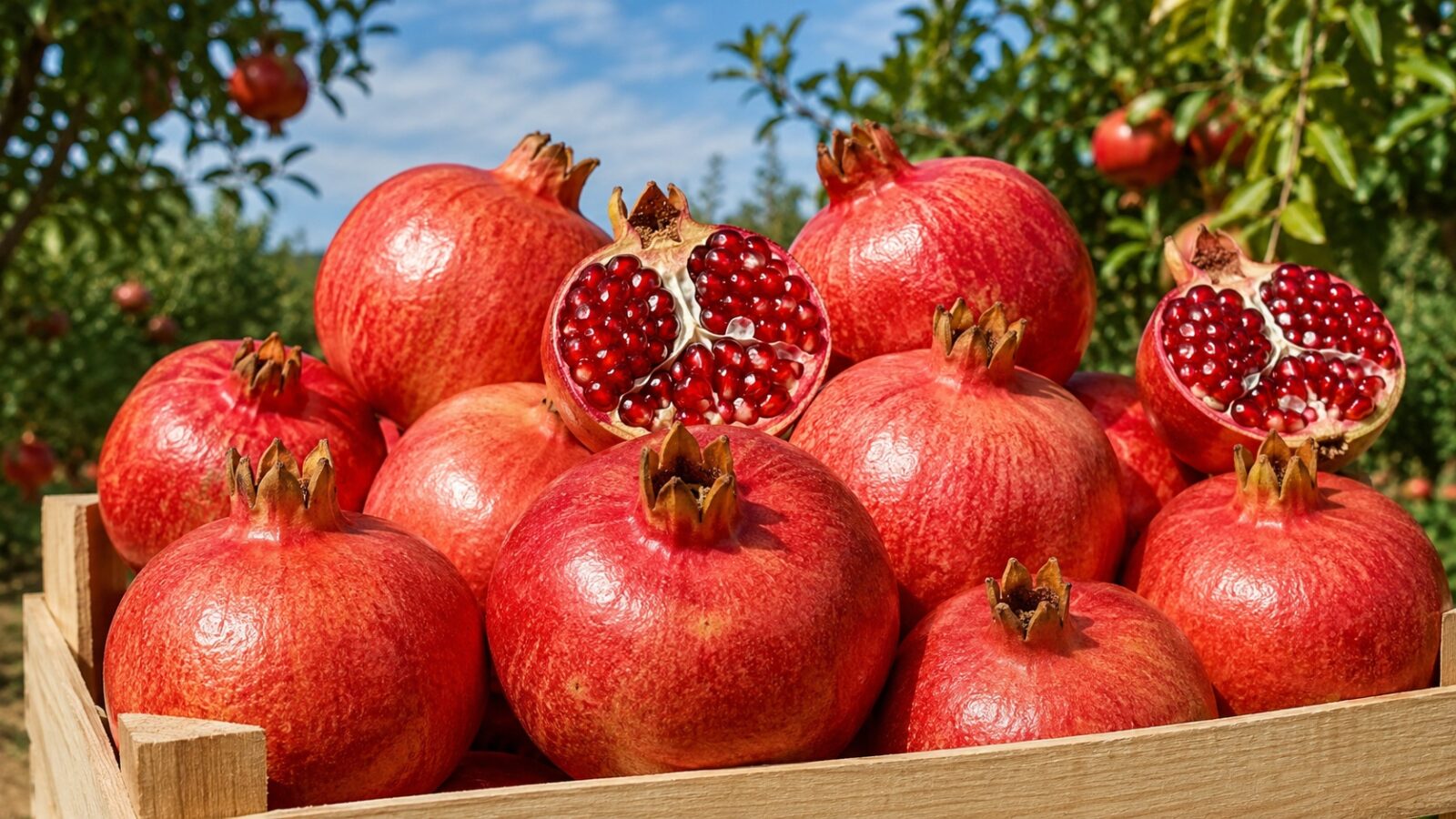
Pomegranate is one of the few Egyptian crops where the buying decision has to be made months before the fruit is on the water. Harvest begins in the second half of September and the main export flow runs from late September into December, with cold-stored fruit extending some programmes into January. Importers who wait until the first containers are loading usually find that the mid sizes are already committed.
Wonderful accounts for the largest share of Egyptian export volume. It carries deep red skin, dark arils, a firm rind that travels well, and a sweet-tart balance that suits both retail display and juice extraction. Harvest runs roughly from the first week of October into November depending on the growing area.
The 116 variety, sometimes traded as Early 116, opens the season. It starts around mid September and is the fruit that fills the earliest bookings before Wonderful is ready. Skin colour is lighter and the aril is softer, so it is generally routed to markets with shorter transit rather than long-haul programmes.
Manfalouti remains a domestic and regional favourite. Large fruit, pale skin, very soft seed. It has a following in parts of the Gulf market but it is not the variety to build a European retail programme around.
Egyptian pomegranate is sold on count per carton rather than millimetre diameter in most contracts. A standard 4.5 kg carton runs 8, 9, 10, 12 or 14 pieces. A 10 kg carton typically runs 16 to 30 pieces. Counts of 8 to 10 in the 4.5 kg format command the strongest premium in the Gulf. Counts of 12 to 14 and the smaller end of the 10 kg range move to processors and to juice buyers.
Class I (a grade tier from the applicable marketing standard, not a marketing term — see our Extra, Class I and Class II tolerances reference) requires uniform colour, a clean unbroken rind, no sunburn on the exposed shoulder, and calyx intact. Sunburn and rind cracking are the two defects that generate the most arrival disputes on this crop, so it is worth agreeing a written tolerance on both before the first container ships.
Fruit is usually packed in single layer on a moulded tray or in individual foam net sleeves inside a telescopic carton. Ventilated corrugated cartons with a minimum of 5 percent vent area are standard. On a 100 x 120 cm pallet, 4.5 kg cartons stack 8 per layer and 10 to 12 layers high depending on carton height, giving roughly 360 to 430 kg per pallet. A 40ft high cube reefer takes 20 pallets, which lands most pomegranate loads between 7 and 9 tonnes of net fruit.
Recommended carriage temperature is 5 to 7 degrees Celsius with 90 to 95 percent relative humidity. Pomegranate is chilling sensitive below about 4 degrees, and the damage shows as internal browning that is invisible from outside the fruit. We cover the wider crop-by-crop settings in our note on reefer set points for Egyptian produce.
Standard file is commercial invoice, packing list, certificate of origin, phytosanitary certificate, and bill of lading. GLOBALG.A.P. certification at farm level and a residue analysis against the destination MRL list are requested by most European buyers and by an increasing number of Gulf importers. SGS or Intertek inspection can be arranged at loading on request.
Programme volume for October and November is normally allocated between August and mid September. Buyers who want specific counts, own-brand cartons, or a fixed weekly shipment schedule should have the specification agreed before the end of August. Spot containers remain available through the season but the count mix on spot is whatever the packhouse has that week. For where this crop sits against the rest of the year, see our Egyptian produce export calendar.
To request the current pomegranate specification sheet, indicative FOB and CFR pricing, or to reserve counts for the 2026/2027 season, message the PEI Trade export desk on WhatsApp at +20 10 9911 1918.
