Address
Work Hours
Monday to Friday: 7AM - 7PM
Weekend: 10AM - 5PM

Address
Work Hours
Monday to Friday: 7AM - 7PM
Weekend: 10AM - 5PM


How Egyptian fresh produce exports are paid for in 2026. Advance TT, deposits against allocation, letters of credit, cash against documents and open account, with the risk each side carries.
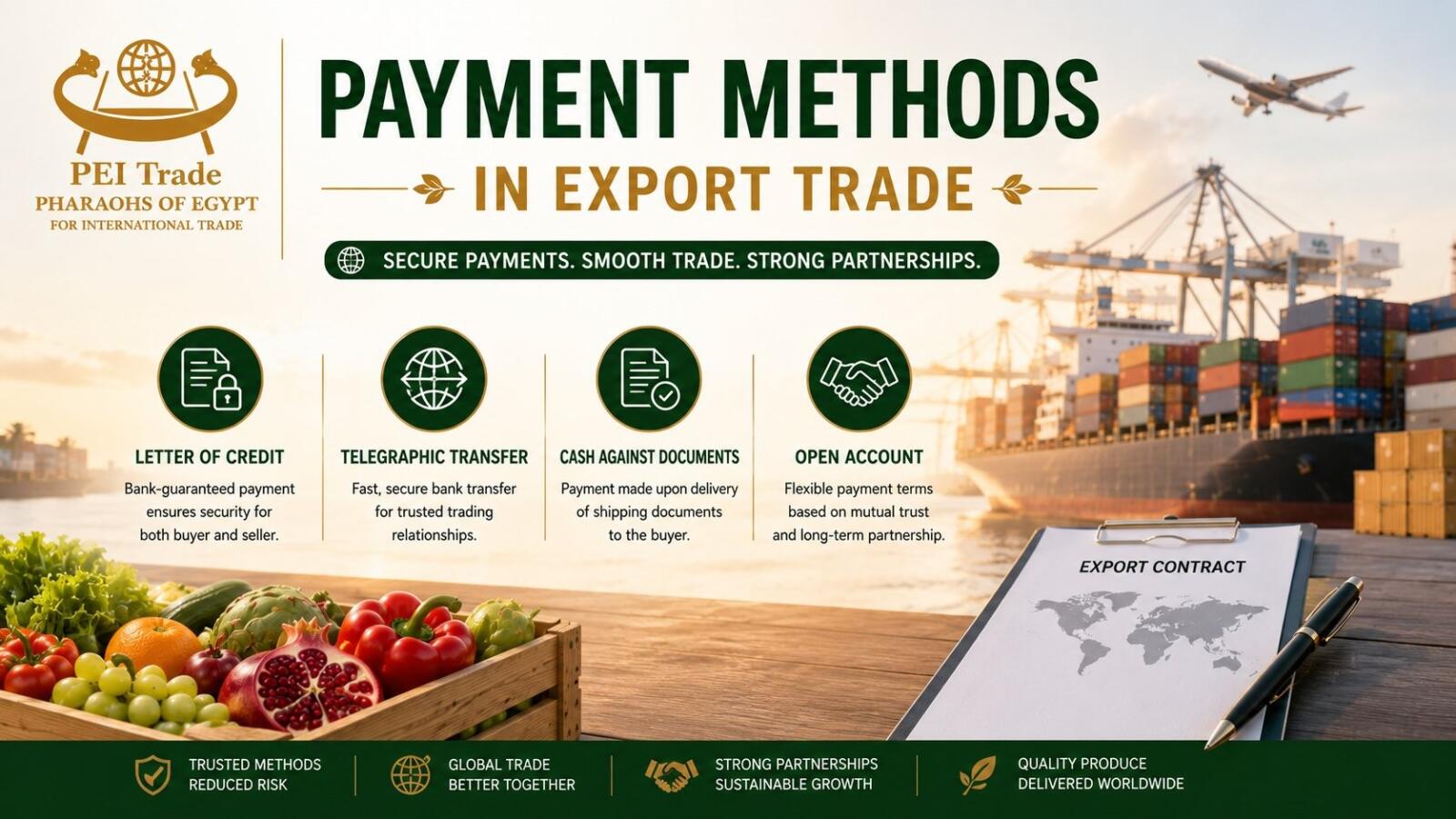
Price per carton is the easy part of a produce negotiation. Payment terms are where most first-time deals stall, because both sides are being asked to trust a counterparty they have not shipped with before. This is a plain account of the instruments used on Egyptian fresh produce in 2026, what each one actually protects, and what we can work with.
Full payment before loading is the cleanest arrangement and the cheapest. No bank fees beyond the wire, no document discrepancies, no delay in releasing the bill of lading. It puts all the performance risk on the buyer, so it suits established relationships, small trial loads, and situations where the buyer wants the lowest possible unit price. On a first container from a new customer we generally do not insist on 100 percent advance, because it is a hard ask for a buyer with no shipment history with us.
The most common structure on our accounts is 30 percent deposit against the proforma invoice and 70 percent balance against scanned documents before the originals are couriered. The deposit does real work. It reserves packhouse capacity and reefer space in a peak week, and it means neither party walks away lightly once the fruit is picked to a specific size and count. Some buyers prefer 20 or 25 percent, which is negotiable on repeat business.
An irrevocable letter of credit at sight, issued or confirmed by a bank we can work with, gives the buyer control and gives us bankable security. It is the right instrument on large volumes, on new relationships where neither side wants to carry exposure, and in markets where currency controls make direct transfer slow. The cost is real: issuance and confirmation fees, and a documentary discipline that punishes small errors. A single mismatch between the carton marking and the LC text can hold payment for weeks. If you are opening an LC with us, send the draft text before it is issued so we can check it against what we can physically produce. Our note on the full export document set lists what the LC will normally call for.
Under CAD the documents move through the banking channel and are released to the buyer on payment. It is cheaper than an LC and faster to arrange. The gap is that no bank guarantees payment, so if the buyer declines the documents the cargo is sitting at destination with demurrage running. We use CAD selectively, generally with buyers who have already completed two or three shipments on deposit terms.
Payment 30 or 60 days after arrival is standard in some European retail supply chains and is occasionally requested on Egyptian origin. We can consider it on long-running programmes with credit insurance in place, but it is not a starting position on a first order.
Payment terms and delivery terms answer different questions and are often confused. Incoterms decide where cost and risk transfer, not when money moves. A CIF sale can still be paid by advance TT, and an FOB sale can still sit behind a letter of credit. Our guide to Incoterms 2020 on Egyptian produce sets out the delivery side.
Terms and price move together. A quote against 100 percent advance is not the same quote as one against a confirmed LC. Tell us the structure you need and the volume you intend to take, and we will price against it. WhatsApp +20 10 9911 1918.
