Address
Work Hours
Monday to Friday: 7AM - 7PM
Weekend: 10AM - 5PM

Address
Work Hours
Monday to Friday: 7AM - 7PM
Weekend: 10AM - 5PM


Variety, grade, punnet and tray formats, cold chain set points and airfreight versus sea options for Egyptian strawberry exports in the 2026/2027 season.
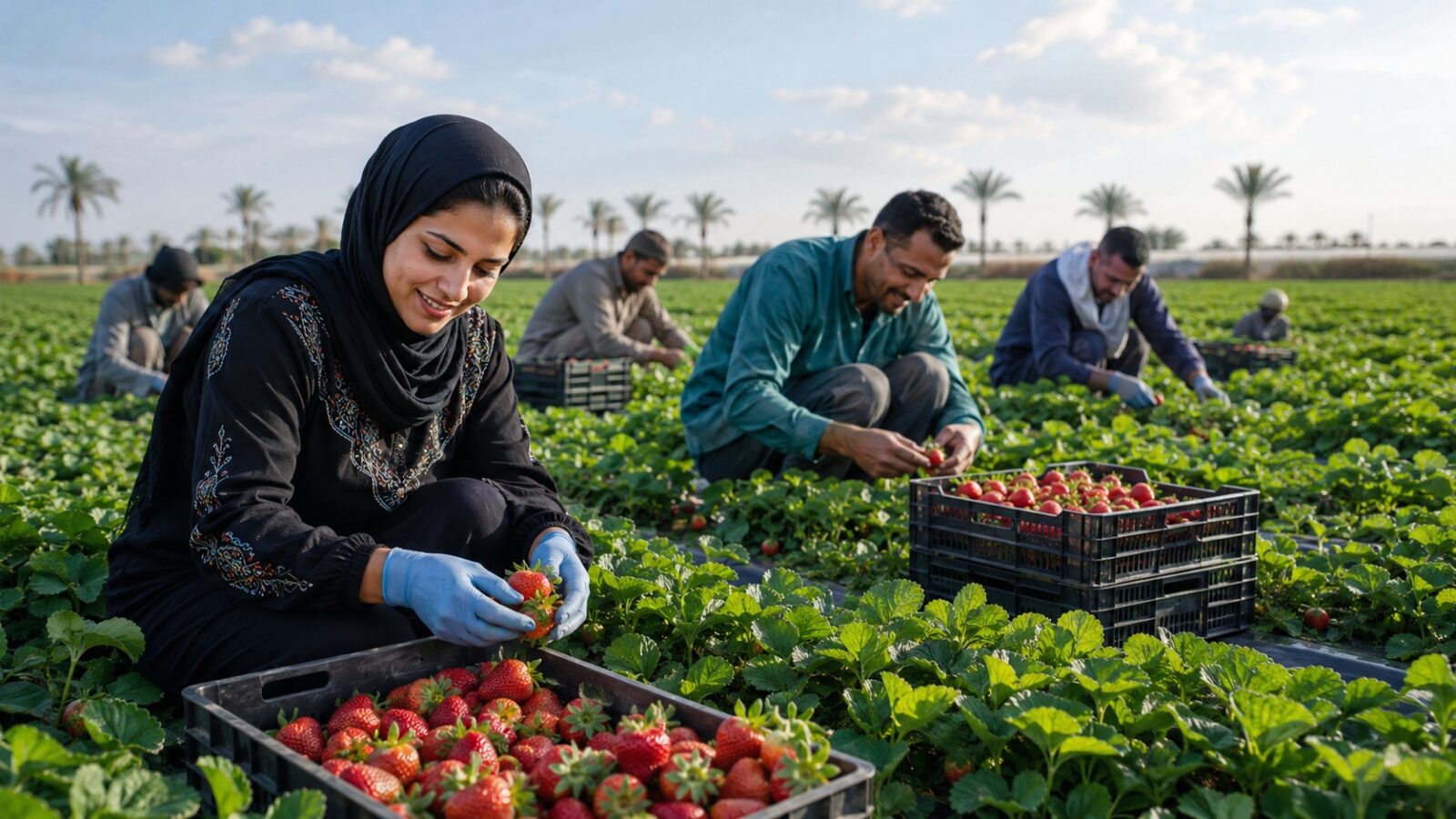
Strawberry bookings for the coming Egyptian winter open now, in September, while the transplants are going into the ground. Buyers who wait until the first fruit is picked in November are negotiating against a volume that has already been allocated. This is a short, intense category with tight arrival tolerances, so specification matters more than it does on a storage crop.
Commercial volume runs from the second half of November through March, with the peak between January and early March. October fruit exists but is thin and expensive. April fruit is available in some years and generally goes to the processing line rather than the fresh export programme. The Egyptian window sits deliberately in the gap between the end of the northern European season and the start of Spanish volume, which is what makes it commercially interesting to EU and GCC buyers.
Fortuna is the volume variety for fresh export, valued for firmness and a conical shape that travels and displays well. Festival remains widely grown and carries good colour and flavour but is softer on arrival, which suits shorter lanes and the GCC. Sensation and Winter Star appear in newer plantings. Camarosa is still present but is increasingly directed to the frozen line.
For a fresh sea shipment, firmness on arrival is the binding constraint, so Fortuna is normally the correct answer. Specify the variety by name in the contract. Strawberry is a category where substituting one variety for another changes the arrival result completely.
Class I (a grade tier from the applicable marketing standard, not a marketing term — see our Extra, Class I and Class II tolerances reference) export fruit is typically specified at 25 mm minimum diameter, with uniform colour cover of at least three quarters of the surface, the calyx fresh and green, and the fruit free of bruising, wet or sunken tissue and visible mould. Count per punnet is not usually fixed. Weight per punnet is.
Buyers running a retail programme should specify a colour range rather than a single stage, because fruit picked for a ten-day sea transit is picked lighter than fruit picked for airfreight.
The standard retail format is a 250 g or 500 g vented PET punnet, eight or ten punnets to a carton, giving 2 kg or 2.5 kg net per carton. Wholesale and foodservice fruit moves in 500 g punnets or in 1 kg open trays. Punnets sit in a shallow tray or carton with a lid, and cartons are stacked on a Euro pallet at 1200 by 800 mm, typically 8 to 10 cartons per layer and 12 to 16 layers depending on carton height.
Insist on a vented punnet and a vented carton. Strawberry needs field heat removed fast, and a closed pack makes forced-air cooling ineffective. Our reference on retail pack formats on Egyptian produce covers punnet and tray specifications across crops.
Fruit should be forced-air cooled to 1 degree Celsius pulp within a few hours of picking, and held there. The reefer set point for transit is 0 to 1 degree Celsius with relative humidity around 90 to 95 percent and fresh air exchange closed or minimal. Strawberry is not chilling sensitive in the way mango is, so the risk is on the warm side rather than the cold.
Some programmes ship under modified atmosphere or with CO2 pads to suppress Botrytis. This extends usable life but changes the flavour profile slightly and needs to be agreed in advance, not applied as a surprise. See cooling methods for Egyptian produce for how forced-air cooling is specified and verified.
Airfreight from Cairo gives arrival in the EU or GCC within 24 to 48 hours and preserves a fresh-picked eating quality that sea cannot match. It also costs several times more per kilo and only makes sense on premium retail or early-season fruit. Sea transit to Mediterranean and northern EU ports runs roughly 5 to 12 days depending on destination, which is workable on firm Fortuna fruit that was cooled properly. Anything softer should fly.
EU and UK consignments need a phytosanitary certificate and, for EU entry, CHED-PP pre-notification. Residue compliance is the live risk on this crop given the spray intervals in a protected winter production system, so pre-shipment residue testing against the destination market’s limits is worth building into the programme rather than treating as optional. GLOBALG.A.P. certification is a practical requirement for EU and UK retail.
To request specifications, pack options and availability for the 2026/2027 Egyptian strawberry window, message the PEI Trade export desk on WhatsApp at +20 10 9911 1918.
