Address
Work Hours
Monday to Friday: 7AM - 7PM
Weekend: 10AM - 5PM

Address
Work Hours
Monday to Friday: 7AM - 7PM
Weekend: 10AM - 5PM


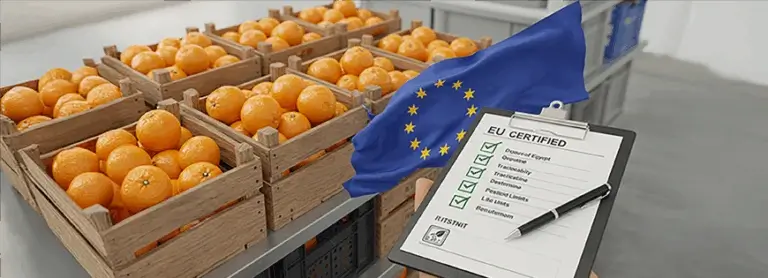
The European Union runs some of the strictest import controls on fresh produce anywhere, and citrus is one of the most closely watched categories. If you are buying Egyptian oranges for an EU market, the compliance burden is shared: your supplier has to produce the documents, and you have to be able to check that what you were promised is what arrived.
This guide sets out what is legally required, what large retailers demand on top of the law, and the specific questions to put to an Egyptian supplier before you contract. It is written so a buyer can verify rather than trust.
These are two different lists, and confusing them is the most common mistake on both sides of the trade. The law decides whether the container clears the border. The retailer decides whether it gets onto a shelf.
| Requirement | Legally required? | Who asks for it |
|---|---|---|
| Phytosanitary certificate | Yes | EU plant health law; issued by Egypt’s national plant protection organisation |
| Residues within EU maximum residue limits | Yes | Regulation (EC) No 396/2005, enforced at border checks and in-market |
| Pre-notification through the EU import system | Yes | The importer of record, before arrival |
| Marketing standard compliance on grade and labelling | Yes | The EU marketing standards for citrus |
| Traceability back to the grower | Yes in substance | EU food law; and every serious buyer |
| GLOBALG.A.P certification | No | Retailers, almost universally. Not a legal condition of entry |
| A social or ethical audit | No | Large retail groups, increasingly |
| Third-party inspection at loading | No | Buyers who want independent confirmation before payment |
Which Egyptian authority signs off which of these is set out in Egypt’s export control bodies, and how lot codes are built so a carton ties back to a field block is in traceability and lot coding.
Maximum residue limits are set in EU law under Regulation (EC) No 396/2005, with the European Food Safety Authority providing the scientific assessment behind them. Two points matter commercially, and both are routinely missed:
A failed residue check can mean rejection at the border, destruction or re-export at the importer’s cost, and increased check frequency on subsequent consignments from that origin. The rules that most often catch buyers out are in five pesticide rules for Egyptian fruit exports to the EU.
Citrus entering the EU is subject to plant health controls under the EU plant health regime, which means three things in practice:
Whether cold treatment applies to your consignment depends on the pest requirements in force for Egyptian citrus at the time you ship, so confirm it per programme rather than assuming last season’s position still holds.
Beyond safety, the EU sets marketing standards that govern how citrus may be graded and labelled. The practical consequences for a carton arriving in Rotterdam or Genoa:
Tolerances for defects and sizing are set in the standard itself and are revised from time to time, so we do not reproduce the figures here. Ask your supplier to state the class and tolerance they are packing to, in writing, on the contract. Our packing and labelling standards guide covers how the carton is built to satisfy this.
An unbroken, documented cold chain is not optional on this lane. Temperature records have to show continuous refrigeration from the packhouse to the EU port, and a gap in the record is treated as a gap in the cold chain whether or not the fruit suffered.
Set points for oranges sit in a narrow band, and the right figure depends on the variety, the voyage length and whether cold treatment is being run at the same time. We confirm the set point per shipment rather than publishing one number; the ranges and the monitoring we work to are in the cold chain requirements guide.
PEI Trade supplies from GLOBALG.A.P certified farms with residues managed to the destination market’s limits, full document sets prepared for the EU lane, and third-party inspection at loading by an internationally recognised body on request. Certificate numbers, issuing bodies and validity dates go to buyers on request rather than being published here.
No. It is not a condition of entry under EU law. In practice it is close to unavoidable, because EU supermarkets ask for it as a condition of listing. The legal requirements are the phytosanitary certificate, residues within EU limits, pre-notification, marketing standard compliance and traceability.
It can be refused entry, then destroyed or re-exported at the importer’s cost, and subsequent consignments from that origin may face increased check frequency. That is why the control that matters is the pre-harvest interval at the orchard, not testing at the end.
The importer of record, before the consignment arrives, so the border control post can schedule its check. Missing it holds the container regardless of the quality of the fruit or the exporter’s paperwork.
It depends on the pest requirements in force for Egyptian citrus when you ship. Where treatment applies, the schedule is set by the destination and has to be planned into the voyage from the start, because it cannot be applied at arrival. Confirm it per programme rather than assuming last season’s position.
Class and size, country of origin, an identifiable packer or dispatcher, and lot information that ties the carton to a specific harvest, in a language the destination accepts. The fruit inside must match what the label declares.
Because they are set in the EU marketing standard and revised from time to time, and a figure copied onto a web page goes stale without warning. Ask your supplier to state the class and tolerance on the contract, which is the version that binds anyone.
Yes. Third-party inspection at loading can be arranged on request, alongside the lot residue analysis and the reefer temperature record for the voyage.
Send the destination port, the volume, the variety and count, the class and tolerance your market needs, and the shipping weeks. We will confirm what the EU document set will look like for that lane before you commit.