Address
Work Hours
Monday to Friday: 7AM - 7PM
Weekend: 10AM - 5PM

Address
Work Hours
Monday to Friday: 7AM - 7PM
Weekend: 10AM - 5PM


Egyptian garlic specifications for the 2026 season: white and Balady types, bulb diameters, curing standards, mesh bag and carton formats, container loading and shipping windows for wholesale buyers.
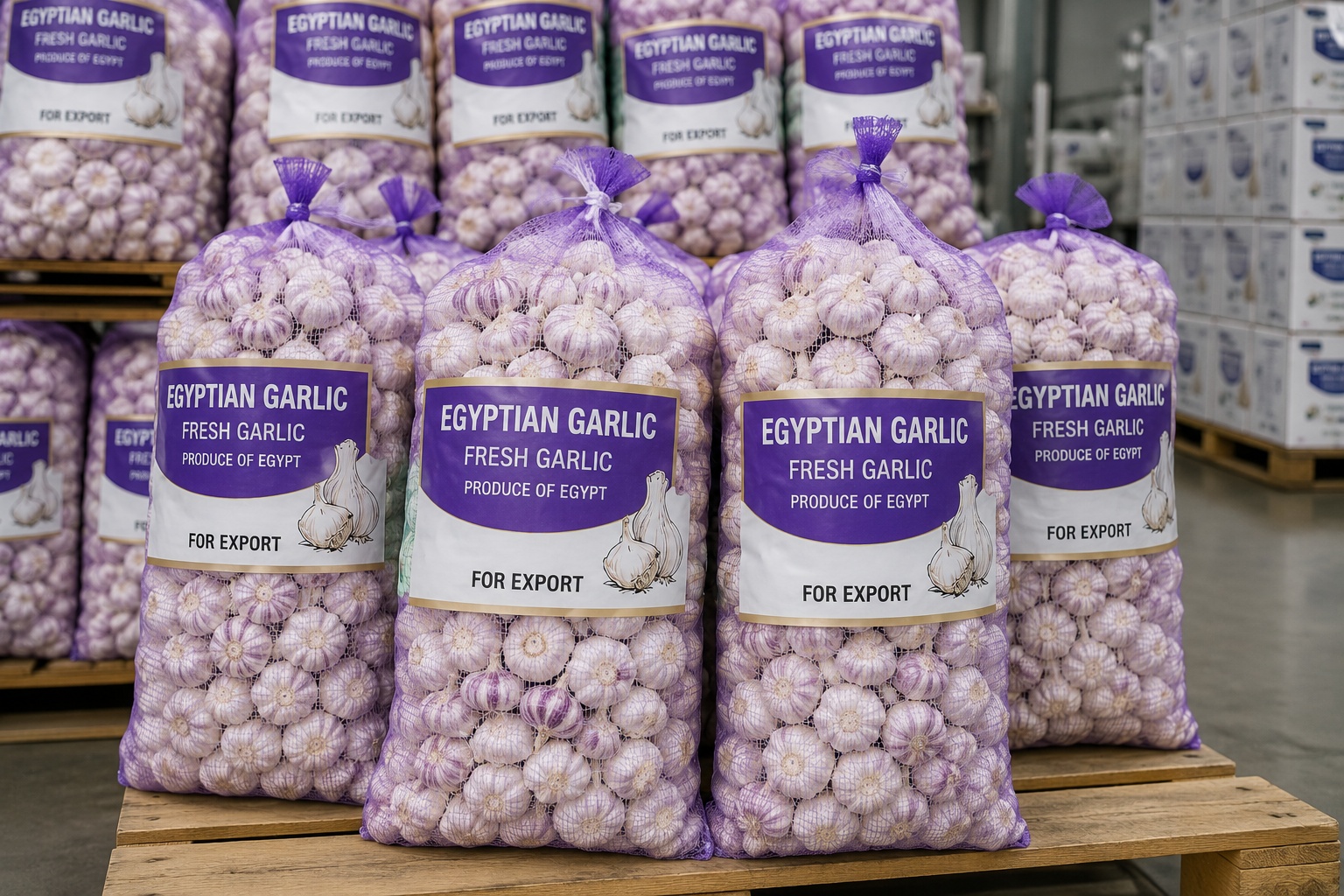
Garlic is one of the quieter lines in the Egyptian export basket, and it is also one of the most predictable. The crop is lifted between March and May, cured through late spring, and then moves out of controlled storage in a steady flow that runs into the following winter. For buyers planning purchases now, in the second half of July, the 2026 crop is fully cured and graded, and stock positions are clear enough to quote against with confidence.
Two commercial types dominate shipments. Egyptian white garlic, sometimes listed as Chinese-type white, produces a large, clean, uniformly shaped bulb with white outer skin and a moderate clove count. It is the standard choice for retail packing and for buyers who resell in nets or trays. Balady garlic, the traditional local type, has a pink to purple tint, more cloves per bulb, and a stronger flavour profile. Processors, dehydrators and buyers serving Middle Eastern and North African kitchens usually specify Balady.
Sizing is measured across the widest point of the bulb. Commercial ranges run 4.5 to 5.0 cm, 5.0 to 5.5 cm, 5.5 to 6.0 cm, and 6.0 cm and up. Most GCC and Asian programmes sit in the 5.0 to 6.0 cm band. Larger counts carry a premium and are usually reserved for retail-facing packs.
Grade criteria we work to are straightforward: bulbs firm and fully cured, outer skin intact and dry, no sprouting, no visible mould, no soil clinging, roots trimmed close, and stems cut to specification. Moisture after curing should sit at a level that keeps the bulb dormant through the voyage. We reject soft-necked or partially split bulbs at the packhouse rather than at the port.
The most common export format is the 10 kg mesh bag, palletised. Also available are 5 kg mesh, 20 kg mesh, 10 kg telescopic cartons for higher-value retail programmes, and consumer nets of 250 g, 500 g and 1 kg packed into master cartons. Peeled and dehydrated garlic is a separate line with its own specification sheet.
Pallet configuration for 10 kg mesh runs 100 bags per pallet on a standard 100 x 120 cm base, giving 1,000 kg per pallet. A 40 ft container takes 20 pallets, so roughly 20 to 24 tonnes depending on format and whether the load is floor-stacked or palletised. Floor loading raises volume but slows discharge and increases handling damage, so we recommend palletising for any buyer running a modern warehouse.
Garlic ships either in ventilated dry containers or in reefers set at 0 to 2 degrees Celsius with low relative humidity, around 60 to 70 per cent, and active ventilation. The choice depends on transit time and destination climate. Short Red Sea and Gulf runs are often fine in ventilated dry boxes. Longer voyages to South and East Asia, or to Europe in warm months, justify the reefer. Our full breakdown of set points by crop is in the guide on reefer container loading for Egyptian produce.
Loading is from Alexandria, Damietta or Port Said depending on the line and the destination. We quote on FOB, CFR, CIF and DAP under Incoterms 2020. Standard document set covers commercial invoice, packing list, bill of lading, certificate of origin, and phytosanitary certificate issued by the Egyptian Central Administration of Plant Quarantine. Third-party inspection by SGS or Intertek is arranged on request and at buyer cost, with the report issued before loading.
Cured garlic is available from controlled storage from June through to the following March. Volumes are deepest between July and December. Lead time from confirmed order to loading is typically 7 to 14 days for standard mesh formats, longer for consumer packs that need printed film or private-label netting. Buyers who need garlic alongside other storage vegetables can consolidate with onions, which run on a similar calendar. See the note on Egyptian onion supply for summer.
To price a load, send us the type, size band, pack format, destination port and Incoterm, and the volume you need per shipment. We come back with a firm offer and a specification sheet. Samples of the current crop can be sent by courier ahead of a first order.
Contact the PEI Trade export desk on WhatsApp at +20 10 9911 1918 for current garlic availability and pricing.
