Address
Work Hours
Monday to Friday: 7AM - 7PM
Weekend: 10AM - 5PM

Address
Work Hours
Monday to Friday: 7AM - 7PM
Weekend: 10AM - 5PM


The Netherlands is Egypt’s gateway into the European lemon market. Rotterdam is Europe’s largest fresh-produce port, and Dutch importers re-distribute Egyptian lemons (HS 0805.50) across the EU, the UK and Scandinavia. For Dutch buyers, Egypt offers EU-compliant Eureka fruit, competitive FOB and a supply window that fills the gap between Spanish seasons. This guide covers varieties, cold-chain logistics, EU import requirements, seasonality and pricing.
The Netherlands is Egypt’s EU re-export hub for lemons via Rotterdam. Peak supply is November–April. The export-standard variety is Eureka (Adalia), thick-peeled for long shelf life; Baladi serves juice buyers. Transit is 8–12 days by reefer. Imports must meet EU MRLs, EU plant-health (phytosanitary certificate) and retailer schemes (GLOBALG.A.P, GRASP, often BRCGS for packers).
The Netherlands consumes relatively few lemons itself but is Europe’s leading re-export platform. Dutch traders source Egyptian Eureka to cover the window when Spanish lemons run short (late spring into summer) and to add competitively priced volume year-round. Rotterdam’s reefer infrastructure, ripening and repacking capacity, and pan-European distribution make it the logical first port for Egyptian citrus destined for multiple EU retailers.
| Market snapshot | Detail |
|---|---|
| Role | EU re-export gateway (Rotterdam) |
| HS code | 0805.50 (lemons & limes) |
| Main entry port | Rotterdam |
| Transit time | 8–12 days by sea |
| Peak window | November–April (plus summer gap-fill) |
| Key variety | Eureka (Adalia) |
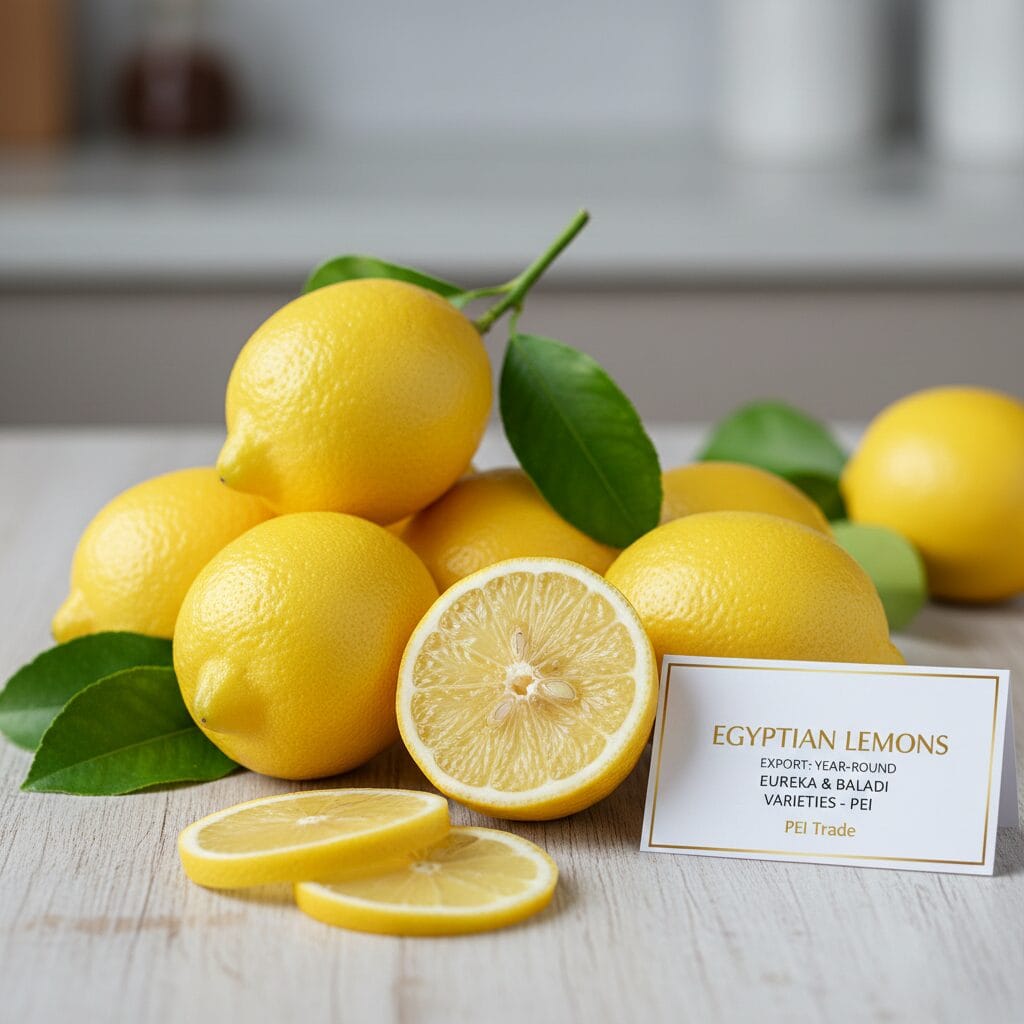
Eureka (Adalia): the EU export standard — elongated, thick-skinned, bright yellow, with the shelf life needed for repacking and onward distribution. Baladi: round, high-juice, mostly for processing/juice buyers. Graded to EU/UNECE calibre standards (counts 80–150), packed in 15 kg or retail-ready cartons/punnets. Grade A is smooth and colour-uniform; class-II fruit routes to processing.
Shipments sail from Alexandria or Damietta to Rotterdam in roughly 8–12 days. Lemons travel in reefer containers at 10–13°C — warmer than oranges to avoid chilling injury — at 85–90% RH. Fruit is pre-cooled, waxed and treated within EU-permitted limits. At Rotterdam it is inspected, repacked to retailer spec and distributed across the EU/UK cold chain.
EU imports require a phytosanitary certificate and compliance with EU plant-health entry rules for citrus. Pesticide residues must meet EU MRLs (among the world’s strictest), verified by border and retailer testing. Organised buyers require GLOBALG.A.P plus GRASP at farm level and typically BRCGS or IFS at the packhouse. Labelling follows EU marketing standards (variety, class, calibre, origin, packer). Full lot traceability is mandatory.
| Period | Availability |
|---|---|
| November–April | Peak — winter main crop |
| May–July | Summer Eureka — fills the Spanish gap |
| August–October | Cold-store & late fruit — continuity supply |
The summer Eureka (Adalia) crop is Egypt’s key EU advantage — it supplies the Dutch trade precisely when Spanish lemons are scarce and prices firm.
Source & data: Egyptian lemon exports ~100,000 tonnes (2023); Egypt among fastest-growing lemon exporters. Source: FreshPlaza, 2024. HS code 0805.50 (lemons & limes). Figures are Egypt-market trade data; per-shipment specifications are confirmed at contracting.
PEI Trade — New Cairo, Egypt. Request a quote or lemon spec sheet →