Address
Work Hours
Monday to Friday: 7AM - 7PM
Weekend: 10AM - 5PM

Address
Work Hours
Monday to Friday: 7AM - 7PM
Weekend: 10AM - 5PM


The Netherlands is not primarily a place to sell mangoes — it is the gateway through which mangoes reach the rest of Europe. In 2024 the Netherlands imported about 181,000 tonnes of mangoes, more than 40% of all mango imports into Europe, and re-exported almost 156,000 tonnes — 86% of the total — onward to Germany (34%), France (10%), Belgium and beyond (CBI). Rotterdam, the largest seaport in Europe, is the entry point, backed by a dense cluster of ripening, repacking and distribution specialists that turn incoming fruit into supermarket-ready product for the whole continent. For an Egyptian exporter, that makes the Netherlands the single most efficient door into the European market: land quality fruit at Rotterdam and reach retail shelves across the EU through the world’s most developed fresh-produce distribution system. Because this is a retail-driven market, it buys on appearance and shelf life, not aromatic intensity — fibreless Kent and Keitt lead, with Naomi and Tommy Atkins close behind. This guide covers the varieties that suit the European market, shipping logistics into Rotterdam, EU import and food-safety requirements, the variety-by-window calendar, and how to open a supply program.
Think of the Netherlands as Europe’s mango distribution hub rather than an end market. It handles more than 40% of Europe’s mango imports and re-exports the overwhelming majority — around 86% — to Germany, France, Belgium and other EU destinations. The reason is infrastructure: Rotterdam is the largest seaport in Europe, and around it sits a cluster of specialist ripening, repacking and cold-chain distribution companies that can take a container of green fruit and deliver ripened, retail-packed product to supermarkets across the continent within days. No other European entry point matches that combination of port capacity and fresh-produce expertise.
For an Egyptian supplier, the strategic logic is simple. Rather than shipping small volumes directly to each consuming country, you land quality fruit at Rotterdam once and let the Dutch trade cluster distribute it EU-wide — so one compliant, well-documented supply line can reach many markets. Success here is about meeting European retail expectations consistently: the right fibreless varieties, reliable calibres and pack specifications, an unbroken cold chain, and honest, dependable volumes. Dutch importers value suppliers who deliver exactly what they promise, season after season.
The European retail market buys on appearance, consistency and shelf life rather than aromatic intensity, and it strongly prefers fibreless fruit. The table below leads with the varieties that suit EU supermarket programmes and sea-freight transit; Egypt’s aromatic indigenous cultivars serve a smaller specialty and ethnic-retail demand.
| Variety | Profile | Best use | Netherlands / EU fit |
|---|---|---|---|
| Kent | Fibreless, sweet, firm; excellent shelf life; the EU’s most popular variety | Supermarket retail & ripening programmes | ★★★ The European benchmark — almost all exporters supply Kent |
| Keitt | Large, firm, low-fibre, mild-sweet; very long shelf life; late-season | Sea-freight retail & extended-window supply | ★★★ Ideal for long sea transit and shelf life |
| Naomi | Attractive golden fruit, sweet, ships well | Retail & ready-to-eat programmes | ★★★ Strong appearance and travel for EU retail |
| Tommy Atkins | Firm, robust, excellent colour and shelf life; some fibre | Long-haul retail & distribution | ★★ Durable and colourful; a familiar EU trade variety |
| Zebda / Owaisi | Rich, aromatic Egyptian specialties | Ethnic & specialty channels | ★ Niche demand via diaspora and specialty retail |
For full variety detail and calibres see the Egyptian mango export guide, and the profiles for Naomi & Kent, Keitt and Tommy Atkins.
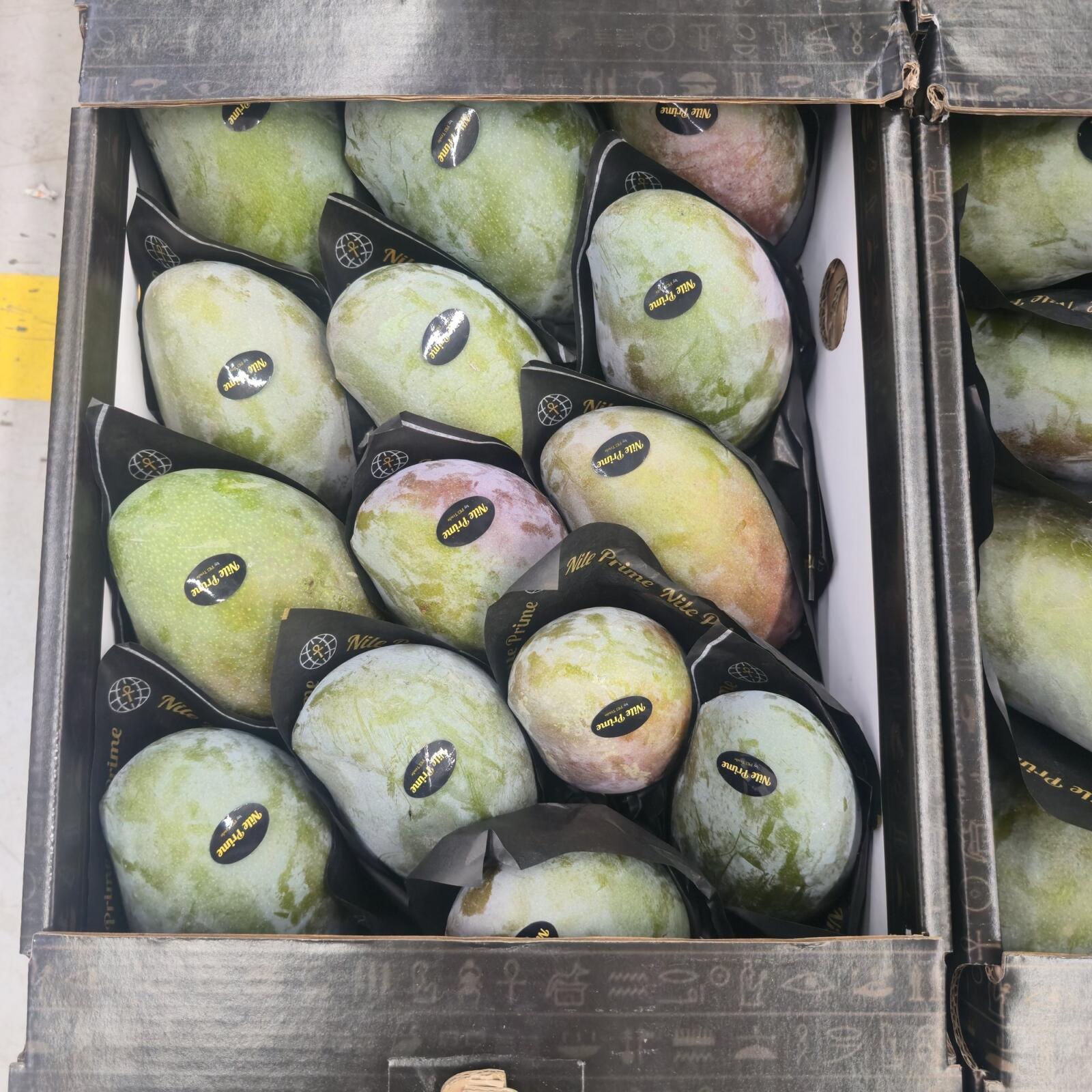
The workhorse route is reefer sea freight from Egypt’s Mediterranean ports — Damietta and Alexandria — to Rotterdam, Europe’s largest seaport, a short and well-served Mediterranean-to-North-Sea lane. On arrival, fruit typically enters the Dutch ripening, repacking and distribution cluster before moving on to EU retail. A controlled cold chain end-to-end is essential, since European retail rejects fruit with chilling injury or inconsistent ripeness.
Hot-water treatment is a standard post-harvest step for export mango, and it serves two purposes. Disease control: a hot-water dip at roughly 48–52 °C for 5–10 minutes, followed by hydro-cooling and drying, suppresses anthracnose and stem-end rot — the main post-harvest diseases that shorten shelf life in transit and cause retail rejection. Fruit-fly disinfestation: EU plant-health rules require imported mango to be free of quarantine pests including fruit flies, and the internationally accepted quarantine schedule is around 46.1 °C for 65–90 minutes, with longer times used for larger fruit. Exact temperature and dwell time depend on cultivar, fruit size and maturity, so the protocol is set per consignment and per destination requirement, applied within about 24 hours of harvest.
| Month | Available varieties (export) | Netherlands / EU notes |
|---|---|---|
| Jun | Season opening — early varieties | Programmes build as the European summer starts |
| Jul | Naomi, Kent building; Zebda (specialty) | Appearance varieties for EU retail |
| Aug | Kent (peak), Naomi; Keitt begins | Core summer window into Rotterdam |
| Sep | Keitt (peak), Kent | Late-season firm fruit ideal for sea freight and shelf life |
| Oct–Nov | Keitt (late) | Late window — travel-ready fruit closes the season |
Windows are indicative and shift year to year with weather. For EU retail, book Kent and Keitt programmes early. See the Egyptian mango export report 2026 for volumes, destinations and price context.
Because the Netherlands is Europe’s #1 mango entry point: it handles over 40% of EU mango imports and re-exports about 86% onward to Germany, France, Belgium and beyond. Landing fruit at Rotterdam lets one compliant supply line reach retail across the EU.
European retail buys on appearance and shelf life and prefers fibreless fruit, so Kent (the benchmark) and Keitt lead, with Naomi and Tommy Atkins close behind. Egypt’s aromatic indigenous varieties serve smaller specialty and ethnic channels.
By reefer sea freight from Damietta or Alexandria to Rotterdam, Europe’s largest seaport, carried at about 10–13 °C, then into the Dutch ripening, repacking and distribution cluster for EU-wide delivery.
A phytosanitary certificate under EU plant-health rules, compliance with EU pesticide MRLs (with random border checks), full traceability under EU food law, and GLOBALG.A.P as the de-facto retail baseline. EU organic certification is optional and opens a premium segment.
June to November, aligning with the European summer and autumn retail window. Kent and Keitt programmes are the mainstay; late Keitt closes the season.
Planning to supply the European market through Rotterdam? PEI Trade supplies EU-retail-focused Egyptian varieties — Kent, Keitt, Naomi and Tommy Atkins — with calibre selection, EU-spec grading and traceable, retail-ready packing, and cold-chain management on the Mediterranean run to Rotterdam. Tell us your target volumes, calibres, certification needs and delivery window, and we’ll structure a compliant, well-timed offer for the EU.
PEI Trade. “Egyptian Mango Exports to the Netherlands: Europe’s Gateway via Rotterdam.” peitrade.com, 2026, https://peitrade.com/egyptian-mango-exports-to-netherlands/
Sources: CBI — Centre for the Promotion of Imports (European & Dutch market potential for mangoes: Netherlands ~181,000 t imported in 2024, >40% of EU; ~156,000 t / 86% re-exported to Germany 34%, France 10%, Belgium 6%; Rotterdam as Europe’s top mango entry point; European preference for fibreless Kent/Keitt); UN Comtrade / WITS (HS 080450); EU plant-health Regulation (EU) 2016/2031 and EU MRL Regulation (EC) 396/2005; UNECE marketing standards for mangoes; ISHS / ScienceDirect post-harvest hot-water-treatment studies; FAO storage-temperature guidance. Figures cover HS 080450 (guavas, mangoes & mangosteens) — consistent with report 12531.
[email protected] · WhatsApp +20 109 911 1918 · www.peitrade.com · Brand: nile-prime.com · Ports: Alexandria, Damietta, Sokhna, Port Said (Incoterms 2020)