Address
Work Hours
Monday to Friday: 7AM - 7PM
Weekend: 10AM - 5PM

Address
Work Hours
Monday to Friday: 7AM - 7PM
Weekend: 10AM - 5PM


The 2026 Egyptian table grape season is closing. A review of variety performance, punnet and carton formats, cold chain requirements and how importers should structure 2027 volumes.
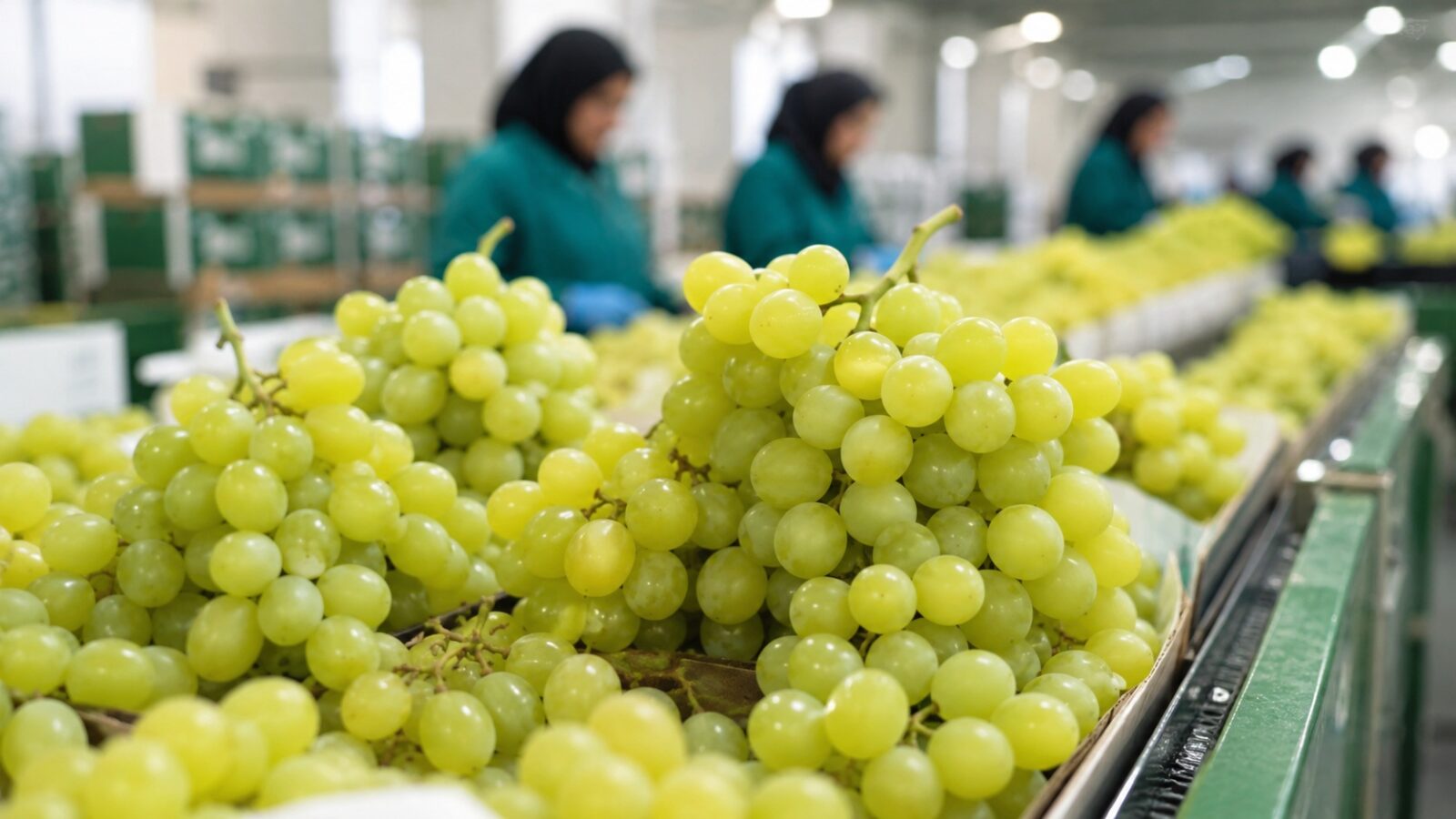
The 2026 Egyptian table grape season is now in its closing weeks. Early Prime and Flame volumes finished in June, the main Superior and Early Sweet blocks cleared through July, and what remains in mid-August is late Crimson Seedless and Autumn Royal out of the Nubaria and Wadi El Natrun reclamation areas. Loading continues into the first week of September on the latest blocks, after which Egypt hands the market back to South Africa and, later, to Peru and Chile.
Superior Seedless carried the bulk of the volume again, as it does most years. Bunch weights held between 500 and 700 grams across the main harvest, with berry diameter mostly in the 18 to 20 mm band and Brix landing between 16 and 18 degrees on fruit picked at the correct maturity. Early Sweet ran ahead of it by roughly ten days and shipped mainly to Gulf buyers who wanted the first arrivals rather than the largest berry.
Flame Seedless remains the variety most sensitive to handling. Colour development was even this year on the blocks that received adequate day and night temperature differential, but Flame still loses appearance faster in transit than Crimson, and buyers taking it beyond a fourteen day transit should expect some loss of gloss. Crimson Seedless, harvested late, gives the firmest berry and the best arrival record of the four, which is why it dominates the tail of the season.
Two formats cover almost all Egyptian grape exports. The 500 gram punnet, packed nine or ten to a 4.5 or 5 kg carton, is the standard for EU and UK retail. The open 4.5 kg carton with a bunch bag and a pad is the format for Gulf wholesale and for buyers who repack at destination. Both formats palletise the same way, at 100 to 108 cartons on a 1200 by 1000 mm Euro pallet, giving 20 pallets in a 40 foot high cube reefer and roughly 9 to 10 tonnes of net fruit per container.
Every export carton carries an SO2 generator pad. Buyers should confirm the pad type at the point of ordering, because a dual release pad suits transits above twenty days while a single release pad is adequate for a ten to fourteen day Mediterranean run and reduces the risk of bleaching around the pedicel.
Grapes are pre-cooled to 0 to 1 degree Celsius within eight hours of harvest and shipped at 0 degrees with 90 to 95 percent relative humidity and closed vents. Pulp temperature at gate-in should read within half a degree of the set point. Our full crop-by-crop reference is set out in the guide to reefer set points for Egyptian produce. Transit from Alexandria or Damietta runs 5 to 8 days to Northern Europe, 4 to 6 days to the Western Mediterranean, and 10 to 14 days to Jebel Ali or Jeddah depending on the service and transhipment.
Grape allocation for the 2027 season is contracted between December and February, well before the vines break dormancy. Importers who want a fixed weekly programme rather than spot cartons should indicate variety split, weekly volume, punnet or open carton format, and destination port during that window. Buyers running a full year of Egyptian supply should also read the Egyptian produce export calendar to see how the grape window sits against citrus, pomegranate and the winter vegetable programmes.
PEI Trade supplies more than thirty five export-grade crops from Egypt under strict quality control, with SGS or Intertek inspection available on request. To discuss late Crimson positions still available this season, or to open a 2027 grape programme, contact our export desk on WhatsApp at +20 10 9911 1918 with your destination port, required format and target weekly volume, and we will come back with a specification and quotation.
