Address
Work Hours
Monday to Friday: 7AM - 7PM
Weekend: 10AM - 5PM

Address
Work Hours
Monday to Friday: 7AM - 7PM
Weekend: 10AM - 5PM


 ByMaha
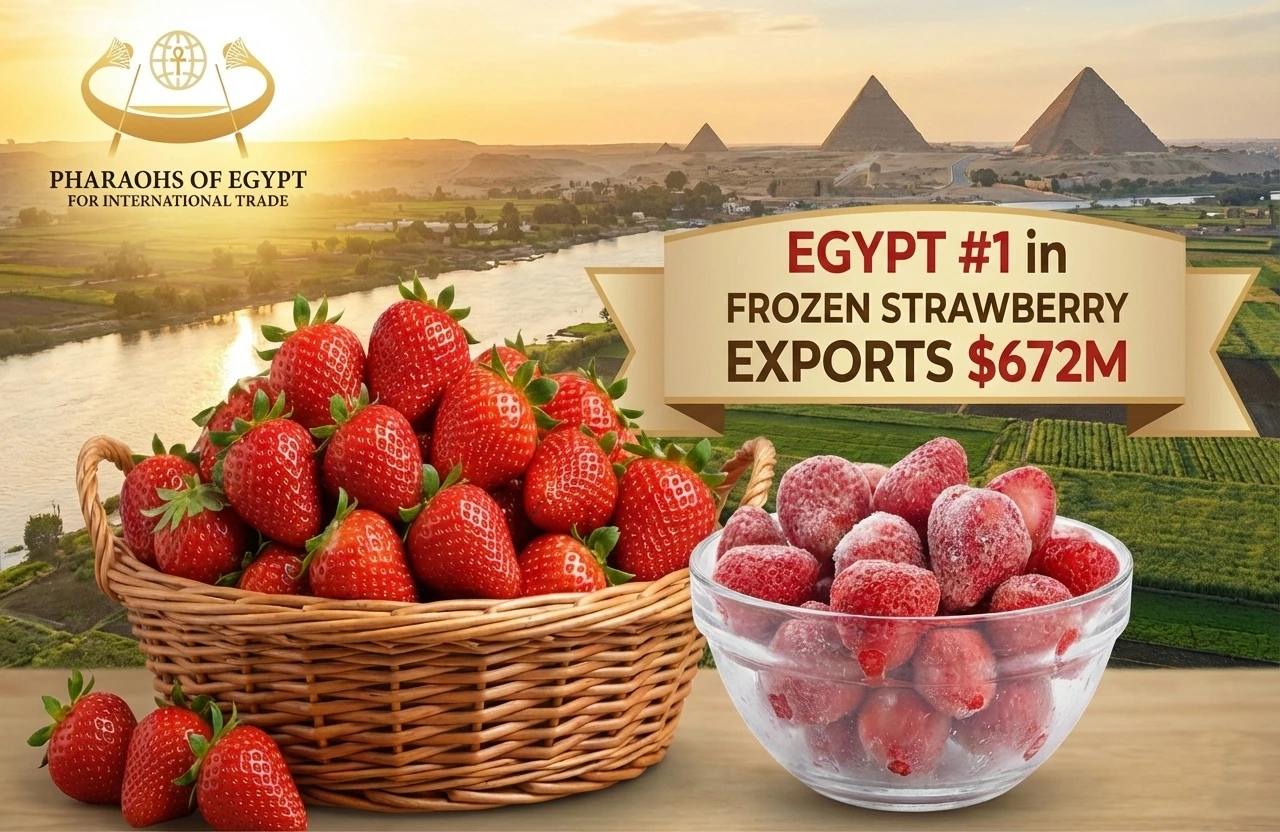
Egypt has claimed the top position worldwide in frozen strawberry exports, generating an impressive $672 million in revenue during 2025. This remarkable achievement represents an 81% surge compared to the $370 million recorded in the same period of 2024, adding $302 million to the country’s agricultural export earnings.
The frozen strawberry sector has emerged as the leading product in Egypt’s food industry exports. This outstanding performance highlights the country’s expanding production capacity and growing international demand for high-value Egyptian agricultural products. The record growth rate demonstrates Egypt’s competitive edge in global frozen fruit markets.
The $302 million increase in frozen strawberry exports marks one of the most significant gains in Egypt’s food export portfolio. This growth outpaced nearly all other food categories, establishing frozen strawberries as the country’s top agricultural export commodity. The 81% expansion reflects strong demand from international buyers who value Egyptian quality standards.
Egyptian frozen strawberry producers have invested heavily in modern processing facilities and sustainable farming practices. These investments have paid off with increased production volumes and improved product quality that meets stringent international requirements.
Egypt’s frozen strawberry industry benefits from several competitive advantages:
The country’s processing facilities operate under international certifications including HACCP, ISO, and Global GAP standards. These certifications open doors to premium markets in Europe, Asia, and North America where buyers demand verified quality assurance systems.
While frozen strawberry leads the pack, Egypt’s food export portfolio demonstrates remarkable diversity. Egyptian citrus also took the lead globally, surpassing 2 million tons in exports in 2025, reflecting strong international demand and premium quality standards. Cola concentrates ranked second with $533 million in exports, showing steady 5% growth that reflects stable global demand. This consistency provides a reliable revenue stream alongside more dynamic product categories.
Edible oils delivered strong performance, climbing from approximately $285 million to $405 million. This 42% increase worth $119 million demonstrates Egypt’s expanding role in regional cooking oil markets. Similarly, grain-based products and biscuits reached $340 million with impressive 42% growth, adding $100 million in export value.
Not all categories experienced growth. Sugar exports declined 6% to $353 million due to global price fluctuations, resulting in a $24 million decrease. Flour and milling products also faced headwinds, dropping 32% to approximately $304 million with a $145 million loss driven by increased international competition.
Fruit juice exports fell 21% to $209 million as competition intensified in major markets. These declines highlight the importance of continuous innovation and market diversification to maintain Egypt’s competitive position in global food trade.
Egyptian frozen strawberry production follows rigorous quality protocols. Farmers harvest strawberries during early morning hours when fruit temperatures are lowest and sugar content peaks. This timing ensures optimal flavor and texture in the final frozen product.
Transportation from farms to processing facilities occurs within hours of harvest. This rapid timeline prevents quality degradation and maintains the strawberry’s natural characteristics. Processing plants located near major growing regions minimize transit time and preserve freshness.
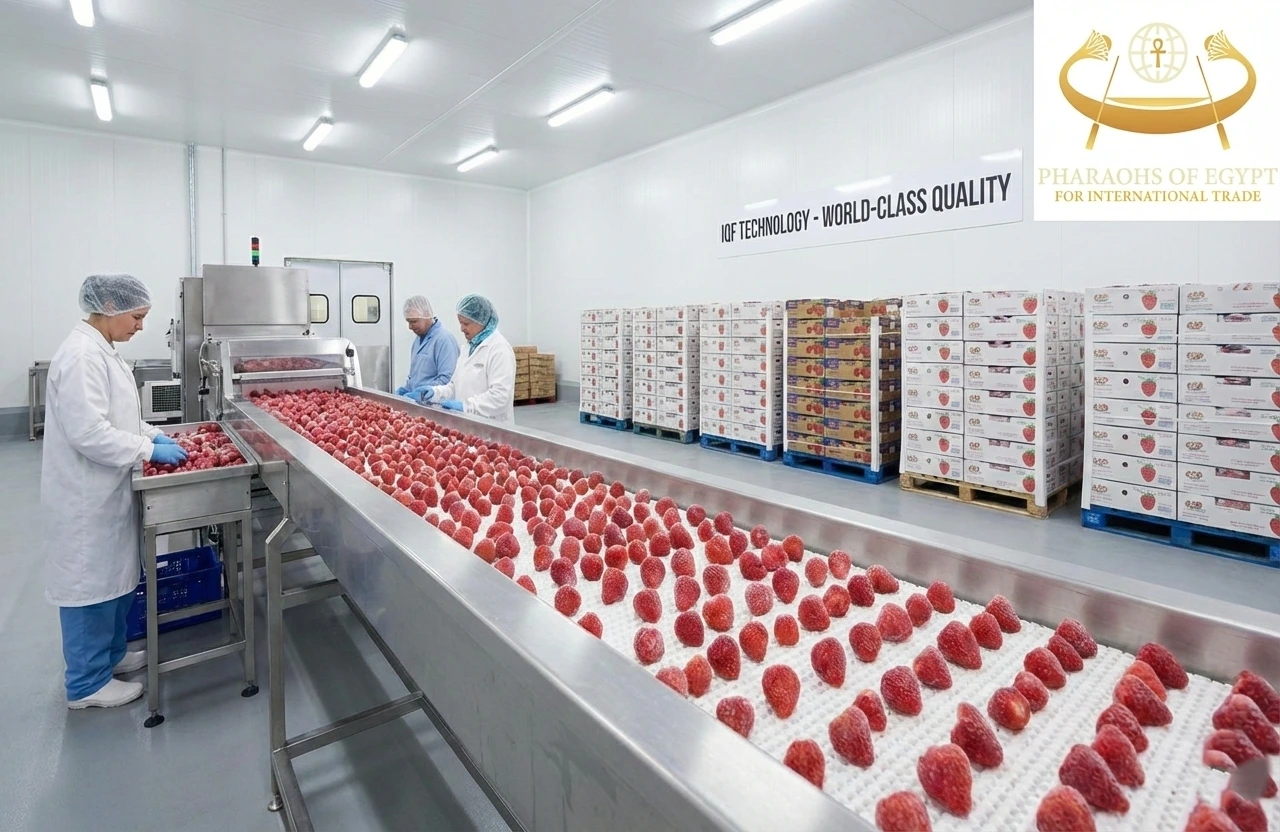
Modern IQF systems freeze individual strawberries in minutes rather than hours. This rapid freezing process creates smaller ice crystals that preserve cell structure and prevent mushiness after thawing. The technology maintains:
Quality control teams inspect each production batch for size uniformity, color consistency, and absence of defects. Only strawberries meeting strict specifications proceed to packaging and export.
Egyptian exporters maintain unbroken cold chains from processing facility to international destinations. Temperature-controlled warehouses keep frozen strawberry products at optimal storage conditions. Refrigerated containers equipped with monitoring systems track temperatures throughout ocean and land transport.
This infrastructure investment protects product quality and reduces waste. Buyers receive frozen strawberries in the same condition they left Egyptian facilities, ensuring customer satisfaction and repeat orders.
European countries remain the largest consumers of Egyptian frozen strawberry products. Germany, Belgium, Netherlands, and France import substantial volumes for yogurt manufacturing, ice cream production, and bakery applications. These markets value Egypt’s ability to deliver consistent quality at competitive prices.
Food manufacturers in the EU appreciate Egypt’s certification standards and traceability systems. The ability to track each batch from specific farms through processing provides transparency that European retailers demand.
Asian markets are driving significant growth in frozen strawberry imports from Egypt. Japanese food processors use Egyptian strawberries in premium desserts and beverages. South Korean manufacturers incorporate them into popular snack foods and smoothie products.
Middle Eastern countries also represent growing opportunities. As regional economies develop and consumer preferences shift toward convenience foods, demand for frozen fruit continues rising. Egypt’s geographic proximity provides delivery advantages over distant competitors.
The United States and Canada present emerging markets for Egyptian frozen strawberry exports. Health-conscious consumers are purchasing more frozen fruit for smoothies, breakfast bowls, and snacking. This trend creates openings for Egyptian suppliers to establish relationships with North American importers and retailers.
The $672 million in frozen strawberry export revenue makes substantial contributions to Egypt’s economy. This income supports foreign currency reserves and helps balance trade accounts. The agricultural sector’s success demonstrates Egypt’s potential to compete in high-value international markets.
Government officials recognize frozen strawberries as a strategic export commodity. Policies supporting agricultural modernization and export promotion have created favorable conditions for industry expansion.
The frozen strawberry industry provides employment across Egypt’s agricultural regions. Farm workers, processing plant employees, logistics staff, and quality control specialists all benefit from sector growth. These jobs offer stable incomes in rural communities where employment opportunities can be limited.
Contract farming arrangements connect small-scale growers with major exporters. These partnerships provide farmers with technical training, quality inputs, and guaranteed purchase agreements. Such arrangements improve farm incomes while ensuring exporters receive consistent supplies of premium strawberries.
Frozen strawberry’s 81% growth rate significantly exceeded most other food export categories in 2025. This performance established it as Egypt’s fastest-growing major food export. The $302 million increase surpassed gains in categories like chocolate (45% growth to $232 million) and animal feed preparations (51% growth to $213 million).
Even products showing strong performance couldn’t match frozen strawberry’s momentum. Frozen potatoes grew 16% to $240 million, while frozen vegetables remained relatively stable at $240 million with just 1% growth. These comparisons highlight frozen strawberry’s exceptional market position.
Egypt’s diverse food export portfolio provides resilience against market fluctuations. While some categories face challenges, others like frozen strawberry continue expanding. This balance supports overall export growth and economic stability.
The frozen strawberry sector’s success offers lessons for developing other agricultural exports. Investment in quality, technology, and market relationships creates sustainable competitive advantages. These principles can be applied to other crops with export potential.
Partner with PEI Trade for Direct Access to Egypt’s #1 Export
Don’t miss the opportunity to secure high-quality frozen strawberry supplies from the world’s leading exporter. PEI Trade connects international buyers directly with verified Egyptian producers who meet the highest quality standards.
Contact PEI Trade today to receive product samples, current pricing, and availability information. Our trade specialists will match you with the perfect supplier for your frozen strawberry requirements.
Egypt’s achievement of $672 million in frozen strawberry exports establishes the country as the undisputed global leader in this category. The remarkable 81% growth rate and $302 million increase demonstrate the industry’s strength and international competitiveness. Egyptian producers have successfully combined favorable growing conditions, advanced processing technology, and strategic market development to dominate global frozen fruit trade.
This success story extends beyond simple revenue figures. The frozen strawberry industry creates employment, supports rural development, and generates foreign currency that strengthens Egypt’s economy. As the top-performing food export category, it sets standards for quality and growth that other sectors can emulate.
Looking forward, Egyptian frozen strawberry exporters must continue innovating to maintain their leading position. Investments in sustainable farming, processing efficiency, and market diversification will be essential as competition intensifies. With proper strategies and continued commitment to excellence, Egypt can build on its $672 million achievement and further expand its share of global frozen strawberry markets.
Yes. Egyptian strawberries are known for their rich flavor, firm texture, and high quality. Grown in ideal climate conditions, they offer excellent sweetness, stability, and meet international market standards.
Egypt achieved this growth through modern IQF processing, expanded farming areas, higher quality standards, and strong demand from European and Asian markets. Favorable weather in 2025 also boosted yields while maintaining quality.
Year-round production, lower costs, fast delivery to key markets, ideal Nile Delta growing conditions, and advanced IQF technology give Egypt a pricing and quality advantage. International certifications ensure global compliance.
Top importers include Germany, Belgium, the Netherlands, and France, followed by Japan, South Korea, and Middle Eastern markets. North America is an emerging growth destination.