Address
Work Hours
Monday to Friday: 7AM - 7PM
Weekend: 10AM - 5PM

Address
Work Hours
Monday to Friday: 7AM - 7PM
Weekend: 10AM - 5PM



Key definition: Hot Water Treatment (HWT) and Vapor Heat Treatment (VHT) are postharvest phytosanitary heat treatments that kill fruit fly eggs and larvae inside fruit such as mango, so it can clear quarantine in importing markets. HWT immerses the fruit in hot water (for mango, around 46.1°C / 115°F); VHT uses heated water vapour to raise the fruit’s pulp temperature to about 46–47°C. Many countries require one of these treatments before they will accept host fruit.
Fruit flies are quarantine pests, so most importing countries require host fruit like mango to be disinfested before entry. Heat treatments — hot water immersion or vapour heat — are the main non-chemical way to do this. This page explains what HWT and VHT are, the temperatures and durations involved, and how the two differ.
Fruit flies (family Tephritidae, including Mediterranean and Anastrepha species) lay eggs in ripening fruit, and their larvae develop inside. Because they are quarantine pests, importing countries require host commodities to be treated so no live insects survive in the shipment. HWT and VHT are approved quarantine (phytosanitary) treatments that use heat — rather than chemicals or irradiation — to kill these immature stages. The treatment is applied postharvest under a protocol agreed with the importing country’s plant-protection authority, and is recorded on the phytosanitary certificate.
In hot water treatment, fruit is fully immersed in a tank of hot water held at a controlled temperature for a set time. For mango, the established standard is immersion at 46.1°C (115°F), with the duration set by fruit weight and variety — typically in the range of 65 to 110 minutes under USDA-APHIS schedules. The heat penetrates toward the seed and kills fruit fly eggs and larvae. Done correctly, HWT can also reduce postharvest diseases such as anthracnose. After treatment the fruit is cooled (often hydrocooled) and moved into the cold chain. HWT needs relatively simple equipment — heated, temperature-controlled immersion tanks — which makes it widely used.
| Parameter | Mango HWT (standard) |
|---|---|
| Medium | Immersion in hot water |
| Temperature | 46.1°C (115°F) |
| Duration | ~65–110 min, by fruit weight & variety |
| Target | Fruit fly eggs & larvae |
| After treatment | Cool / hydrocool, then cold chain |
In vapour heat treatment, fruit is held in a chamber filled with heated, saturated water vapour (humid hot air). The vapour condenses on the fruit and raises its internal pulp (core) temperature to a target of about 46–47°C, which is then held for a set time to kill fruit fly eggs and larvae. The controlled variable is the fruit’s core temperature — monitored with probes — not just the air temperature. VHT is the treatment accepted by markets such as Japan and South Korea for mango and papaya. It is gentler on the fruit surface but has a longer come-up time and needs specialised, more costly VHT chambers.
| Aspect | Hot Water Treatment (HWT) | Vapor Heat Treatment (VHT) |
|---|---|---|
| Medium | Immersion in hot water | Heated saturated water vapour |
| Controlled variable | Water temperature + time | Fruit pulp/core temperature + hold |
| Typical target | ~46.1°C (115°F) water | Pulp ~46–47°C |
| Target pest | Fruit fly eggs & larvae | Fruit fly eggs & larvae |
| Example markets | e.g. USA (mango) | e.g. Japan, South Korea (mango) |
| Equipment | Immersion tanks (simpler) | VHT chambers (specialised) |
| Extra benefit | Some disease control (e.g. anthracnose) | Mainly disinfestation |
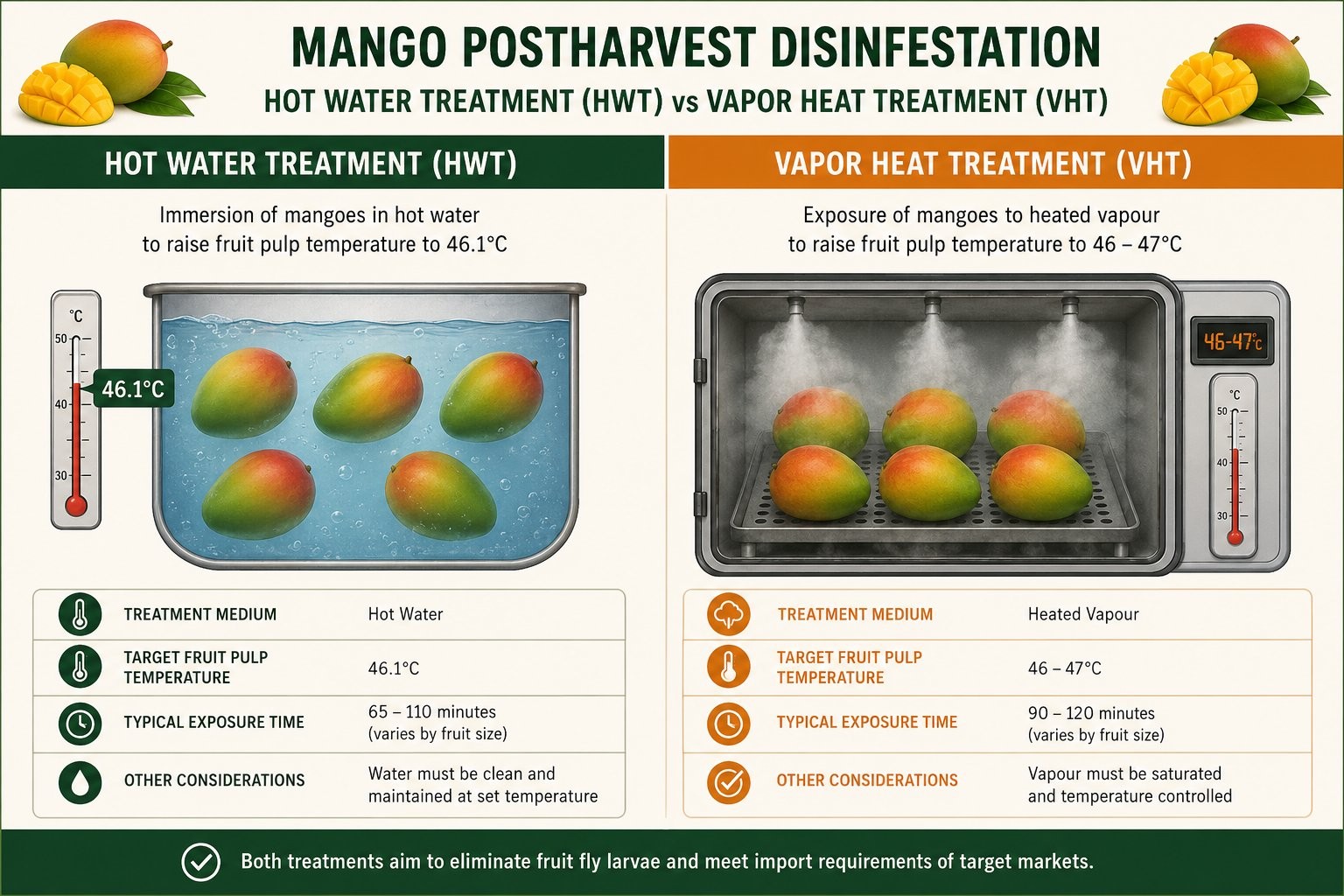
Egyptian mango exporters apply whichever heat treatment the destination market requires — HWT or VHT — under the protocol set by that country’s plant-protection authority, with the treatment recorded on the phytosanitary certificate. The choice of treatment, temperature, and time depends on the importing market and on the mango variety and size. For the full set of mango export requirements — varieties, grading, certification, cold chain, and documentation — see our Egyptian mango export requirements guide.
Phytosanitary heat-treatment schedules are defined by national plant-protection authorities and international standards.
PEI Trade. “Hot Water Treatment (HWT) and Vapor Heat Treatment (VHT) Explained.” PEI Trade Export Knowledge Base. https://peitrade.com/knowledge-base/hot-water-treatment-vht/
Hot water treatment immerses mango in water held at a controlled temperature (the standard is 46.1 degrees Celsius, or 115 degrees Fahrenheit) for a set time based on fruit weight, to kill fruit fly eggs and larvae so the fruit can clear quarantine.
HWT immerses the fruit in hot water, while VHT exposes it to heated water vapour that raises the fruit pulp temperature. Both kill fruit fly eggs and larvae, but markets differ: the USA accepts HWT for mango, while Japan and South Korea require VHT.
The standard water temperature for mango hot water treatment is 46.1 degrees Celsius (115 degrees Fahrenheit), held typically for about 65 to 110 minutes depending on the fruit weight and variety.
Fruit flies are quarantine pests, so importing countries require host fruit like mango to be disinfested before entry. Heat treatment is an approved non-chemical way to kill any fruit fly eggs and larvae in the fruit.
When the temperature and time are controlled correctly and the fruit is cooled afterwards, hot water treatment is safe for the fruit. Incorrect temperature or time can cause heat injury, which is why following the approved protocol and cooling promptly matters.