Address
Work Hours
Monday to Friday: 7AM - 7PM
Weekend: 10AM - 5PM

Address
Work Hours
Monday to Friday: 7AM - 7PM
Weekend: 10AM - 5PM


Egypt's fine bean and snap pea window opens in November and runs to May. Grades, punnet and bulk formats, cold chain, residue compliance and air versus sea options.
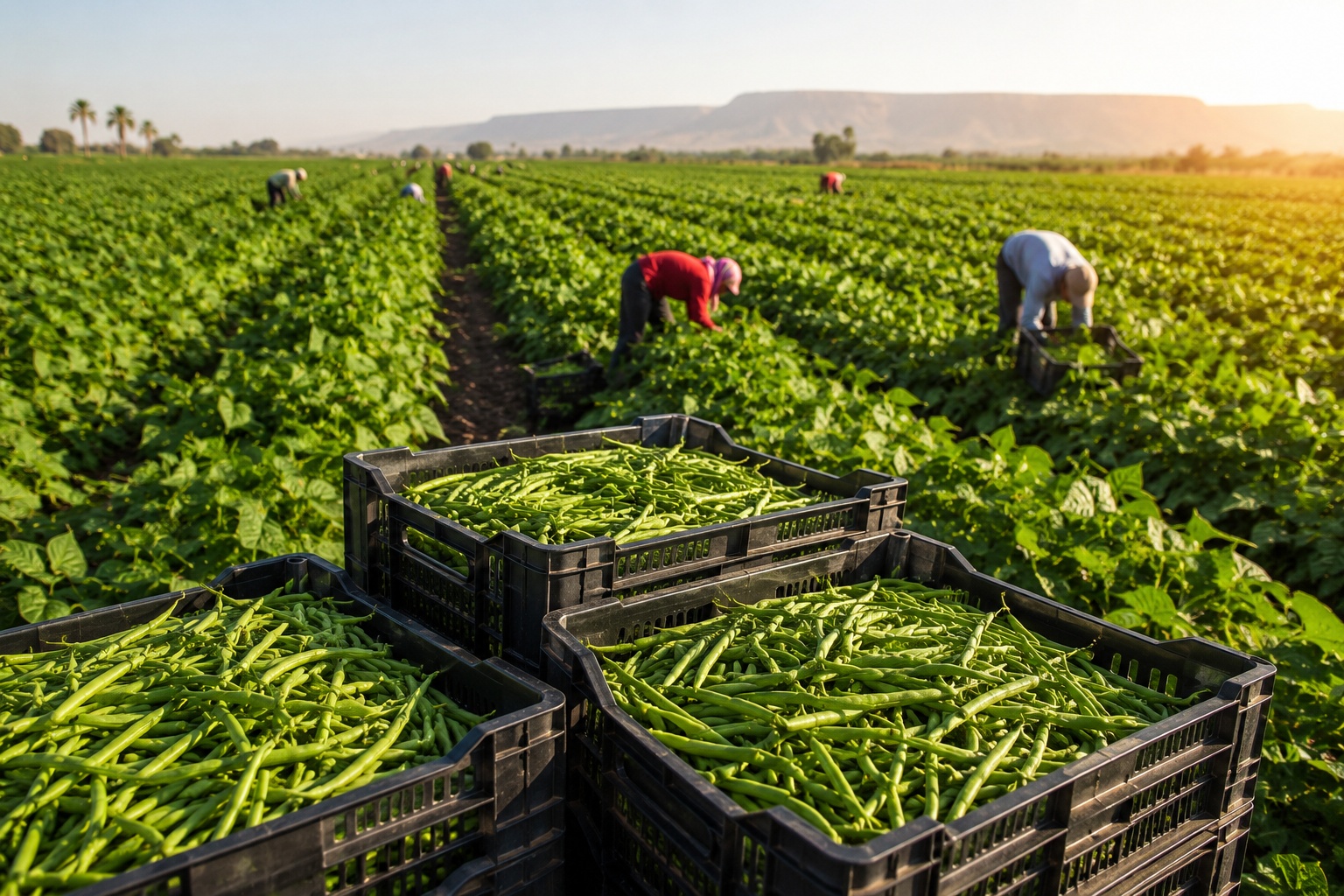
Buyers planning winter vegetable supply are already asking about Egypt, and with good reason. While European field production is finished and Kenyan volumes are under freight pressure, Egyptian fine beans and snap peas run reliably from November through May. Planting decisions for that window are being made now, in late July and August, which is why serious programmes get discussed at this point in the year rather than in October.
Three products sit in this category and they are not interchangeable. Fine beans, cut at 6 to 8 mm diameter, are the volume line and go mainly to UK, German and Dutch programmes. Extra-fine beans at under 6 mm command a premium and are picked more frequently, which raises labour cost and tightens the harvest window. Snap peas and sugar snaps are a smaller, higher-value line that responds well to air freight into retail. Bobby beans, at 9 mm and above, still move into Gulf wholesale and some Eastern European markets where price matters more than calibre.
| Item | Detail |
|---|---|
| Fine bean calibre | 6 to 8 mm, length 10 to 12 cm, straight and stringless |
| Extra-fine calibre | Under 6 mm, length 9 to 11 cm |
| Retail pack | 150 g, 200 g and 250 g punnets or flow-wrap, own label available |
| Bulk pack | 3 kg and 5 kg cartons, perforated liner |
| Cold chain | 4 to 6 C from packhouse to arrival, 95 percent relative humidity |
Beans are picked in the cool of the morning, hydrocooled within a few hours, then graded and packed the same day. Field heat left in the product is the single most common reason a bean shipment arrives with yellowing and limp pods. Anyone quoting you a bean programme should be able to tell you their time from harvest to cooling, not just their carton price.
Fine beans are among the most heavily tested products entering the EU, and Egyptian origin has been under scrutiny in past seasons. That is manageable but it has to be designed in rather than checked at the end. Our grower blocks operate on documented spray diaries with defined pre-harvest intervals, and we pull residue samples before loading rather than after. GLOBALG.A.P certification at farm level and independent laboratory analysis against EU maximum residue limits are standard on programme volumes, and third-party verification through SGS or Intertek is available on request. The same logic we apply on pre-shipment inspection across other categories applies here, with residue testing added as a gate rather than a formality.
Snap peas and extra-fine beans generally justify air freight out of Cairo, arriving in Europe within 24 to 48 hours of packing and giving retail a full shelf life. Fine beans in bulk cartons move by sea from Alexandria and Damietta on a 9 to 14 day transit to North European ports, which lowers landed cost significantly but demands tight temperature discipline throughout. Many buyers run both, using air for the top-tier retail line and sea for volume. Set points and pallet configuration by crop are covered in our note on reefer container loading for Egyptian produce.
All terms are quoted under Incoterms 2020 on FOB, CFR, CIF or DAP. To discuss a November to May bean or snap pea programme, send your target calibre, pack format, destination and weekly volume to our export desk on WhatsApp at +20 10 9911 1918 and we will return a quotation with a planting-backed availability calendar.
