Address
Work Hours
Monday to Friday: 7AM - 7PM
Weekend: 10AM - 5PM

Address
Work Hours
Monday to Friday: 7AM - 7PM
Weekend: 10AM - 5PM


How long Egyptian export produce sits in the cold store between packing and stuffing, what rotation discipline looks like, and how each day of staging is paid for in arrival quality.
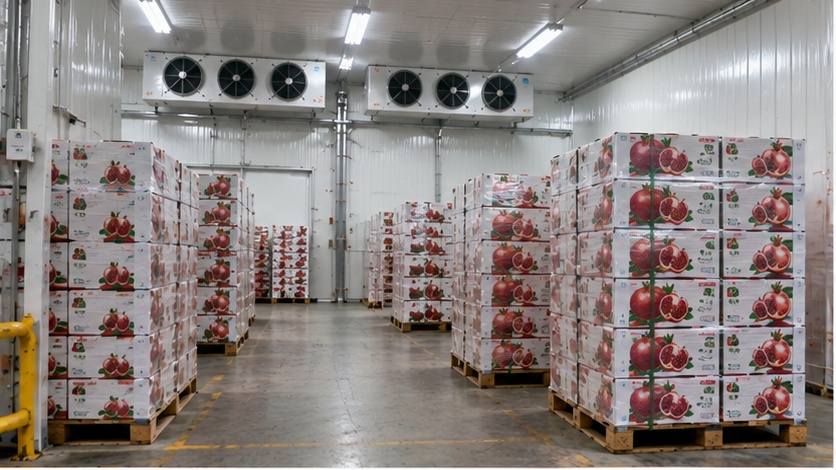
Very little Egyptian export fruit goes straight from the packing line into a container. Between the last carton on the pallet and the moment the reefer doors close there is a holding period in the packhouse cold store, and on most shipments it is the least documented part of the cold chain. Importers ask about set points and transit days. They rarely ask how many days the pallet stood in the store before it was stuffed, which is often the difference between fruit arriving with a fortnight of shelf life and fruit arriving with four days.
Staging is a scheduling artefact, not a quality step. Packing runs to the harvest, loading runs to the vessel. A packhouse filling a 40ft high cube with 20 pallets rarely completes that volume in a single shift, and the booking may sit two or three days after the last pallet is finished. Add a delayed truck, a phytosanitary inspection appointment, a public holiday or a rolled sailing, and a pallet packed on Sunday can be loaded the following Thursday. The fruit is not idle during those days. It is respiring, losing water and using shelf life that the buyer expects to receive.
The practical ceiling for staging is not the crop’s total storage potential. It is the share of that potential the exporter is willing to consume before the transit clock even starts.
Citrus, both Navel and Valencia, tolerates staging best. Held at 4 to 6 degrees Celsius at high relative humidity, three to five days in the store is normal and largely invisible at destination, provided the fruit went in properly cooled. Pomegranate behaves similarly, and Wonderful in particular holds well at 5 to 7 degrees, though every extra day raises husk scald risk on long sailings. Onion and garlic, being cured storage crops, are the only products where a week or more of staging is routine and harmless.
At the other end sit the short-life lines. Mango, table grape, green bean, strawberry and fresh herbs should be loading within 24 to 48 hours of packing. Grapes lose stem condition quickly even at 0 to 1 degree, and mango staged beyond two days at 12 degrees arrives already advanced in ripening. When a mango programme misses a vessel, the honest answer is usually to repack or divert, not to hold and hope.
Two disciplines separate a cold store that protects fruit from one that quietly degrades it. The first is strict first in, first out by pallet placard, with the pack date printed on the placard and not only on the carton. The second is physical separation between products with different set points and different ethylene behaviour, which is where mixed programmes most often go wrong. Our reference on ethylene sensitivity by crop sets out which combinations should never share a chamber.
Buyers can control this contractually. Ask for the pack date and the stuffing date on the packing list, not just the shipment date. A gap of more than three days on a perishable line should be explained. Ask for the store temperature record covering the staging period, in the same way you would ask for the container download. And check that the fruit was cooled to store temperature before it entered, because a warm pallet placed in a full chamber cools slowly and warms its neighbours. Our note on cooling methods by crop covers how that pull-down should be done.
We publish pack dates and stuffing dates on every shipment, hold citrus and pomegranate in dedicated chambers, and schedule short-life lines to load within 48 hours of packing. SGS or Intertek inspection at loading is available on request. For staging terms on a specific crop and destination, message our export desk on WhatsApp at +20 10 9911 1918 and we will confirm what your programme can realistically hold.
