Address
Work Hours
Monday to Friday: 7AM - 7PM
Weekend: 10AM - 5PM

Address
Work Hours
Monday to Friday: 7AM - 7PM
Weekend: 10AM - 5PM


Grade terminology, pack formats, set points and the November to April window for Egyptian fine beans, bobby beans, snow peas and sugar snaps, written for importers building a winter vegetable programme.
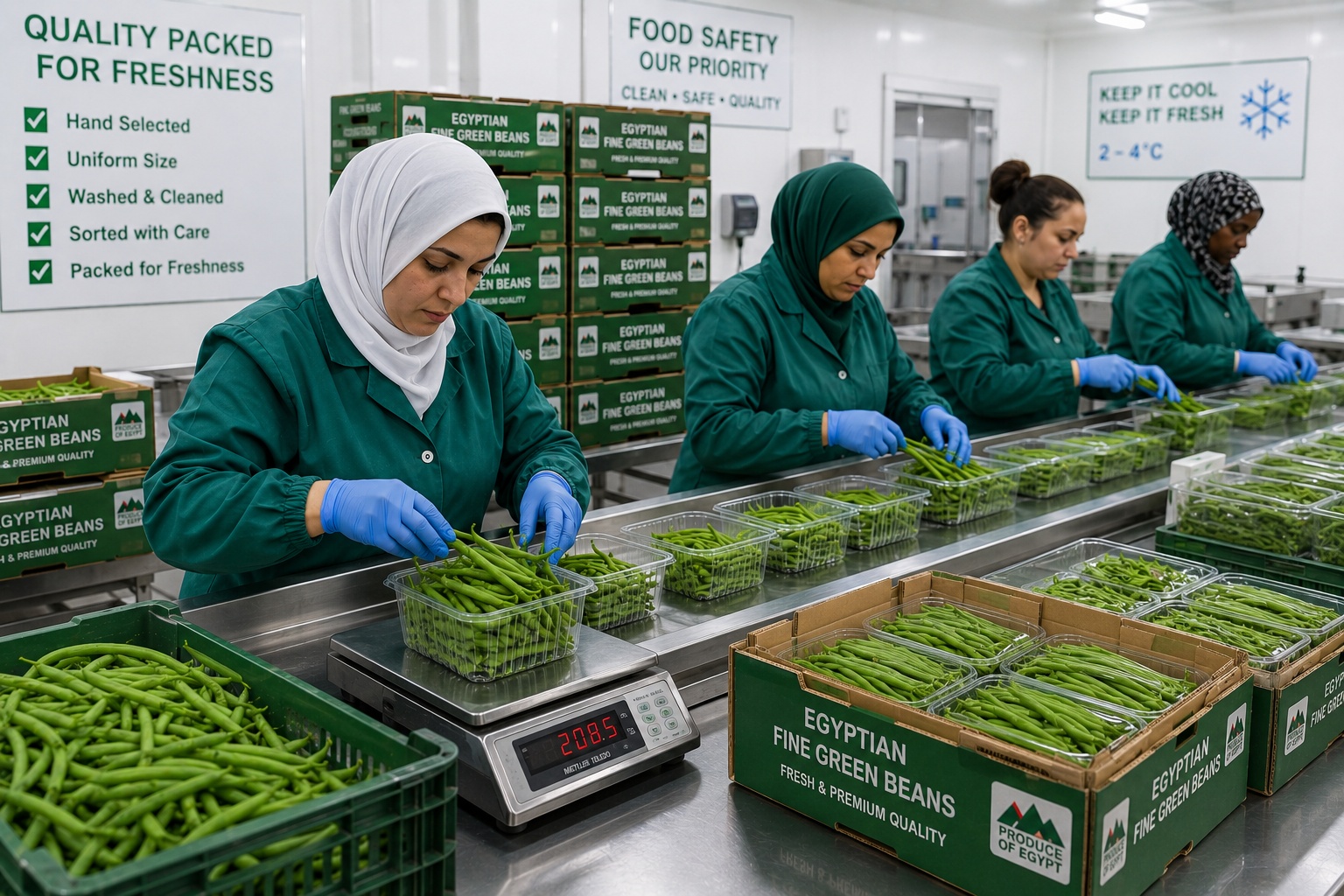
Green beans are one of the few Egyptian crops where the buyer specifies the product by a single measurement. Pod diameter decides the grade, the grade decides the price, and almost every arrival dispute on this category traces back to a sieve size that was assumed rather than written into the contract. The 2026/2027 winter programme opens in November, so specifications are being agreed now.
The European trade names four working grades. Extra fine covers pods under 6.5 mm diameter, fine runs 6.5 to 8 mm, medium sits between 8 and 9.5 mm, and bobby or standard bean is anything above that. Length is a secondary criterion, usually 9 to 12 cm for extra fine and 10 to 14 cm for fine. Egyptian packhouses grade mechanically on sieve bars and then hand-check, which is why a stated tolerance matters: 5 percent of pods one grade above or below is the common commercial allowance, and anything tighter should be priced accordingly.
Snow pea and sugar snap are separate categories rather than bean grades. Snow pea is a flat pod harvested before the seed swells, sugar snap is a rounded pod eaten whole. Both are picked by hand, both bruise easily, and both carry higher labour cost per kilo than any bean grade.
Commercial volume runs from the second half of November to late April, with the reliable peak from mid December through March. Nubaria, Beheira and the reclaimed land west of the Delta supply most export volume. Plantings in Upper Egypt around Luxor and Aswan bring the first pods forward by two to three weeks in a warm autumn, though early lots tend to be irregular on length. Cold snaps in January slow pod fill and compress supply for roughly ten days at a time, which is the single most common cause of a short week on a fixed weekly programme.
| Format | Net weight | Usual destination |
|---|---|---|
| Loose bulk carton | 4 kg or 5 kg | Gulf wholesale, EU repackers |
| Flow-wrapped punnet, 10 or 12 per carton | 200 g or 250 g per punnet | UK and EU retail |
| Perforated bag | 500 g or 1 kg | Foodservice |
| Topped and tailed, vacuum or MAP | 2.5 kg | Processing and catering |
Retail punnet work needs a print run agreed roughly six weeks before the first loading. Bulk cartons can be confirmed in days. If you are undecided, start bulk and convert to retail once the size curve of the season is visible.
Beans and peas want 5 to 7 degrees Celsius with 90 to 95 percent relative humidity. Running the reefer colder does not buy extra days. Below about 5 degrees the pods develop russeting and surface pitting that appears two or three days after unloading, when the container trace already reads as a clean shipment. Field heat has to come out within four to six hours of picking, normally by forced-air cooling, and a bean that sits warm in the field until evening has already lost a third of its selling life. Realistic shelf life on arrival is 10 to 14 days from packing for beans and 8 to 10 days for snow peas.
Because of that short life, most retail-grade fine bean moves by air. Sea freight under modified atmosphere is viable on bulk grades to nearby markets. Our note on air freight on Egyptian produce sets out the cost per kilo and which crops justify flying, and the wider winter greenhouse vegetable programme covers the products that usually travel alongside beans in the same weekly booking.
Beans are a high-frequency residue testing category in the EU and the UK, so pre-harvest intervals and a recent multi-residue report belong in the file before loading, not after a border query. Add the phytosanitary certificate, EU pre-notification where applicable, and GLOBALG.A.P. cover for the specific farm blocks. Certification bodies and scope can be confirmed on request, and SGS or Intertek pre-shipment inspection can be arranged at buyer instruction.
If you are building a November to April bean or pea programme, send the grade, the pack, the weekly volume and the destination airport or port, and we will come back with a specification sheet and an indication. WhatsApp +20 10 9911 1918 reaches the export desk directly.
