Address
Work Hours
Monday to Friday: 7AM - 7PM
Weekend: 10AM - 5PM

Address
Work Hours
Monday to Friday: 7AM - 7PM
Weekend: 10AM - 5PM


The three bill of lading formats used on Egyptian reefer produce shipments, what each one does to cargo release, and how the choice interacts with payment terms and free time at destination.
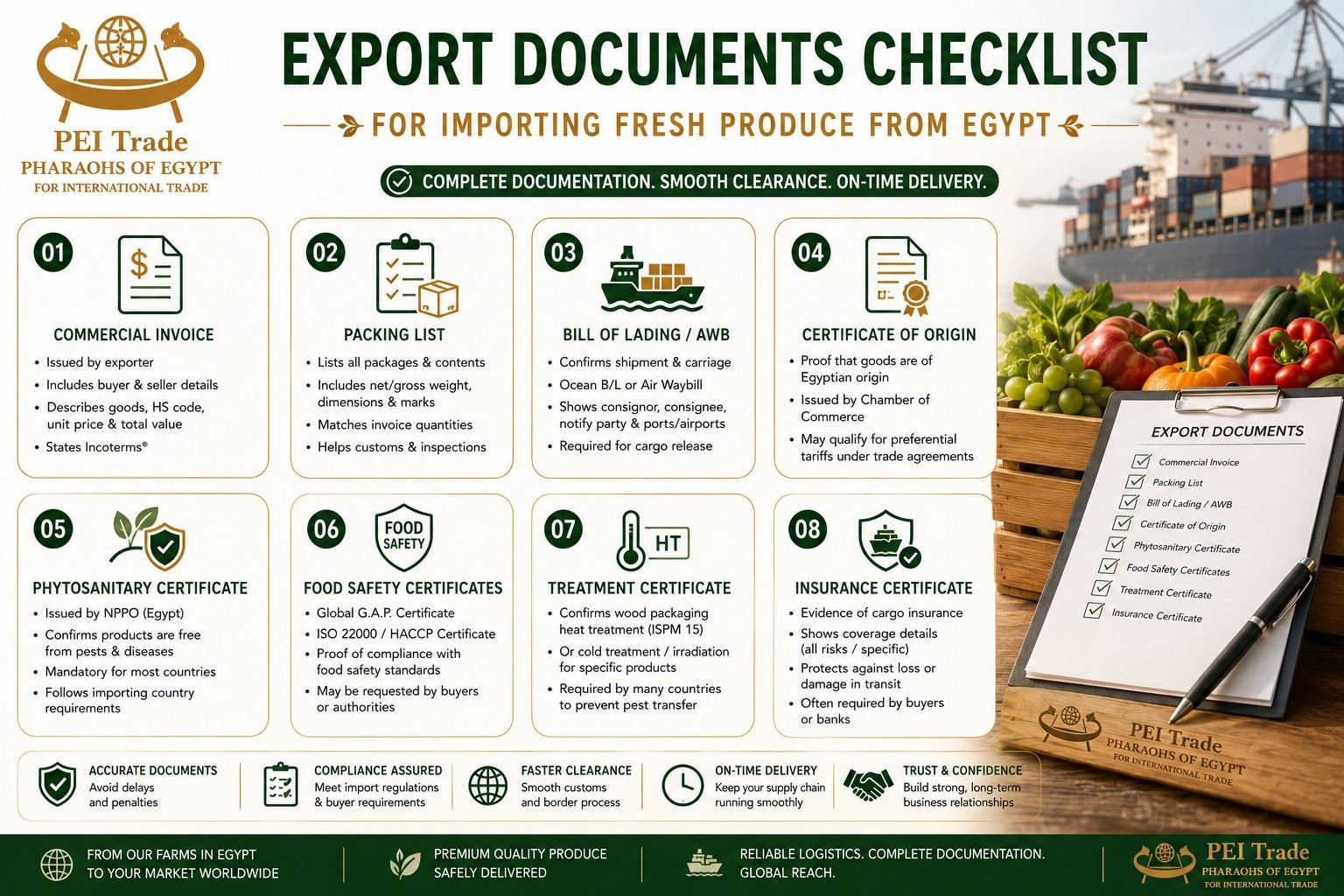
Most disputes we see on a first shipment are not about fruit. They are about who can collect the container at destination and when. That question is settled by one document, the bill of lading, and by which of its three formats the exporter and the buyer agreed to before the vessel sailed. On perishable cargo the choice matters more than it does on dry goods, because every day the container waits at the terminal is a day of free time consumed and a day of shelf life lost.
The classic form. The carrier issues a set of three original negotiable copies, usually released to the exporter after the container is gated in and the manifest is filed. The cargo at destination is released only against surrender of one original. Whoever physically holds that paper controls the goods.
This is the right instrument when payment is documentary. Under cash against documents or a letter of credit, the originals travel through the banks, and the buyer receives them only after paying or accepting. It protects the seller. It also introduces a courier leg. On a nine day sailing from Damietta to Algeciras, a document set couriered from Cairo on the day of departure usually arrives in time. On a four day sailing to Jeddah it frequently does not, and the container sits.
Here the originals are issued and then surrendered back to the carrier at origin. The line sends an electronic message to the destination office authorising release to the named consignee without any paper. No courier, no waiting, and the consignee can begin clearance as soon as the vessel berths.
The trade-off is that surrender is irreversible in practice. Once the telex release is lodged, the exporter has given up control of the cargo. We issue it where payment has already been received in full, or where the relationship and the credit history justify it. A telex release granted on an unpaid balance is not a commercial risk, it is a gift.
A non-negotiable receipt. No originals exist at all, and release is made to the consignee named on the document on proof of identity. It is the fastest of the three and increasingly common on short GCC and Mediterranean lanes where transit is measured in days.
Because a seaway bill cannot be endorsed or transferred, it does not suit trades where the cargo is sold afloat or where a bank needs to hold title as security. For a buyer taking delivery under their own name, on prepaid or partially prepaid terms, it removes an entire failure point from the process.
Pick the document format at the same meeting where you settle price, Incoterm and payment. They are one decision. The Incoterm decides who pays freight and where risk passes, as covered in our note on Incoterms 2020 on Egyptian produce exports. The payment method decides whether the seller can afford to release title early, which is the subject of our guide to payment terms on Egyptian produce exports. The bill of lading format is simply where those two answers meet.
Two practical points. First, check the consignee and notify party details on the draft bill before the carrier finalises it. Correcting a name after the manifest closes attracts an amendment fee and can cost a day. Second, confirm the switch of format before the documentation cut-off, not after. A request to convert originals to a telex release once the vessel has sailed depends on the originals physically reaching the origin office, which defeats the purpose.
PEI Trade ships export-grade Egyptian produce under all three formats, matched to the payment terms agreed for the shipment. To discuss documentation on a specific lane, message our export desk on WhatsApp at +20 10 9911 1918.
