Address
Work Hours
Monday to Friday: 7AM - 7PM
Weekend: 10AM - 5PM

Address
Work Hours
Monday to Friday: 7AM - 7PM
Weekend: 10AM - 5PM


The cold chain is the single most critical factor determining whether citrus arrives at its destination in premium condition or deteriorated beyond sale. Even brief temperature abuse can reduce shelf life by 50% and cause irreversible quality damage that no amount of subsequent care can reverse.
This guide covers complete cold chain requirements for Egyptian citrus exports—from harvest through delivery to international buyers. Understanding these protocols helps importers set correct specifications, identify potential problems, and ensure consistent quality arrival.
For variety-specific information, see our Complete Egyptian Citrus Export Guide and individual variety pages.
Citrus fruits are living organisms that continue respiring after harvest. Respiration consumes sugars, produces heat, and accelerates aging. Temperature directly controls respiration rate—cooler temperatures slow the process, extending shelf life and preserving quality.
Respiration and Sugar Loss: At 20°C, citrus respires 3-4 times faster than at optimal cold storage temperature. This rapid respiration consumes the sugars that create sweetness, leaving fruit bland and less appealing. Extended warm exposure literally “burns off” the quality you’re paying for.
Moisture Loss: Warm temperatures accelerate transpiration (water loss through the peel). Citrus losing more than 5% of its weight becomes visibly shriveled with loose, puffy skin. Once dehydrated, fruit cannot recover—the damage is permanent.
Decay Development: Fungal spores present on all citrus remain dormant at cold temperatures but multiply rapidly when warm. A single day at 25°C can activate decay that becomes visible within a week, spreading to adjacent fruit and ruining entire cartons.
Color Breakdown: The orange pigments (carotenoids) that give citrus its appealing color degrade faster at warm temperatures. Fruit may develop off-colors, brown spots, or uneven appearance that reduces retail value.
Cold chain failures are expensive:
Investing in proper Citrus Export cold chain management costs far less than dealing with quality failures.
Different citrus varieties have different optimal storage temperatures. Using incorrect temperatures causes either chilling injury (too cold) or accelerated deterioration (too warm).
| Variety | Optimal Range | Minimum Safe | Maximum Safe | Humidity |
|---|---|---|---|---|
| Navel Oranges | 5-7°C | 3°C | 10°C | 85-90% |
| Valencia Oranges | 5-7°C | 3°C | 10°C | 85-90% |
| Mandarins (Baladi) | 4-6°C | 3°C | 8°C | 90-95% |
| Mandarins (Fremont) | 4-6°C | 3°C | 8°C | 90-95% |
| Lemons | 10-13°C | 10°C | 15°C | 85-90% |
The most common Citrus Export cold chain mistake is storing lemons at orange temperatures. This causes severe, irreversible damage:
What Happens Below 10°C:
Prevention: Always store lemons separately from oranges in dedicated cold rooms set to 10-13°C. Never mix lemons with oranges in the same container unless temperature is set for lemons (which would then be too warm for oranges).
| Problem | Cause | Symptoms | Affected Varieties |
|---|---|---|---|
| Chilling Injury | Storage below minimum safe temperature | Peel pitting, brown staining, off-flavors, internal breakdown | Lemons most sensitive; mandarins moderately; oranges tolerant to 3°C |
| Heat Damage | Storage above maximum safe temperature | Accelerated decay, color loss, dehydration, reduced shelf life | All varieties; mandarins most sensitive due to thin peel |
The export Citrus Export cold chain consists of five critical stages. Temperature must be maintained through every transition—a single break can compromise the entire shipment.
Cold chain management begins at harvest:
Harvest Timing: Fruit picked in early morning when field temperatures are coolest (ideally below 25°C). Afternoon harvest when fruit temperature reaches 30-35°C requires more aggressive pre-cooling and risks quality.
Field Containers: Harvested fruit placed in ventilated plastic bins, never overfilled. Bins kept in shade, never left in direct sun. Fruit temperature can rise 5-10°C per hour in direct sunlight.
Transport to Packhouse: Field bins moved to packhouse within 4-6 hours maximum. Covered transport prevents sun exposure. Night harvest operations during peak season enable cooler handling.
Target: Deliver fruit to packhouse at lowest practical temperature, ideally below 28°C.
Pre-cooling removes field heat rapidly—the most critical step for shelf life extension.
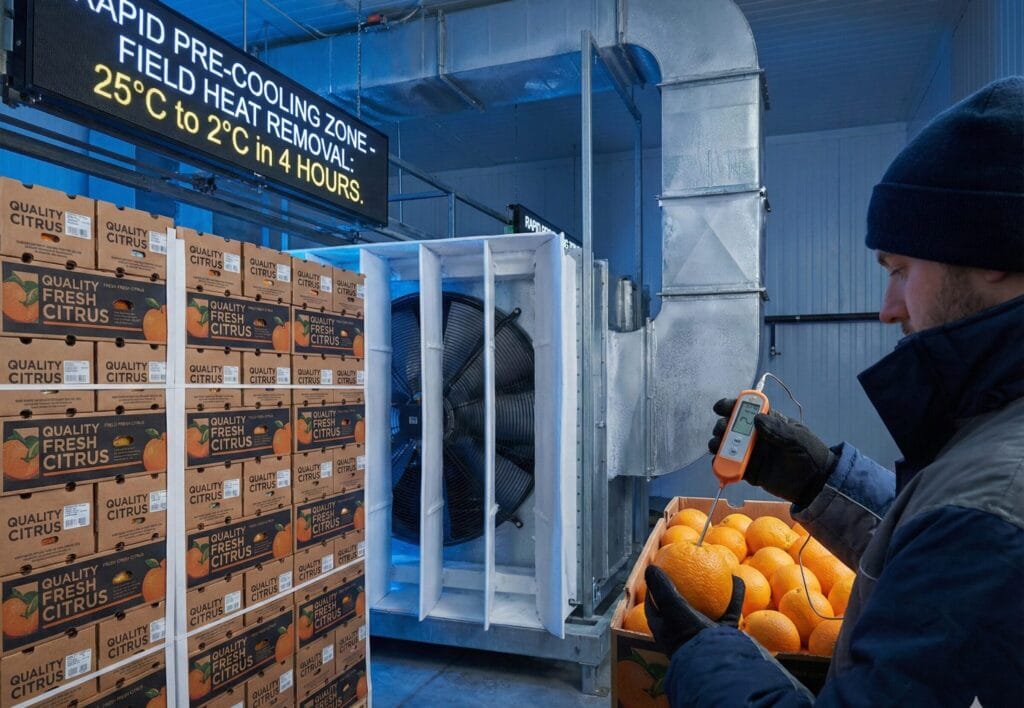
Timing: Pre-cooling should begin within 12 hours of harvest, ideally within 6 hours. Every hour of delay at warm temperatures costs shelf life.
Methods:
Room Cooling: Packed cartons placed in cold room with high airflow. Slowest method (24-48 hours to reach target) but simple and common. Adequate for nearby markets with short transit times.
Forced-Air Cooling: Fans pull cold air through carton vents, dramatically increasing cooling speed. Reaches target temperature in 6-12 hours. Preferred method for export citrus. Requires proper carton stacking with air channels.
Hydrocooling: Fruit immersed in or sprayed with chilled water. Fastest cooling but adds moisture—requires thorough drying before packing. Less common for export citrus due to decay risk from surface moisture.
Temperature Targets:
Verification: Pulp temperature measured with probe thermometer, not air temperature. Fruit core takes longer to cool than surface. Pre-cooling complete when pulp reaches target.
After pre-cooling, fruit enters cold storage awaiting shipment. Duration varies from days to weeks depending on order timing.
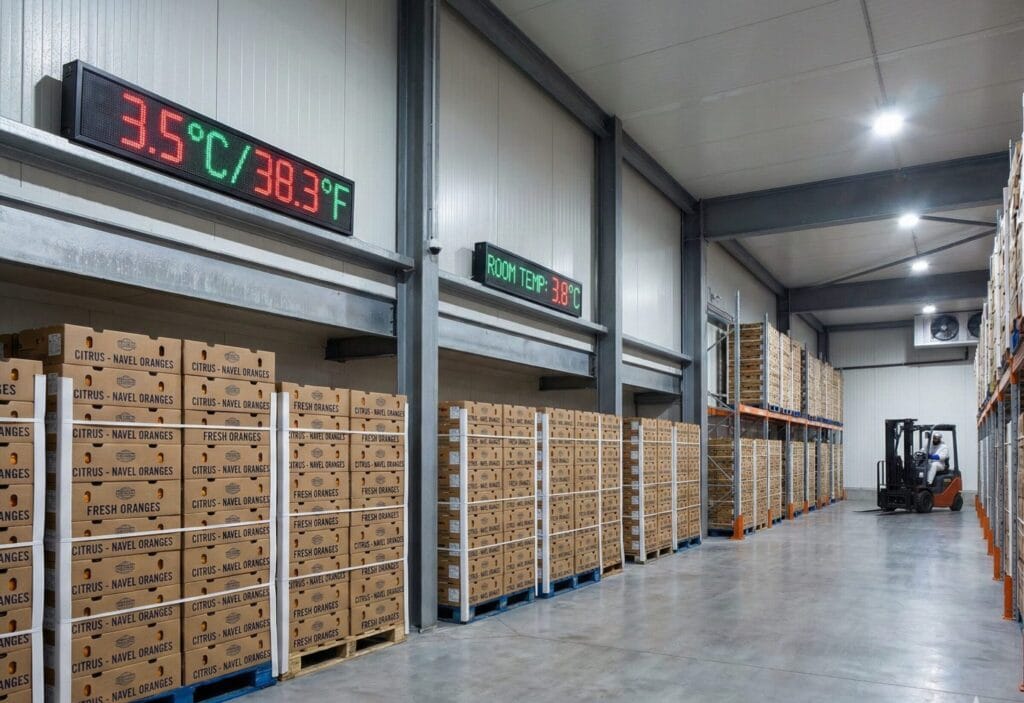
Temperature Maintenance:
Humidity Control:
Stacking and Airflow:
Maximum Storage Duration:
| Variety | Recommended Maximum | Absolute Maximum |
|---|---|---|
| Navel Oranges | 4-6 weeks | 8 weeks |
| Valencia Oranges | 4-6 weeks | 8 weeks |
| Mandarins | 2-3 weeks | 4 weeks |
| Lemons | 8-12 weeks | 16+ weeks |
The journey from packhouse cold storage to destination involves multiple handling points—each a potential Citrus Export cold chain break.
Packhouse to Port (Truck Transport):
Container Loading:
Container Settings:
| Variety | Set Point | Ventilation | Humidity |
|---|---|---|---|
| Oranges | 5-6°C | 25-30 CMH | 85-90% |
| Mandarins | 4-5°C | 25-30 CMH | 90-95% |
| Lemons | 11-12°C | 25-30 CMH | 85-90% |
Sea Transit:
Buyer responsibility begins at destination port, but exporter should advise on proper handling:
Port Discharge:
Inspection:
Distribution:
Proper Citrus Export cold chain management achieves maximum shelf life potential. These figures assume unbroken cold chain at optimal temperatures.
| Variety | Cold Storage | Transit | Post-Arrival | Total Potential |
|---|---|---|---|---|
| Navel Oranges | 4-6 weeks | 2-3 weeks | 3-4 weeks | 8-12 weeks |
| Valencia Oranges | 4-6 weeks | 2-3 weeks | 3-4 weeks | 8-12 weeks |
| Baladi Mandarins | 2-3 weeks | 1-2 weeks | 1-2 weeks | 4-6 weeks |
| Fremont Mandarins | 3-4 weeks | 2 weeks | 2-3 weeks | 6-8 weeks |
| Lemons | 8-16 weeks | 2-4 weeks | 4-8 weeks | 12-24 weeks |
Professional Citrus Export cold chain management requires continuous monitoring and documentation for quality assurance and dispute resolution.
Electronic data loggers record temperature throughout the supply chain:
Logger Placement:
Recording Interval:
Data Download:
Pre-Cooling Records:
Cold Storage Records:
Shipping Documentation:
Understanding common failures helps prevent them and identify responsibility when problems occur.
Cause: Fruit sits at ambient temperature too long after harvest due to transport delays, packhouse bottlenecks, or weekend harvest without processing capacity.
Effect: Accelerated respiration, moisture loss, decay initiation. Shelf life may be reduced 20-30% before fruit even enters Citrus Export cold chain.
Prevention: Harvest scheduling matched to packhouse capacity. Weekend cold storage for Saturday harvest. Backup transport arrangements. Maximum 12-hour harvest-to-cooling target.
Cause: Lemons stored with oranges at orange temperatures (5-7°C instead of 10-13°C). Often happens when cold room space is limited or staff unaware of lemon requirements.
Effect: Chilling injury to lemons—pitting, browning, off-flavors. Damage may not appear until fruit warms, leading to claims at destination.
Prevention: Dedicated lemon cold rooms. Staff training on variety requirements. Clear labeling of storage areas. Temperature verification before loading.
Cause: Reefer container arrives at packhouse warm (20-30°C ambient temperature). Loading proceeds without pre-cooling to meet shipping deadlines.
Effect: Fruit temperature rises during loading and initial transit. May take 24-48 hours for container to pull down temperature. Significant quality impact on outer pallets.
Prevention: Container delivery 12-24 hours before loading. Verify container at target temperature before opening doors. Reject warm containers. Build pre-cooling time into shipping schedule.
Cause: Improper stacking blocks cold air circulation. Pallets pushed against walls. Cartons with ventilation holes misaligned. Plastic wrapping without ventilation cuts.
Effect: Hot spots develop where air cannot reach. Center pallets may be 5-10°C warmer than specification. Uneven quality—some cartons perfect, others decayed.
Prevention: Trained loading crews. Air channels between pallets and walls. Ventilation hole alignment. Perforated stretch wrap or ventilation cuts. T-floor containers that ensure bottom airflow.
Cause: Container unit malfunction, power interruption at port, incorrect set point, vessel reefer system issues.
Effect: Temperature rises for hours or days. Severity depends on duration and peak temperature reached. May cause total loss if extended.
Prevention: Data loggers provide evidence. Shipping line responsible for transit temperature. Insurance coverage for mechanical breakdown. Choose reliable shipping lines with good reefer performance.
When quality problems occur, temperature data determines responsibility and supports claims.
Clear Exporter Responsibility:
Clear Shipping Line Responsibility:
Clear Buyer Responsibility:
If quality issues occur, document immediately:
PEI Trade maintains rigorous Citrus Export cold chain standards throughout our operations:
Pre-Cooling: All fruit pre-cooled within 12 hours of harvest using forced-air cooling systems. Pulp temperature verified before packing.
Cold Storage: 5,000+ ton capacity across multiple temperature zones. Separate rooms for lemons (10-13°C) and oranges/mandarins (4-7°C). Continuous automated monitoring with 24/7 alarm response.
Container Loading: Containers pre-cooled and verified before loading. Loading completed within 3 hours. Data logger placed in every container.
Documentation: Complete Citrus Export cold chain records available for every shipment. Data logger reports provided upon request. Traceability from field to container.
Compliance Rate: 99.5%+ Citrus Export cold chain compliance verified by customer feedback and data logger analysis.
Lemons are extremely sensitive to chilling injury below 10°C. Their cell membranes and oil glands are damaged by cold temperatures that oranges tolerate easily. This causes peel pitting, brown staining, and internal breakdown. Always store lemons at 10-13°C—never with oranges at 5-7°C.
Request data logger reports from previous shipments showing temperature history. Ask about pre-cooling procedures and timing. Visit the facility to inspect cold storage capacity and monitoring systems. Request references from other buyers who can confirm arrival quality.
Impact depends on severity and duration. Brief deviations (few hours, 2-3°C above target) usually cause minimal damage. Extended deviations (days, 10°C+ above target) can cause total loss. Data logger evidence determines responsibility—shipping line covers mechanical failures; exporter covers pre-loading issues; buyer covers post-arrival problems.
At 20-25°C ambient temperature, citrus quality declines rapidly. Expect 3-5 days maximum before visible deterioration begins, with significant shelf life reduction even if fruit looks acceptable. Each day at ambient temperature costs approximately 3 days of cold-stored shelf life.
Yes, requiring data loggers in your contract protects both parties. Specify: logger must be included, placement location, recording interval, data to be provided upon request. This ensures temperature evidence exists if quality issues arise.
Avoid mixing varieties with different temperature requirements when possible. If mixing oranges and mandarins, use 5-6°C (acceptable for both). Never mix lemons with oranges—the 5°C difference in requirements makes combined shipping impossible without damaging one or the other.
When ordering Egyptian citrus from PEI Trade, you can trust our Citrus Export cold chain management. We also welcome specific requirements:
Standard Service (included):
Enhanced Options (available on request):
Contact PEI Trade:
Email: sales@peitrade.com
WhatsApp: +201099111918
Office: +201099111918
Website: www.peitrade.com
Request Cold Chain Specifications
Our technical team can discuss your specific cold chain requirements and provide documentation demonstrating our temperature management capabilities.