Address
Work Hours
Monday to Friday: 7AM - 7PM
Weekend: 10AM - 5PM

Address
Work Hours
Monday to Friday: 7AM - 7PM
Weekend: 10AM - 5PM


The UAE is both a major consumer and the leading re-export hub for Egyptian lemons in the Gulf. Dubai and Abu Dhabi distributors supply the Emirates’ large expatriate population and HORECA sector, then re-export onward across the GCC and East Africa. Egyptian lemons (HS 0805.50) offer an export season from the end of September to May, short transit and competitive pricing. This guide covers varieties, logistics, UAE/ESMA import requirements and seasonality.
The UAE is a top Gulf market and re-export hub for Egyptian lemons. Exports run from the end of September to May. Main varieties: Eureka (Adalia, retail) and Baladi (round, high-juice, foodservice). Transit is 5–9 days by reefer to Jebel Ali. Imports require a phytosanitary certificate, ESMA/GSO-compliant labelling, Halal handling and MRL conformity.
With negligible domestic citrus and a large, diverse population, the UAE imports nearly all its lemons. Egyptian fruit suits the market on price, quality and calendar, and the Emirates’ role as a regional trading platform means much of the volume is re-exported through Jebel Ali to other GCC states and East Africa. Egypt competes with South Africa and Turkey here, winning on freight cost.
| Market snapshot | Detail |
|---|---|
| Role | Top Gulf consumer + re-export hub |
| HS code | 0805.50 (lemons & limes) |
| Main entry port | Jebel Ali (Dubai) |
| Transit time | 5–9 days by sea |
| Export season | End of September–May |
| Key varieties | Eureka (Adalia), Baladi |
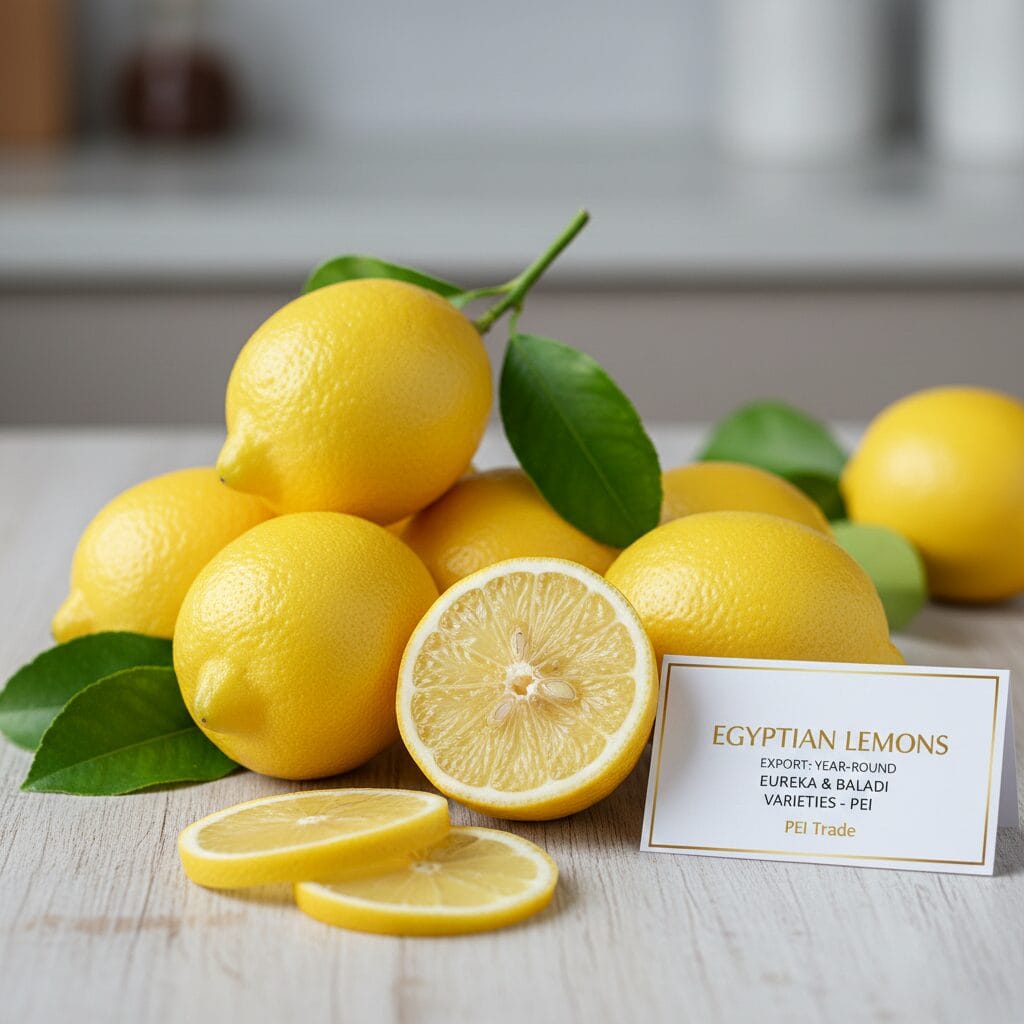
Eureka (Adalia): elongated, thick-skinned, bright yellow — the retail and re-export standard with strong shelf life. Baladi: round, thin-skinned, very high juice — preferred by the UAE’s large foodservice and juice trade. Graded by calibre, packed in 15 kg or 10 kg telescopic cartons.
Shipments sail from Egyptian ports via the Red Sea/Suez to Jebel Ali in roughly 5–9 days. Lemons are carried in reefer containers at the temperature set for the product. Fruit is pre-cooled, waxed and treated within permitted limits. Jebel Ali’s free-zone facilities support fast repacking and onward GCC/East-Africa re-export.
UAE imports require a phytosanitary certificate from Egyptian plant quarantine, a certificate of origin, and compliance with ESMA/GSO food-safety and labelling standards (Arabic + English: product, origin, packer, net weight, lot). Pesticide residues must meet GSO MRLs, checked at port. Halal-compliant handling applies. Organised buyers require GLOBALG.A.P at farm level and full lot traceability.
| Period | Availability |
|---|---|
| End of September–May | Export season — Baladi & Eureka |
Egyptian lemon exports run from the end of September to May.
Yes. A large share of Egyptian lemons landing at Jebel Ali is repacked and re-exported across the GCC and East Africa.
Eureka (Adalia) for retail and re-export shelf life; Baladi for the large foodservice and juice trade.
A phytosanitary certificate, certificate of origin, ESMA/GSO labelling and MRL compliance, and Halal-compliant handling. GLOBALG.A.P is expected by organised buyers.
Roughly 5–9 days by reefer to Jebel Ali, carried in reefer containers at the temperature set for the product.
Source & data: Egyptian lemon exports ~100,000 tonnes (2023); UAE among top Gulf destinations. Source: FreshPlaza, 2024. HS code 0805.50 (lemons & limes). Figures are Egypt-market trade data; per-shipment specifications are confirmed at contracting.
PEI Trade — New Cairo, Egypt. Request a quote or lemon spec sheet →