Address
Work Hours
Monday to Friday: 7AM - 7PM
Weekend: 10AM - 5PM

Address
Work Hours
Monday to Friday: 7AM - 7PM
Weekend: 10AM - 5PM


Storage-season onion and garlic from Egypt: variety and colour split, size bands, mesh bag and carton formats, container loading weights and programme timing for 2026/2027.
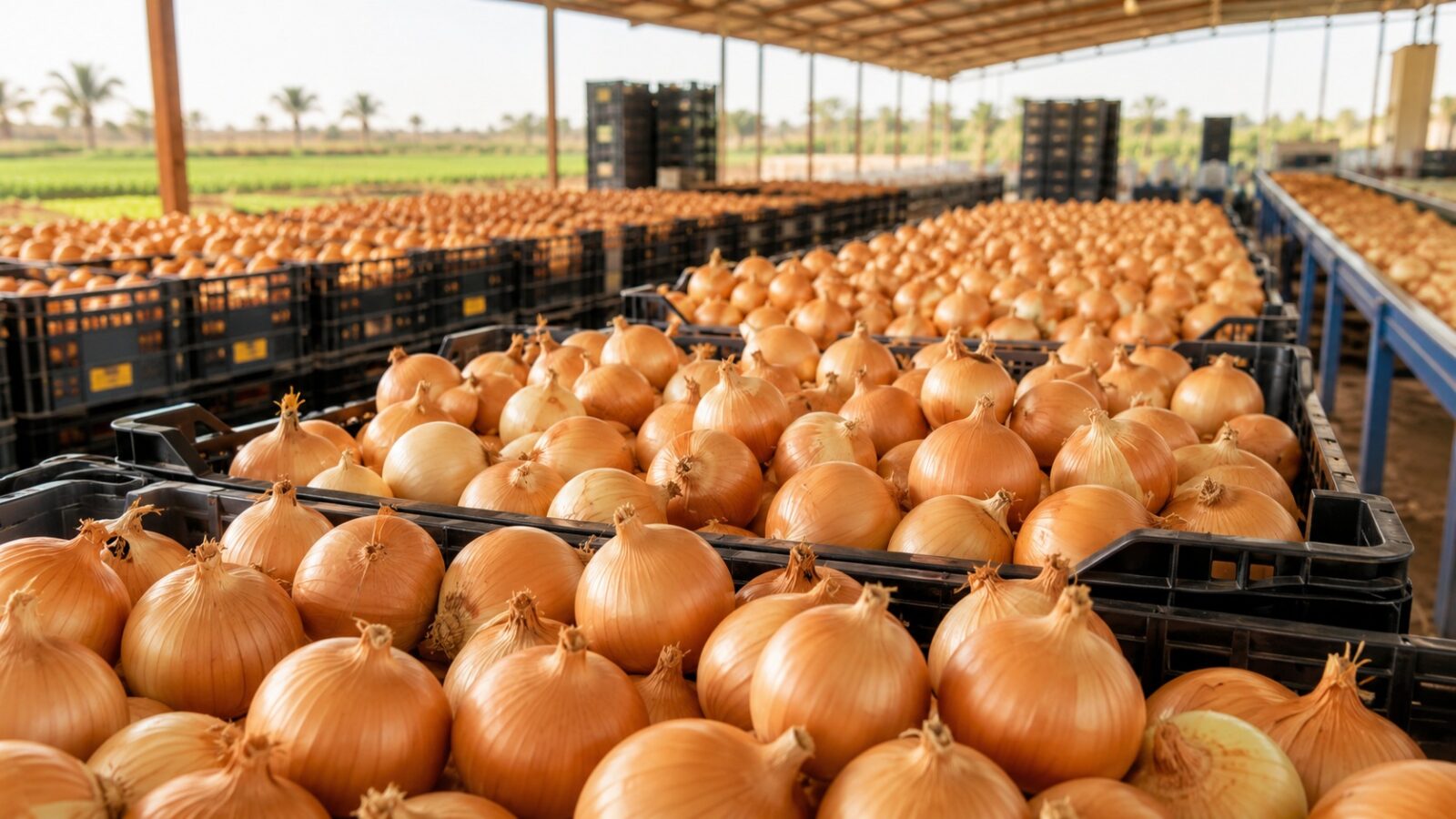
August is a quiet month in the onion trade and that is exactly why it matters. The spring crop lifted between March and June is now in store, the fresh crop is months away, and buyers planning autumn and winter arrivals are pricing against inventory rather than against a harvest. Understanding what is actually in Egyptian stores right now is the difference between a firm offer and a guess.
Egypt runs two onion cycles. The main spring crop is harvested March to June and moves fresh through the summer, then out of controlled storage from roughly August through December. A smaller autumn crop, sown late and lifted from December, bridges into the following spring. Garlic follows a narrower path, harvested March to May and shipped from store for most of the rest of the year.
For a buyer planning Q4 arrivals, storage-crop onion is the product on the table. Store quality is good but it is not identical to fresh-lifted fruit, and the specification should reflect that. Sprouting risk rises through the storage period, so it is normal to tighten the sprouting tolerance in contracts loading after October.
Golden or yellow onion is the volume product, sold in size bands of 40 to 60 mm, 50 to 70 mm, 60 to 80 mm and 70 to 90 mm. Netherlands, UK and Russian buyers generally take 50 to 70 and 60 to 80. Gulf and East African buyers lean toward the larger bands.
Red onion moves in smaller volume, mainly to Gulf and to specific European wholesale channels, in the same size bands. Skin colour uniformity is the deciding quality point rather than size.
White onion is a niche line, usually contracted rather than offered on spot.
Garlic ships as white or purple bulb, sized 4.5 to 5.5 cm, 5.5 to 6.5 cm and 6.5 cm and up. Clove count and neck cut quality matter more to most buyers than headline diameter.
Onion is packed in 5, 10, 20 or 25 kg mesh bags, or in 10 and 15 kg ventilated cartons for retail-facing programmes. Jumbo or big bags of 800 to 1000 kg are used on industrial and processing loads. Garlic goes into 5 and 10 kg mesh bags, 10 kg cartons, or braided formats for specialty buyers.
A 40ft high cube reefer holds roughly 26 to 28 tonnes of bagged onion depending on bag size and whether the load is palletised or floor loaded. Palletised loading costs about 2 tonnes of capacity but cuts damage and speeds discharge, and most European receivers now insist on it. Ventilated 40ft dry containers are used on shorter routes and on garlic where ambient carriage is acceptable.
Carriage temperature for onion is 0 to 2 degrees Celsius at 65 to 70 percent relative humidity, with high air exchange. Humidity above 75 percent is what causes neck rot to appear on arrival. Garlic carries at the same temperature but drier, 60 to 70 percent.
Phytosanitary certificate, certificate of origin, commercial invoice, packing list and bill of lading form the base file. Fumigation certificates are requested on some destinations. GLOBALG.A.P. at farm level and residue analysis against the destination limits are standard for European retail supply chains and are covered in our note on what each certification actually proves.
Alexandria and Damietta handle most onion volume to Europe and the Black Sea. Sokhna is the practical choice for Gulf, Indian subcontinent and East African routings. Port choice affects both transit time and inland trucking cost from the growing areas, and the difference is rarely trivial on a low-value-per-tonne crop. See our comparison of the Egyptian export ports for the routing detail.
For current storage-crop availability, size band pricing, or to build a rolling onion or garlic programme for the 2026/2027 season, contact the PEI Trade export desk on WhatsApp at +20 10 9911 1918.
