Address
Work Hours
Monday to Friday: 7AM - 7PM
Weekend: 10AM - 5PM

Address
Work Hours
Monday to Friday: 7AM - 7PM
Weekend: 10AM - 5PM


Pomegranates have a cold-chain quirk that catches people out: they are chilling-sensitive, so storing them too cold actually damages them. Get the temperature right — cool, but not as cold as most produce — and well-handled Wonderful fruit stores for months. This guide covers the Egyptian pomegranate cold chain from harvest to reefer, the special case of arils, and packing formats.
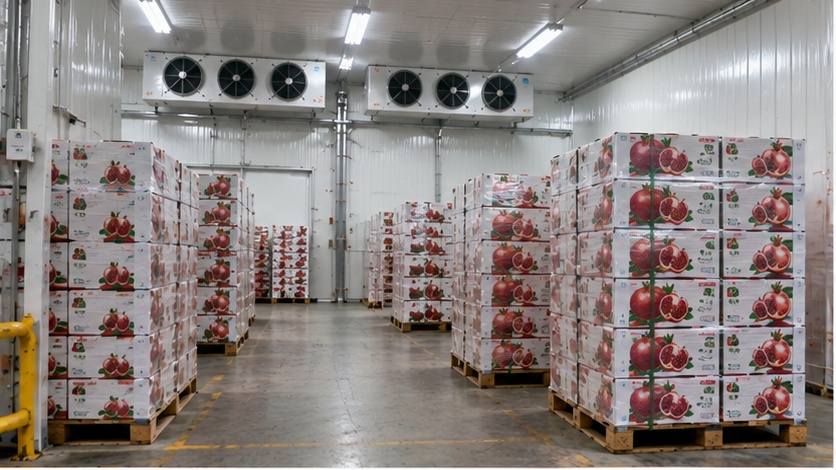
Quick answer: Whole Egyptian pomegranates are pre-cooled and stored around 5–7°C at 90–95% RH — not near 0°C, because pomegranates suffer chilling injury (husk scald, pitting) below about 5°C. Handled well, they store for 2–3 months. Fresh arils are held colder and short, or frozen at −18°C. Whole fruit is packed in single-layer or telescopic cartons (~4–5 kg); arils in MAP punnets. Shipping is by reefer at ~5°C.
Unlike apples, grapes or most vegetables, pomegranates are chilling-sensitive. Stored below roughly 5°C for extended periods, they develop husk scald (skin browning), surface pitting and internal breakdown. The target is therefore a moderate chill — around 5–7°C — cold enough to slow ageing and decay, but warm enough to avoid chilling injury. This single point is the most important thing to get right, and it is why pomegranates sit apart from the near-freezing settings listed in our reference table of cold chain storage temperatures for fresh produce.
After harvest, fruit is pre-cooled to remove field heat, then held at 5–7°C and 90–95% RH with good airflow. High humidity prevents the skin from drying and the fruit from losing weight. Under these conditions, sound Wonderful fruit can be stored for 2–3 months, which is what enables the December–January storage window.
| Product | Temperature | Notes |
|---|---|---|
| Whole fruit | ~5–7°C, 90–95% RH | Avoid <5°C (chilling injury); stores 2–3 months |
| Fresh arils | Chilled, short shelf life | MAP packs; strict hygiene & cold chain |
| Frozen arils | −18°C | IQF; long shelf life |
The main storage risks beyond chilling are Botrytis (grey mould) and Alternaria heart rot. Control comes from careful harvest and handling (avoiding cuts and bruising), good sanitation, correct temperature and humidity, and airflow. Damaged or cracked fruit is sorted out, as it decays fastest.
Ready-to-eat fresh arils are extracted, washed and packed in modified-atmosphere (MAP) punnets under strict hygiene, then kept cold with a short shelf life. Frozen arils are individually quick-frozen and held at −18°C for long shelf life. Both demand food-safety controls (see the requirements guide).
Fruit is graded by size/count, handled gently to avoid skin damage, and palletised for stable, ventilated loading.
Whole pomegranates ship in reefer containers at around 5°C with airflow and the temperature monitored and logged — carefully avoiding setpoints that drop the fruit into chilling-injury territory. Frozen arils ship at −18°C. A temperature recorder in the load gives the buyer proof the chain held.
Around 5-7 degrees C at 90-95% humidity – not near 0 degrees C, because pomegranates are chilling-sensitive and suffer husk scald and pitting when too cold.
Well-handled Wonderful fruit stores for about 2-3 months, which supports the December-January window.
Extracted and packed in modified-atmosphere punnets under strict hygiene, kept chilled with a short shelf life; frozen arils are held at minus 18 degrees C.
In single-layer or telescopic cartons (around 4-5 kg) with trays/liners to prevent bruising.
Whole fruit by reefer at about 5 degrees C with logged temperature; frozen arils at minus 18 degrees C.
How to cite this page
PEI Trade. “Egyptian Pomegranate Packaging & Cold Chain.” peitrade.com, 2026. https://peitrade.com/egyptian-pomegranate-packaging-cold-chain/
This page is part of our Egyptian Pomegranate Export Guide hub.
Ship Egyptian pomegranates that arrive in spec with PEI Trade. Correct chilling-sensitive storage, decay control, careful handling and reefer discipline for whole fruit — plus hygienic arils and frozen IQF. Contact: [email protected] · WhatsApp +20 109 911 1918 · www.peitrade.com