Address
Work Hours
Monday to Friday: 7AM - 7PM
Weekend: 10AM - 5PM
Address
Work Hours
Monday to Friday: 7AM - 7PM
Weekend: 10AM - 5PM



Key definition: a payment method in export trade is the mechanism and timing by which an importer pays an exporter for goods. The four methods used across fresh-produce trade sit on a risk spectrum: Advance Payment (TT) is safest for the exporter and riskiest for the importer; Open Account is the reverse; Letter of Credit (LC) and Cash Against Documents (CAD) sit in between, balancing risk through the banking system.
Choosing how you get paid is as important as the price itself. For perishable goods moving in reefer containers across 7–21 day transit windows, the payment method decides how much risk the exporter and the importer each carry, how quickly cash is released, and how much the deal costs in bank fees. This guide explains the four payment methods used in international fresh-produce trade — Telegraphic Transfer (TT), Letter of Credit (LC), Cash Against Documents (CAD) and Open Account — how each works, who carries the risk, and when each one fits.
Every payment method trades exporter security against importer security. The more secure the exporter is, the more cash and trust the importer must commit up front — and vice versa. From the exporter’s point of view, the methods rank from safest to riskiest as follows:
A Telegraphic Transfer (TT) — also called a bank wire or SWIFT transfer — is a direct bank-to-bank electronic payment. Used as advance payment, the importer wires funds before the goods are shipped. It is the simplest and cheapest method and gives the exporter complete security, but it places all the risk on the importer, who pays before seeing or receiving the goods.
In practice, fresh-produce trade often uses a split TT: a deposit (commonly 20–30%) is wired on order confirmation, and the balance is wired against a copy of the shipping documents or the bill of lading. This shares the risk and is widely used between partners who have an established relationship but do not want the cost and paperwork of a Letter of Credit.
A Letter of Credit — or documentary credit — is a written undertaking by the importer’s bank (the issuing bank) to pay the exporter a fixed amount, provided the exporter presents a set of compliant documents within the stated deadlines. Payment depends on the documents, not on the goods, so accurate and on-time documentation is critical. Letters of Credit are governed internationally by the ICC’s UCP 600 rules. Common variations include:
An LC protects both sides, which makes it the default choice for first transactions or higher-value shipments. The trade-offs are cost (issuing, advising and confirmation fees) and discipline: for perishables, any discrepancy in the documents can delay payment past the point where the cargo has already been delivered.
Under Cash Against Documents — also called a documentary collection — the exporter ships the goods and then sends the shipping documents through the banking chain. The importer can only collect the documents (and therefore clear and receive the goods) by meeting the agreed condition. Documentary collections are governed by the ICC’s URC 522 rules. There are two forms:
CAD is cheaper and simpler than an LC, but the key difference is that the banks act only as intermediaries — they do not guarantee payment. If the importer refuses the documents (for example because the market price dropped), the exporter is left with goods at a foreign port. CAD therefore suits trusted relationships more than first-time buyers.
On Open Account terms, the goods are shipped and delivered before payment is due — typically 30, 60 or 90 days after the invoice or arrival date. This is the most competitive offer for the importer and is standard practice with large retail buyers in mature markets, but it carries the highest risk for the exporter, who has parted with the goods and waits for payment. Exporters commonly manage this risk with trade-credit insurance or by reserving open-account terms for long-standing, reliable buyers.
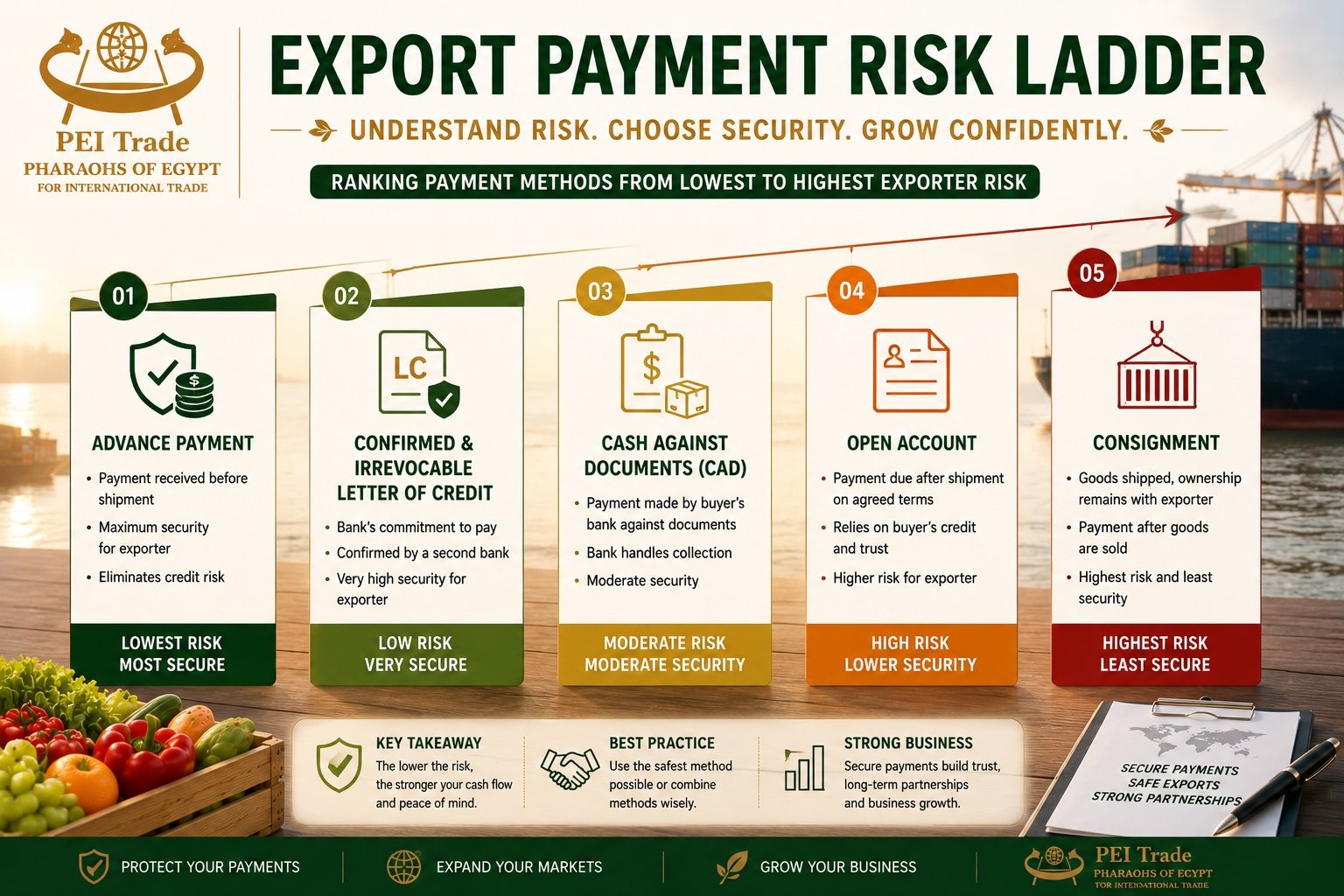
| Method | How it works | Risk to exporter | Risk to importer | Relative cost | Best used when |
|---|---|---|---|---|---|
| Advance Payment (TT) | Importer wires funds before shipment | Lowest | Highest | Lowest | New buyer, small order, or as a deposit |
| Letter of Credit (LC) | Importer’s bank pays against compliant documents (UCP 600) | Low | Low | High | First transactions or higher-value shipments |
| Cash Against Documents (CAD) | Bank releases documents on payment (D/P) or acceptance (D/A); URC 522 | Medium | Medium | Medium | Trusted buyer; cheaper alternative to an LC |
| Open Account | Goods delivered first; payment due in 30–90 days | Highest | Lowest | Low (plus optional credit insurance) | Established, reliable repeat buyers |
Payment terms and Incoterms are two separate parts of the same contract and should never be confused. Incoterms (such as FOB, CIF, CFR and DAP) define who arranges and pays for transport and insurance, and where the risk passes from seller to buyer. The payment method (TT, LC, CAD or Open Account) defines how and when the money moves. A complete agreement specifies both — for example: CIF Rotterdam, payment 30% TT advance and 70% by irrevocable LC at sight.
For Egyptian growers and exporters, the choice usually follows the relationship and the cargo:
PEI Trade works with importers worldwide on transparent payment terms matched to each market and relationship. For first orders we generally structure a TT deposit with the balance against documents, or an irrevocable Letter of Credit; established partners move to split TT, CAD or open-account terms with credit cover. Payment terms are always set alongside the agreed Incoterm and shipping plan — see our Payment & Shipping Terms, and our Egyptian Mango Export Guide and Complete Guide to Egyptian Citrus Export for product-specific terms. To structure your first order, contact the export desk at [email protected] or +20 109 911 1918.
This guide is based on the official ICC rules governing documentary credits and collections.
PEI Trade. “Payment Methods in Export Trade: LC, TT, CAD and Open Account Explained.” PEI Trade Export Knowledge Base. https://peitrade.com/knowledge-base/payment-methods-export-trade/
Advance payment, usually by Telegraphic Transfer (TT), is the safest because the exporter receives funds before shipping. Where the importer will not pay fully in advance, a confirmed irrevocable Letter of Credit offers the next strongest protection.
Under a Letter of Credit the importer’s bank guarantees payment against compliant documents. Under Cash Against Documents the banks only pass documents between the parties and do not guarantee payment, which makes CAD cheaper but riskier for the exporter.
TT stands for Telegraphic Transfer, a bank-to-bank electronic wire sent over SWIFT. It can be a full advance payment or a partial deposit, with the balance paid against shipping documents.
Open Account is the riskiest method for the exporter because the goods are delivered before payment. It is best limited to trusted, long-standing buyers and is usually backed by trade-credit insurance.
No. Incoterms define transport, insurance and where risk passes; the payment method is agreed separately in the sales contract. A complete agreement states both.