Address
Work Hours
Monday to Friday: 7AM - 7PM
Weekend: 10AM - 5PM
Address
Work Hours
Monday to Friday: 7AM - 7PM
Weekend: 10AM - 5PM


Egyptian mango export has grown into one of the most compelling fresh-fruit sourcing opportunities in the world, and Egypt now ranks as the country’s second-largest fruit export after citrus. For importers, wholesalers, and procurement teams, that matters for a simple reason: Egypt combines large, reliable volumes with a premium taste reputation and a harvest window that fills gaps left by other origins.
Last Updated: May 2026
This guide covers everything a serious buyer needs — varieties, season, quality grading, phytosanitary requirements, packaging, target markets, and how to place an order. Whether you are sourcing for supermarket programs in the Gulf, ripening programs in Europe, or volume distribution in Russia and Turkey, this page is your starting point.
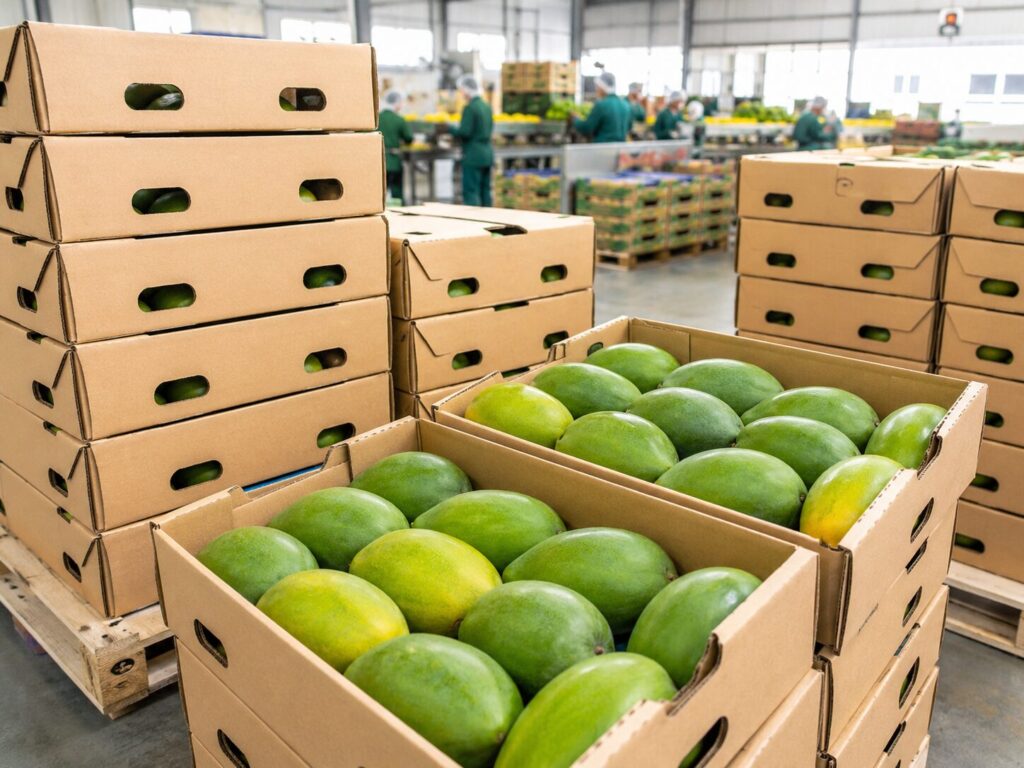
Egypt produces roughly two million tons of mangoes per year across more than 100,000 hectares of cultivation, making it one of the largest mango-growing nations outside Asia and Latin America. Of that production, a growing share is shipped abroad: fresh mango exports reached approximately 72,500 metric tons valued at around USD 133 million in 2023, and the trajectory has been steeply upward since.
Several forces are driving this growth at once:
| Driver | What It Means for Buyers |
|---|---|
| Scale & reliability | ~2M tons produced annually means consistent volume availability across a long season. |
| Premium price positioning | Egypt commands one of the highest average export prices among top global suppliers — a signal of perceived quality. |
| The Peru supply gap | Peru’s production fell sharply (roughly 70%) after El Niño from 2022 onward, shifting global buyers toward alternative origins like Egypt. |
| Geographic position | Egypt bridges European, Middle Eastern, and Asian markets with short sea and air transit times. |
| Counter-seasonal window | Egypt’s August–November peak helps buyers cover periods when other origins are out of season. |
The result is a market with rising demand and firming prices. Wholesale export prices have climbed over recent seasons as quality and global recognition improved. For a buyer, the takeaway is that securing a reliable Egyptian supplier early in the season is now a competitive advantage rather than an afterthought.
Egypt grows more than 30 mango varieties — some sources count over 100 — but only a handful are built for international shipping. The right choice depends on your market: appearance and shelf life dominate in Europe and Russia, while flavor and sweetness drive Gulf demand. Below is a quick comparison of the main export-grade varieties.
| Variety | Profile | Best Markets | Availability |
|---|---|---|---|
| Keitt | Large, green skin, fiberless, sweet; excellent shipping fruit | EU, Russia, GCC | Aug–Dec (longest window) |
| Kent | Large (often 500–1000g), rich, low-fiber, juicy | EU, Russia | Mid-Jun–Aug |
| Naomi | Golden, very attractive, good shelf life; a rising star in Europe | EU, GCC | Mid–late season |
| Tommy Atkins | Early, firm, very durable; the classic entry-market traveler | Broad / entry markets | Early (Jun–Jul) |
| R2E2 | Large, long shelf life, attractive blush | EU | Late |
Alongside these international varieties, Egypt is famous for indigenous types prized for flavor. Owaisi (also written Ewais or Awees) is widely considered the best-tasting Egyptian mango and is now appearing in European trial programs as a premium offer. Zebda is beloved domestically but has a soft texture and short shelf life, so it stays largely in the local market and the juicing trade. Other regional favorites — Taymour, Sokary, Hindi, Mabrouka, Sedekah, and Fagr Kalan — see selective Gulf demand for their sweetness.
To choose the right variety for your specific market and decide on grades and sizes, read our full guide to Egyptian mango varieties, or jump straight to the variety that interests you: Keitt, Kent and Naomi, Owaisi, and Tommy Atkins and Zebda.
Understanding the calendar is essential for planning your programs. The Egyptian mango harvest runs broadly from June to November. July is dominated by local varieties such as Zebda destined for the domestic market, while the commercial export season opens in August with Keitt and Kent and peaks from August through November. Fresh mango is generally available June to September, after which late Keitt and frozen product carry the tail of the season.
| Month | What Is Available |
|---|---|
| June | Early varieties begin (Tommy Atkins, early Owaisi from Aswan); Kent starts mid-month |
| July | Mainly local varieties (Zebda) for the domestic market; volume ramping up |
| August | Export season opens — Keitt, Kent, Naomi |
| September | Peak fresh export |
| October | Continued peak shipments — a record month on several export lanes |
| November | Season winds down; late Keitt extends availability |
One of Egypt’s structural advantages is the geographic stagger of its growing regions. Upper Egypt — around Aswan and Luxor — produces the earliest fruit, the Ismailia governorate is the flagship mango region, and high-volume zones such as Sharkia, Nubaria, and Beheira extend the supply curve. For full month-by-month planning, see our Egyptian mango season calendar.
Export-grade Egyptian mango is selected against clear commercial criteria. Buyers in international markets generally prefer fruit above 300 grams, with size classes matched to retail or wholesale formats. Beyond size, four factors define export quality:
Underpinning all of this are internationally recognized standards. Reputable Egyptian exporters operate under GLOBALG.A.P at farm level and HACCP and ISO 22000 in the packhouse, providing the food-safety and traceability assurances that supermarket and import programs demand.
This is where serious sourcing decisions are won or lost, and where many thin supplier pages go silent. Mango is a host for fruit flies — primarily the Oriental fruit fly (Bactrocera dorsalis) and the Mediterranean fruit fly (Ceratitis capitata) — which lay eggs just beneath the skin. A shipment carrying live pests into a fly-free region can be rejected or destroyed at the border, so quarantine compliance is the single most important technical hurdle in mango export.
| Method | How It Works | Typical Use |
|---|---|---|
| HWT (Hot Water Treatment) | Fruit is immersed in water around 46–48°C for roughly 60–75 minutes to kill fly eggs and larvae beneath the skin. Chemical-free; does not cook the fruit. | Most cost-effective; common for many EU and Middle East lanes |
| VHT (Vapour Heat Treatment) | Heated, humidified air raises fruit core temperature to disinfest it. | Required by the strictest markets (e.g. Japan, South Korea) |
| Irradiation | Low-dose irradiation neutralizes pests without heat. | Accepted under specific protocols by some markets |
| Systems approach | Field trapping, monitoring, and pest-free or low-prevalence area certification. | Used alone or alongside treatment |
Properly applied, hot water treatment achieves a quarantine security level known as “probit 9” — a 99.9968% kill rate — which satisfies the requirements of most importing countries. Alongside treatment, a complete export shipment carries a documentation stack that buyers should expect to see:
For a complete technical walkthrough of treatments, documents, and market-by-market rules, see our dedicated guide to Egyptian mango export requirements.
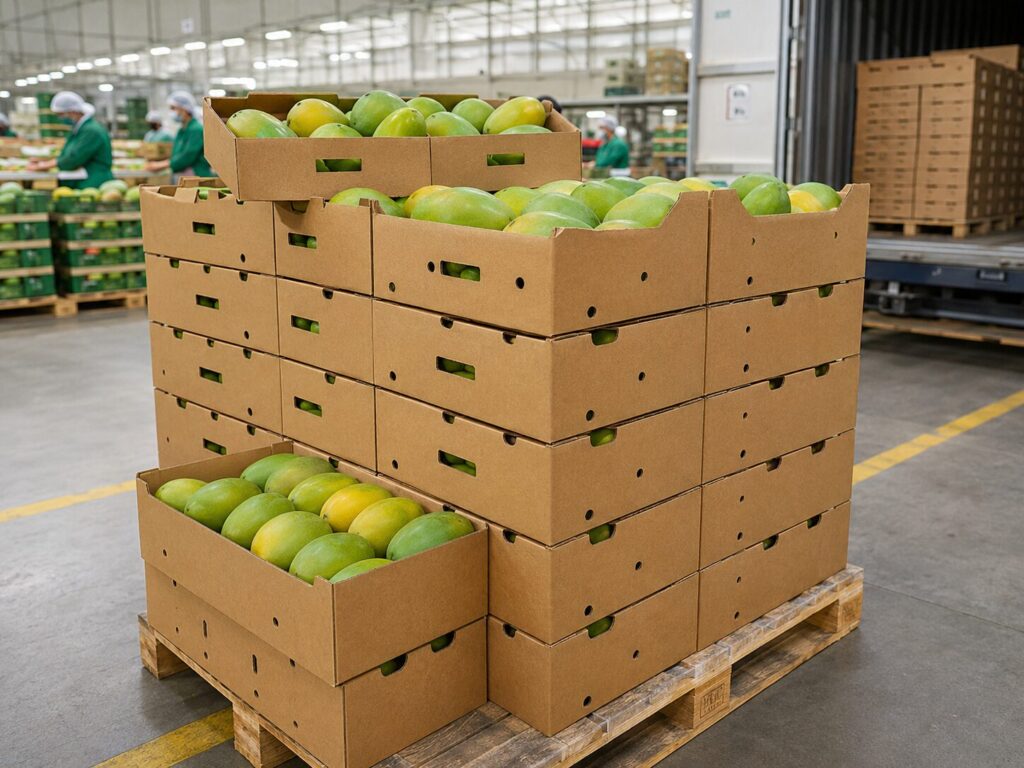
Because mango is climacteric and bruises easily, packaging and temperature control directly determine arrival quality. The industry-standard export format is the 4.5 kg net carton, with 2 kg and 5 kg retail packs and 10 kg bulk options also available. A standard 40-foot reefer container loads in the region of 3,780 cartons of 4.5 kg.
The choice between air and sea freight follows the market: premium and early-season European orders often move by air to protect quality, while high-volume lanes to Russia and the Gulf travel by refrigerated sea container.
Egyptian mango reaches a wide spread of destinations, and matching variety to market is part of a good sourcing strategy.
| Market | Notes | Preferred Varieties |
|---|---|---|
| Russia | Largest single destination; strong supermarket demand | Keitt, Kent, Naomi |
| GCC (KSA, UAE, Kuwait, Oman, Bahrain, Iraq) | Core volume with a strong summer demand peak | Naomi, Taymour, Owaisi, Keitt, Zebda (juice) |
| EU (Netherlands, Germany, Austria) & UK | Premium programs; growing interest in Naomi and Owaisi | Keitt, Kent, Naomi |
| Turkey | Fast-growing lane that expanded as other origins contracted | Keitt, Naomi |
| Regional (Jordan, Lebanon, Libya, Morocco) | Established short-transit lanes | Mixed |
As a rule of thumb, Gulf and Arab buyers prioritize flavor and sweetness, while European and Russian buyers prioritize appearance and shelf life. We help buyers align variety, grade, and shipping method to their destination — just tell us your market.
Ordering Egyptian mango for export is straightforward once you know the commercial terms. Most shipments are quoted on FOB (free on board, at the Egyptian port) or CIF (cost, insurance, and freight, to your destination port) Incoterms. Typical commercial parameters include:
On pricing, the honest answer is that mango prices move with the season and with global supply. Quotes are best given against your specific variety, grade, volume, destination, and timing. The most accurate way to plan your budget is to request a current quote.
PEI Trade is an established Egyptian agricultural exporter serving B2B buyers across Europe, the GCC, the UK, and Asia. For buyers evaluating an Egyptian mango export partner, what matters is consistency and traceability: working directly with growers, applying recognized certifications and food-safety standards, and managing the cold chain from farm to port so fruit arrives as specified.
Our premium mango is shipped under our dedicated mango brand, Nile Prime — the marque you will see on the carton. You can learn more about the brand, its variety range, and packaging at nile-prime.com, which is part of PEI Trade.
Looking for our wider range? Explore our Egyptian citrus export guide for oranges, mandarins, and lemons, or view the mango product page to start a request.
The harvest runs from June to November. Local varieties dominate July, the commercial export season opens in August with Keitt and Kent, and shipments peak from August through November, with late Keitt extending availability.
The main export varieties are Keitt, Kent, Naomi, Tommy Atkins, and R2E2. Egypt also offers premium indigenous varieties such as Owaisi, prized for flavor, and Zebda, which is mostly destined for the domestic and juicing market.
Orders are commonly placed at full container load, and mixed-variety containers can often be arranged. Contact us with your target volume and we will confirm what is available.
Reputable exporters operate under GLOBALG.A.P at farm level and HACCP or ISO 22000 in the packhouse, and every shipment carries a phytosanitary certificate and certificate of origin.
Hot water treatment (HWT) is the most common method, immersing fruit at around 46–48°C for roughly 60–75 minutes to kill fly eggs and larvae. Vapour heat treatment (VHT) and irradiation are used for stricter markets. All are chemical-free.
Russia is the largest single market, followed by the GCC countries, with growing programs in the EU, UK, and Turkey, plus established regional lanes.
The standard format is a 4.5 kg net carton, with retail and bulk options available. A 40-foot reefer loads roughly 3,780 cartons. Premium and early European orders may ship by air, while volume lanes use refrigerated sea containers.
Lead time depends on variety, treatment, and freight mode. Egypt’s location gives short transit times to Europe and the Gulf relative to other origins. Request a quote for a precise schedule.
Ready to plan your season? Tell us your market, target varieties, volume, and timing, and we will send a tailored offer.
Request a quote for Egyptian mango export and secure your supply before the season peaks.