Address
Work Hours
Monday to Friday: 7AM - 7PM
Weekend: 10AM - 5PM

Address
Work Hours
Monday to Friday: 7AM - 7PM
Weekend: 10AM - 5PM


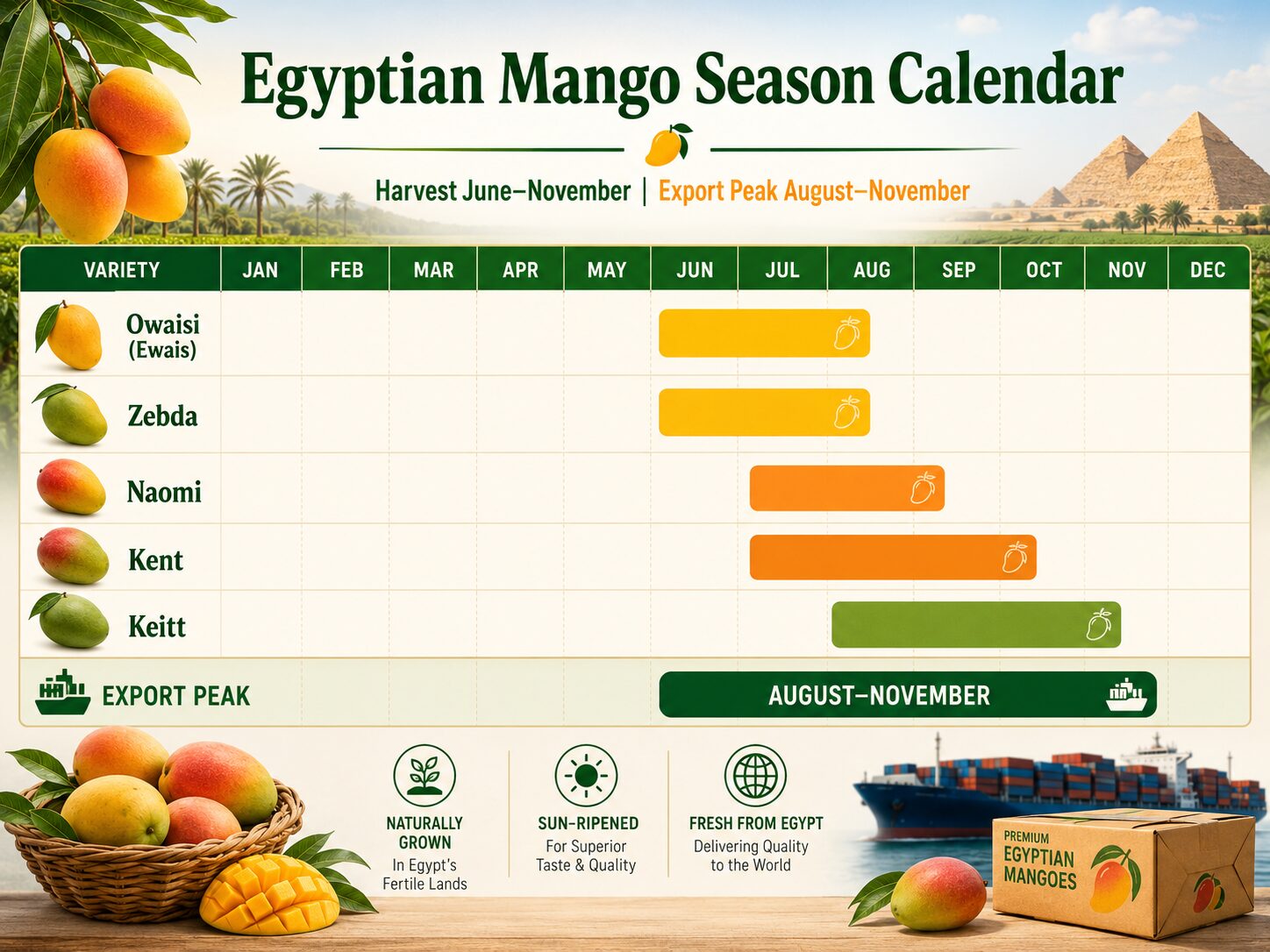
The Egyptian mango season is the single most important planning factor for any importer sourcing from Egypt, because timing decides which varieties you can buy, what quality you receive, and how competitive your price is. This calendar lays out the harvest and export months in detail, shows which variety is available when, and explains how Egypt’s growing regions stretch the supply window further than most origins.
Last Updated: May 2026
The Egyptian mango season runs broadly from June to November. July is dominated by local varieties for the domestic market, the commercial export season opens in August with Keitt and Kent, and shipments peak from August through November. Fresh mango is generally available from June to September, after which late Keitt and frozen product carry the tail of the season into winter.
For buyers, three dates matter most: June (early varieties begin), August (export season opens in volume), and October (a peak shipping month on several lanes). Importers who lock programs before August consistently secure better allocation and pricing than those who wait for the peak.
| Month | Stage | What Is Available |
|---|---|---|
| June | Early season begins | Tommy Atkins and early Owaisi (from Aswan); Kent starts mid-month |
| July | Local focus / ramp-up | Mainly local varieties (Zebda) for the domestic market; volume building |
| August | Export season opens | Keitt, Kent, Naomi enter export channels |
| September | Peak | Peak fresh export across main varieties |
| October | Peak | Continued peak shipments — a record month on several lanes |
| November | Wind-down | Season tapering; late Keitt extends availability |
| Dec–Jan | Tail / frozen | Late Keitt tail; frozen mango takes over |
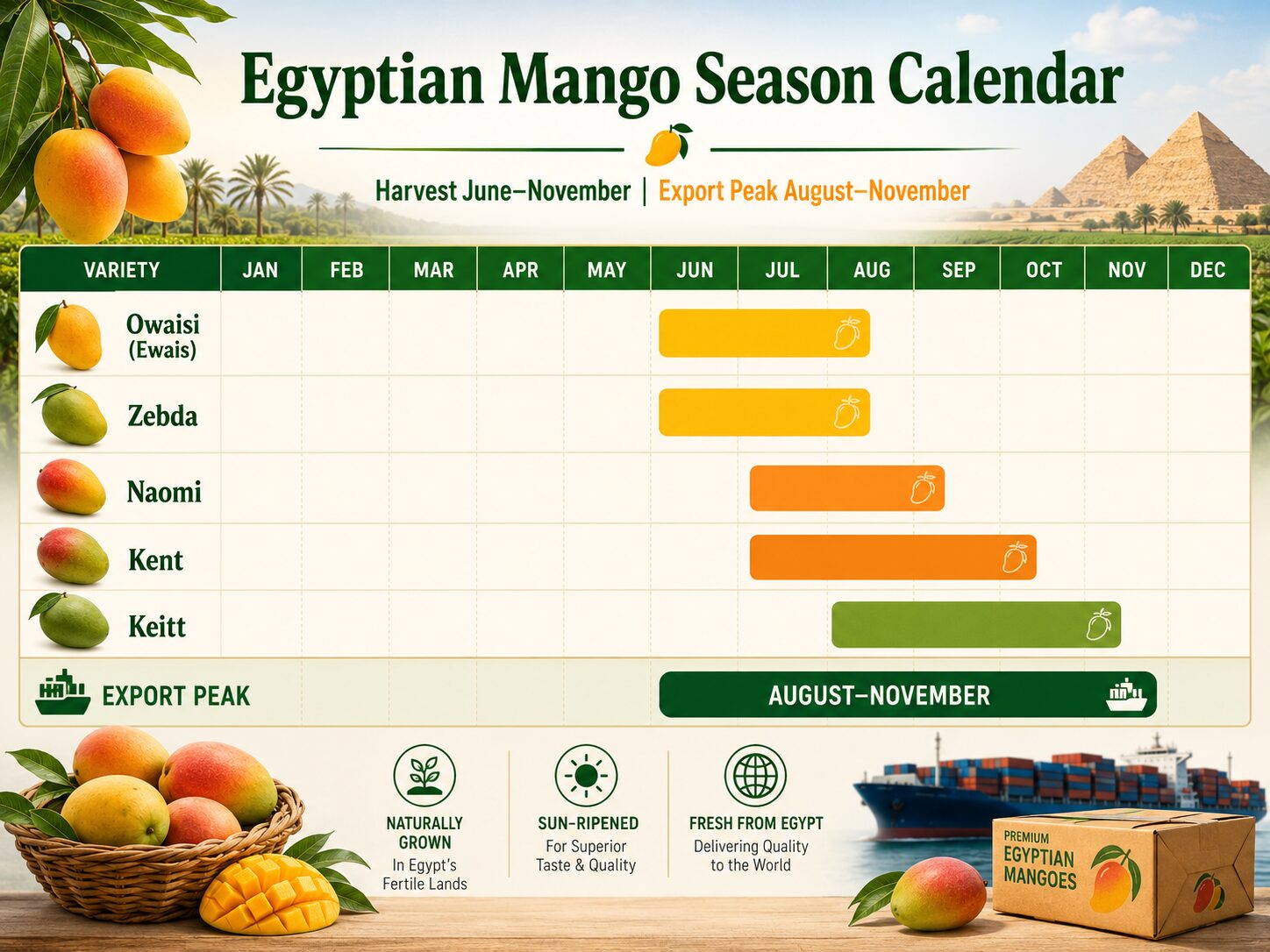
Different varieties peak at different points, which is why a multi-variety program gives the smoothest supply. Here is the rough sequence:
| Variety | Availability Window | Role in the Season |
|---|---|---|
| Tommy Atkins | June–July | Opens the season; durable early fruit |
| Kent | Mid-June–August | Early premium volume |
| Owaisi | Early–September | Premium specialty; starts in Aswan, then Ismailia |
| Naomi | Mid–late season | Visual retail star, EU and GCC |
| Keitt | August–December | The backbone; longest window, carries the tail |
Explore each variety in detail in the Egyptian mango varieties guide, or go directly to Keitt, Kent and Naomi, Owaisi, and Tommy Atkins and Zebda.
Egypt’s geography is a quiet advantage. Production is spread across regions that ripen at different times, which lets exporters offer a longer, more continuous window than single-region origins:
This stagger means a buyer can run a continuous program from early fruit in the south through the main-season volume in the Delta, smoothing supply across months.
A few practical rules help buyers get the most from the Egyptian mango season:
For the full sourcing picture — pricing, packaging, and markets — start with the Egyptian mango export guide.
Harvest runs broadly June to November. Local varieties lead in July, the export season opens in August, and shipments peak August–November, with late Keitt extending into December.
Shipments peak August through November, with September and October especially strong on many lanes.
Tommy Atkins and early Owaisi (from Aswan) open the season in June, with Kent following from mid-June.
Keitt runs roughly August to December — the longest window and the backbone of most programs.
Fresh mango is seasonal (June–November); late Keitt and frozen mango cover demand outside that window.
Tell us your target months and varieties, and we will build a supply plan around the Egyptian mango season for your market.
Request a quote or read the full Egyptian mango export guide.