Address
Work Hours
Monday to Friday: 7AM - 7PM
Weekend: 10AM - 5PM

Address
Work Hours
Monday to Friday: 7AM - 7PM
Weekend: 10AM - 5PM


Germany is one of Europe’s larger mango markets in its own right — a genuine consumption market, not a re-export hub. In 2024 Germany imported about 96,000 tonnes of mangoes and re-exported only around 8,000, which means the fruit is eaten domestically, with hard-discounters such as Aldi, Rewe, Lidl and Penny keeping demand high through promotions. Yet most of that mango reaches Germany indirectly: the Netherlands, Europe’s dominant entry point, re-exports roughly 156,000 tonnes a year and sends about a third of it (34%) onward to Germany — and every handover adds a trading margin. That is the opening for a direct Egyptian supply. Egypt’s northern-hemisphere window (roughly August to November) lands when overseas supply is thin — Peru, Europe’s number-two supplier and top Kent source, saw exports fall by more than half under drought — and European buyers have begun to ask specifically for Egyptian varieties such as Naomi. Egypt’s direct EU presence is still small (its shipments are rising fast, about +35% year on year, but from a low base), which makes this an open lane rather than a saturated market. This guide covers the varieties that suit German and wider European retail, shipping logistics via Rotterdam or direct, hot-water treatment, EU import and food-safety requirements, the variety-by-window calendar, and how to open a supply program.
Egypt sits far closer to Europe than the Latin-American origins that dominate the German shelf. A Mediterranean reefer sailing to Rotterdam — Europe’s main mango gateway — is a matter of days, and from there fruit moves overland into Germany’s dense retail network, or ships direct to Hamburg and Bremerhaven. Egypt’s window (roughly August to November) also lands at a useful moment: it follows the northern-hemisphere summer, sits ahead of the Peruvian sea season (November onward), and — with Peru’s Kent exports down by more than half under drought — helps cover a real supply gap in the second half of the year.
German and wider European retail buys differently from the Gulf. Here the priority is appearance, uniform calibre, low fibre and shelf life for supermarket programmes — not the intense aroma and sweetness prized in Middle-Eastern markets. That favours internationally familiar Kent and Keitt, both fibreless and shipping well, alongside Egypt’s Naomi, whose clean golden colour, low fibre and firm handling suit retail — and which European buyers have started to request by name. The catch, and the opportunity, is that Egypt’s direct European presence is still thin: Western-European demand for Egyptian fruit has been held back partly by limited Egyptian Kent volume, and Egypt’s EU shipments, though growing fast (+35%), remain small. For an importer that means an under-served, price-competitive origin with room to build — rather than a crowded one.
Because German retail buys on look, consistency and shelf life, the table below leads with appearance and handling rather than sweetness. Egypt’s strongest European fit is its supermarket-spec fruit plus rising-interest Naomi.
| Variety | Appearance & handling | Shelf life / transit | Germany / Europe fit |
|---|---|---|---|
| Kent | Large, plump, greenish-red blush, smooth skin, very low fibre | Excellent — the sea-freight standard | ★★★ Europe’s most-wanted variety (Egyptian Kent volume is limited) |
| Keitt | Large, stays green when ripe, firm, fibreless | Excellent — long shelf life, late season | ★★★ Reliable supermarket & late-window fruit |
| Naomi | Attractive golden-yellow, smooth, low fibre, medium–large | Very good — ships by sea | ★★★ Rising European interest; Egypt’s differentiator |
| Tommy Atkins | Firm, deep red blush, thick skin, higher fibre | Excellent — very robust in transit | ★★ Durable commodity fruit with strong colour |
For full variety detail and calibres see the Egyptian mango export guide, and the individual profiles for Naomi & Kent and Keitt.
The workhorse route is reefer sea freight to Rotterdam, Europe’s dominant mango gateway, with onward overland distribution into Germany’s retail DCs; alternatively fruit ships direct to the German seaports of Hamburg and Bremerhaven. European importers typically ripen ready-to-eat fruit and re-pack for retail, so Egyptian supply is delivered mature-green and calibre-sorted.
Hot-water treatment is a standard post-harvest step for export mango, and it serves two purposes. Disease control: a hot-water dip at roughly 48–52 °C for 5–10 minutes, followed by hydro-cooling and drying, suppresses anthracnose and stem-end rot — the main post-harvest diseases that shorten shelf life on long sea legs to Europe. Fruit-fly disinfestation: EU plant-health rules require imported mango to be free of non-European fruit flies (Tephritidae), and the internationally accepted quarantine schedule is around 46.1 °C for 65–90 minutes, with longer times used for larger fruit. Exact temperature and dwell time depend on cultivar, fruit size and maturity, so the protocol is set per consignment and per destination requirement, applied within about 24 hours of harvest.
| Month | Available varieties (export) | Europe / Germany notes |
|---|---|---|
| Aug | Naomi, Kent, early Keitt, Tommy Atkins | Peak arrivals; core summer window as Southern-Hemisphere supply thins |
| Sep | Keitt, Kent, Naomi, Tommy Atkins | High-volume retail window; Peru still off-season (sea from November) |
| Oct | Keitt (peak), Kent, Tommy Atkins | Late-season firm fruit for supermarket programmes |
| Nov | Keitt (late), Kent | Closing window ahead of Peru’s November–April sea arrivals |
Windows are indicative and shift year to year with weather. Book Kent and Naomi ahead of the summer peak. See the Egyptian mango export report 2026 for volumes, destinations and price context.
Kent and Keitt lead — both fibreless, with good appearance and shelf life for supermarket programmes — alongside Naomi, whose clean golden colour, low fibre and firm handling suit retail and which European buyers are increasingly requesting. Sweetness-led indigenous varieties matter less for German retail than look, calibre and handling.
By reefer sea freight to Rotterdam, Europe’s main mango gateway, then overland to German distribution centres — or direct to the German seaports of Hamburg and Bremerhaven — carried at about 8–13 °C and ripened to ready-to-eat at destination. Sea freight dominates; air freight is limited to premium early fruit.
Roughly August to November (core July–September, late Keitt into November). The window helps fill the gap while Peru — Europe’s top Kent supplier — is off-season and down sharply on drought, and before Peru’s own sea season begins in November.
GLOBALG.A.P (with the GRASP social add-on) at farm level, compliance with EU maximum residue levels (Regulation 396/2005), a phytosanitary certificate certifying fruit-fly freedom (via hot-water treatment), EU General Marketing Standard / UNECE FFV-45 grading, full traceability, and consumer labelling of variety, class, calibre and origin.
Most German mango arrives through Dutch re-export — the Netherlands sends about a third of its roughly 156,000 tonnes of re-exports to Germany — and each handover adds a margin. A direct Egyptian program shortens the chain, improves traceability and price, and secures summer-window volume from an under-served origin — useful as Peru’s supply has fallen and European interest in Egyptian Naomi grows.
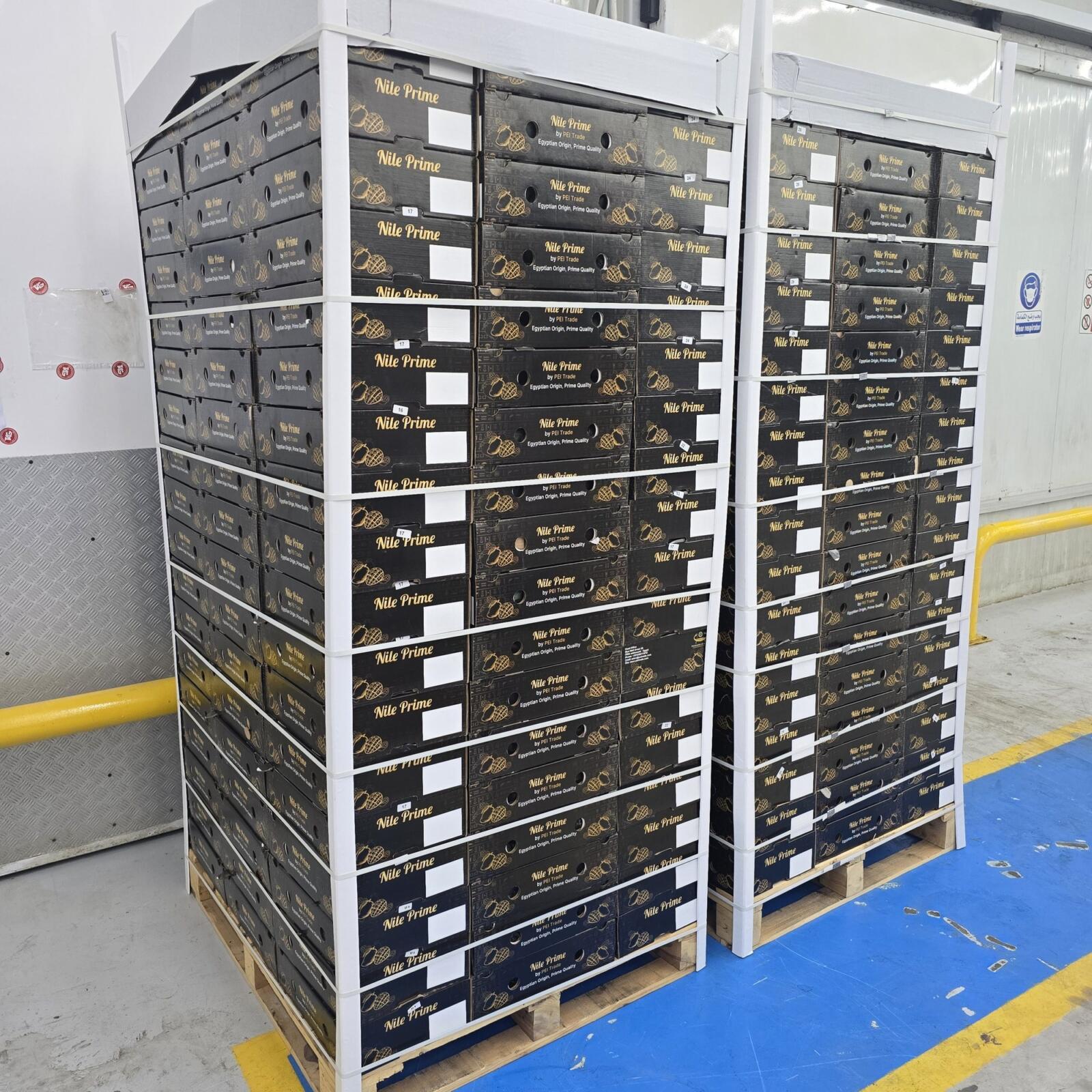
Planning a German or wider European mango program? PEI Trade supplies supermarket-spec Egyptian varieties — Kent, Keitt, Naomi and Tommy Atkins — with calibre selection, EU-standard grading, GLOBALG.A.P-aligned and traceable packing, and cold-chain management to Rotterdam, Hamburg or Bremerhaven. Tell us your target volumes, calibres and delivery window, and we’ll structure a compliant, well-timed offer.
PEI Trade. “Egyptian Mango Exports to Germany: Varieties, Logistics & EU Market Guide.” peitrade.com, 2026, https://peitrade.com/egyptian-mango-exports-to-germany/
Sources: CBI (European & German mango market potential, 2024: Germany ~96,000 t imports and ~8,000 t re-exports; Netherlands ~156,000 t re-exports, 34% to Germany; EU imports ~514,000 t; Brazil ~46%, Peru decline >50%; Egypt +35% Jul–Sep); FreshPlaza (growing European interest in Egyptian Naomi; European variety preference, 2025); UN Comtrade / ITC Trademap (HS 080450); EastFruit; ISHS / ScienceDirect post-harvest hot-water-treatment studies; EU Regulations (EC) 396/2005 (MRLs) and (EU) 2016/2031 (plant health); UNECE FFV-45 mango standard.
[email protected] · WhatsApp +20 109 911 1918 · www.peitrade.com · Brand: nile-prime.com · Ports: Alexandria, Damietta, Sokhna, Port Said (Incoterms 2020)