Address
Work Hours
Monday to Friday: 7AM - 7PM
Weekend: 10AM - 5PM
Address
Work Hours
Monday to Friday: 7AM - 7PM
Weekend: 10AM - 5PM


Fresh and dried Egyptian herbs travel very differently. Specifications, packing, cold chain and residue expectations for importers planning the 2026/2027 herb season.
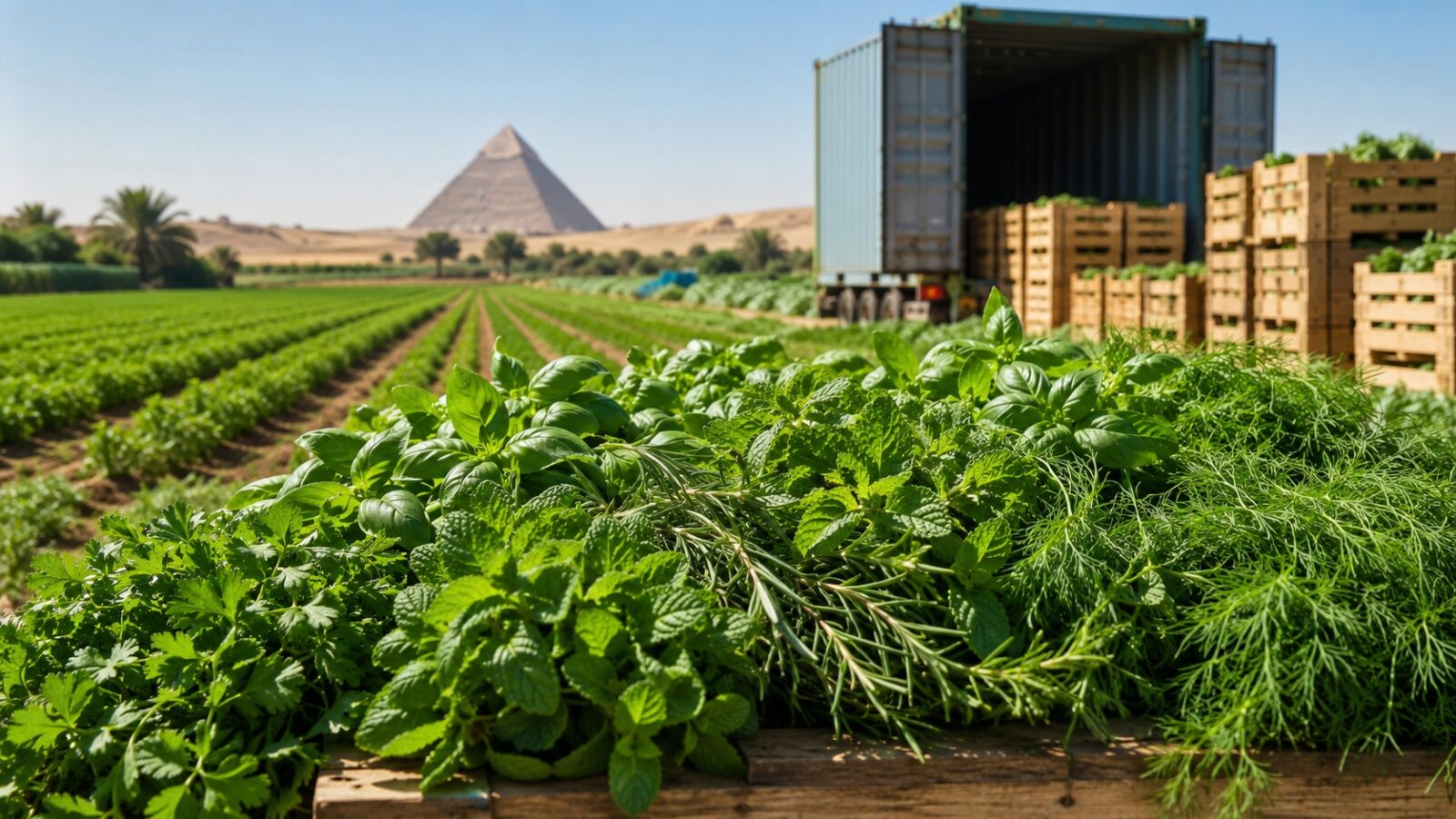
Herbs are one of the few Egyptian categories that ship in two completely different forms out of the same growing areas. Fresh mint, basil, dill, coriander, rocket and chives move as chilled, short-shelf-life cargo, usually by air. Dried mint, basil, marjoram, chamomile and hibiscus move as ambient dry goods in containers, often in volumes a fresh buyer would never handle. Importers who treat them as one category tend to get the specification wrong, so it is worth setting out what each format actually requires before the 2026/2027 season builds.
The main herb areas sit in Beheira, Menoufia, Fayoum and the reclaimed land west of the Delta, with greenhouse and shade-net production filling the shoulder periods. Fresh herbs are available effectively year round, with the strongest export quality between October and May when night temperatures drop and leaf holds better after cutting. Summer cuts are possible but shelf life shortens and buyers should expect tighter grading.
Dried herbs follow the harvest and drying cycle. Mint and marjoram are cut across several passes from spring into autumn, with the bulk of export-grade dried mint becoming available from June onward. Chamomile and hibiscus are winter and early spring crops, with new-crop hibiscus generally available from December. If you are building a full-year plan, cross-check these against our Egyptian produce export calendar for 2026/2027.
Standard fresh export packing is bunched or loose leaf in perforated polybags, packed into corrugated cartons of 1.5 kg to 5 kg depending on the herb and the destination. Mint is normally supplied in bunches of 20 to 50 grams, ten to twenty bunches per bag. Rocket and baby leaf are supplied loose. Cartons are pre-cooled to core temperature before palletising and held at 1 to 4 degrees Celsius, with basil the exception at 10 to 12 degrees because it suffers chilling injury below that. Relative humidity should sit at 90 to 95 percent.
Air freight is the normal route for fresh herbs into Europe and the Gulf, with 100 kg to 1,000 kg consignments common. Sea freight is possible for hardier items such as rocket and parsley on short Mediterranean routes, but transit and set point control become critical. Our note on reefer set points by crop covers the temperature and ventilation side in more detail.
Dried lots are graded on cut size, colour, foreign matter and microbiology. Dried mint is commonly traded as TBC cut, tea cut or powder, packed in 10 kg or 20 kg polypropylene bags with an inner food-grade liner, palletised and shrink wrapped. Typical contract points are moisture below 10 percent, ash and acid-insoluble ash within pharmacopoeia limits where relevant, and total plate count, yeast and mould, E. coli and salmonella tested per lot. Steam sterilisation is available where a buyer requires a reduced microbial load without irradiation.
A 40ft dry container will normally take 12 to 16 tonnes of dried mint depending on cut and bag density, so dried herbs are volume-limited rather than weight-limited. Buyers should confirm bag count per pallet and pallet height before booking.
Herbs draw more residue scrutiny than most categories because they are consumed whole and concentrated. Every export lot should be supported by a residue analysis against the destination limits, a phytosanitary certificate for fresh consignments, and a certificate of analysis for dried lots. GLOBALG.A.P at farm level and BRCGS or ISO 22000 at the processing site are the usual buyer requirements, and third party inspection through SGS or Intertek is available on request. Background on what each scheme actually proves is set out in our guide to certification on Egyptian produce shipments.
Fresh herbs work best on a weekly standing order with a fixed cut day and a fixed flight, because that is what protects shelf life on arrival. Dried herbs work best on a contracted tonnage against new crop, with lot-by-lot release after analysis. Mixing the two on one purchase order rarely helps, since the lead times and quality release steps do not line up.
To discuss fresh or dried herb specifications, request a sample lot, or receive a quotation for the 2026/2027 season, contact the PEI Trade export team on WhatsApp at +20 10 9911 1918.
