Address
Work Hours
Monday to Friday: 7AM - 7PM
Weekend: 10AM - 5PM

Address
Work Hours
Monday to Friday: 7AM - 7PM
Weekend: 10AM - 5PM


Egyptian sweet potato ships from late September through March. Variety mix, the curing protocol, size grades, carton and bin formats, pallet configuration, reefer set points and booking guidance for importers.
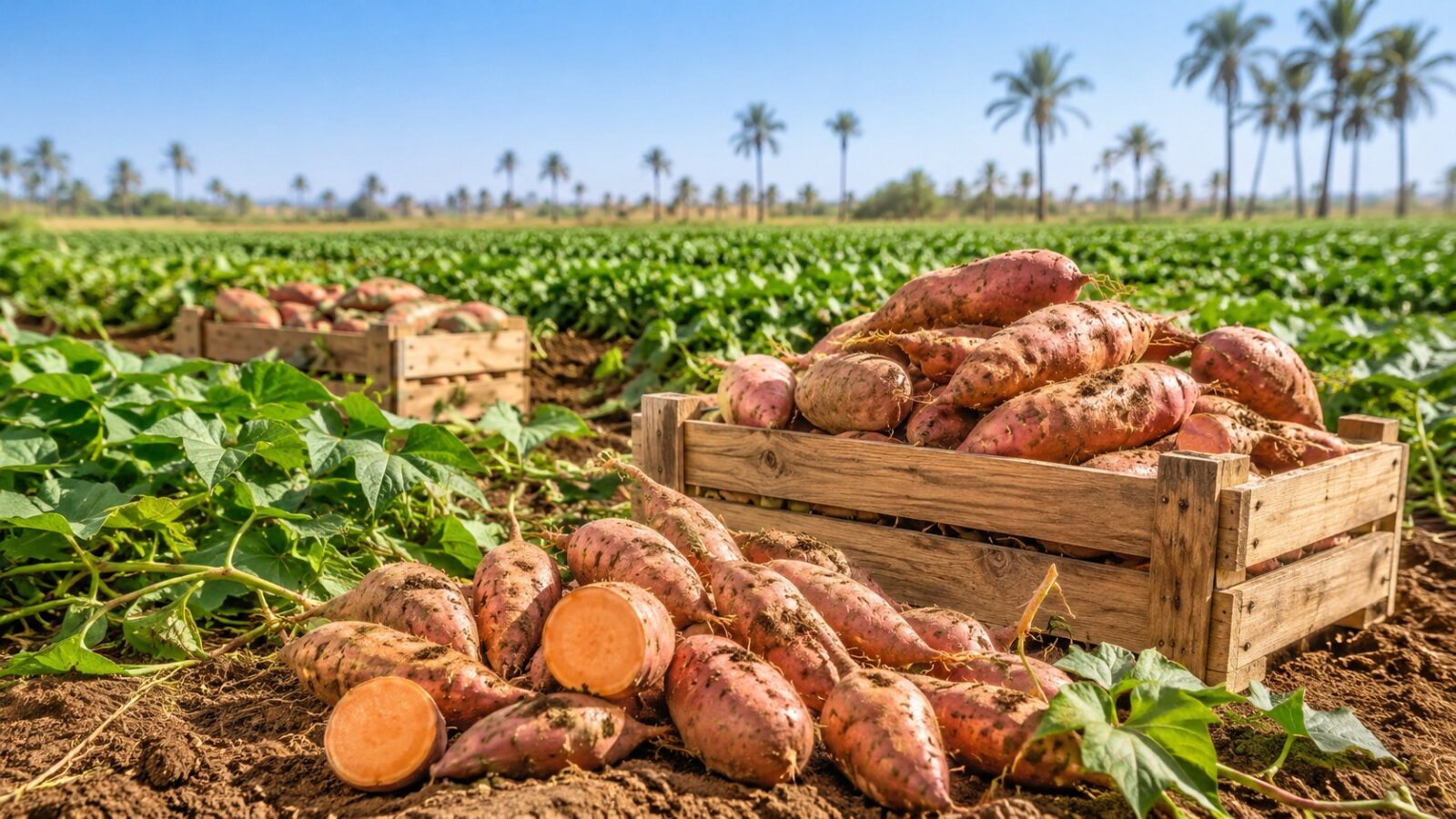
Egyptian sweet potato lifting begins in the second half of September and runs through to February, with the bulk of export volume moving between October and March. Buyers who contract in August secure curing capacity and cold store space before the peak weeks in November and December. What follows covers the variety mix, how the crop is prepared and what a workable specification should state.
Beauregard remains the backbone of the Egyptian export crop. It gives orange flesh, copper to rose skin and a shape that grades cleanly, which is why it dominates programmes in the United Kingdom, the Netherlands, Germany and the Gulf. White-flesh and cream-skin types are grown in smaller volume for specific wholesale channels. Purple-flesh material is available in limited quantity and has to be contracted early, because planted area is small and allocation closes quickly.
Roots are wounded at harvest and will break down in transit if they go straight into a container. Curing seals those wounds. The protocol holds the crop at 29 to 32 degrees Celsius and 85 to 95 percent relative humidity for four to seven days, then steps it down to a holding temperature of 13 to 14 degrees. Sweet potato takes chilling injury below roughly 12.5 degrees, so a reefer set at citrus or potato temperatures will arrive with internal discolouration and pitting. Specify 13 degrees, fresh air vents at 15 to 25 cubic metres per hour, and confirm the set point on the booking rather than assuming the line will read it off the product name.
Export material is graded to Class I (a grade tier from the applicable marketing standard, not a marketing term — see our Extra, Class I and Class II tolerances reference) and Class II. Class I is uniform in shape, free of growth cracks, wireworm damage and green shoulders, with skin intact. Class II carries wider shape tolerance and is normally directed to processing or open-market wholesale. Common size bands are 100 to 200 grams, 200 to 400 grams and 400 to 600 grams. Retail programmes in Europe usually take 200 to 400 grams. Gulf wholesale buyers tend to accept a wider 150 to 500 gram spread, which lifts pack-out and reduces the price.
Standard formats are 5 kg and 6 kg cartons for retail-facing volume, 10 kg and 15 kg cartons for wholesale, and 1,000 kg to 1,200 kg ventilated bulk bins for processors. Cartons are ventilated corrugated board, normally 400 by 300 millimetres or 600 by 400 millimetres footprint, palletised on 100 by 120 centimetre industrial pallets, ISPM 15 heat treated and stamped. A 40 foot high cube reefer takes 20 pallets and lands at roughly 24 to 26 tonnes depending on carton weight and tier count. Corner boards and four-way strapping are worth the small cost on long transits to Russia and Central Asia.
Each shipment travels with a phytosanitary certificate, certificate of origin, commercial invoice, packing list and bill of lading. Residue screening against destination MRLs is run before loading, and SGS or Intertek inspection is arranged on request at the buyer’s cost. For the full documentary set, see our guide to export documents on Egyptian produce. If you are planning a wider winter programme alongside sweet potato, the 2026/2027 export calendar sets out month by month availability by crop.
Realistic lead time from confirmed order to gate-in is 10 to 14 days in October, longer in the December peak when curing rooms are full. Incoterms 2020 quotes are issued FOB Alexandria or Damietta, CFR or CIF to your discharge port, and DAP where inland delivery is required.
Send us your target variety, size band, carton format, monthly volume and discharge port, and we will come back with an offer and an availability window. WhatsApp +20 10 9911 1918.
